

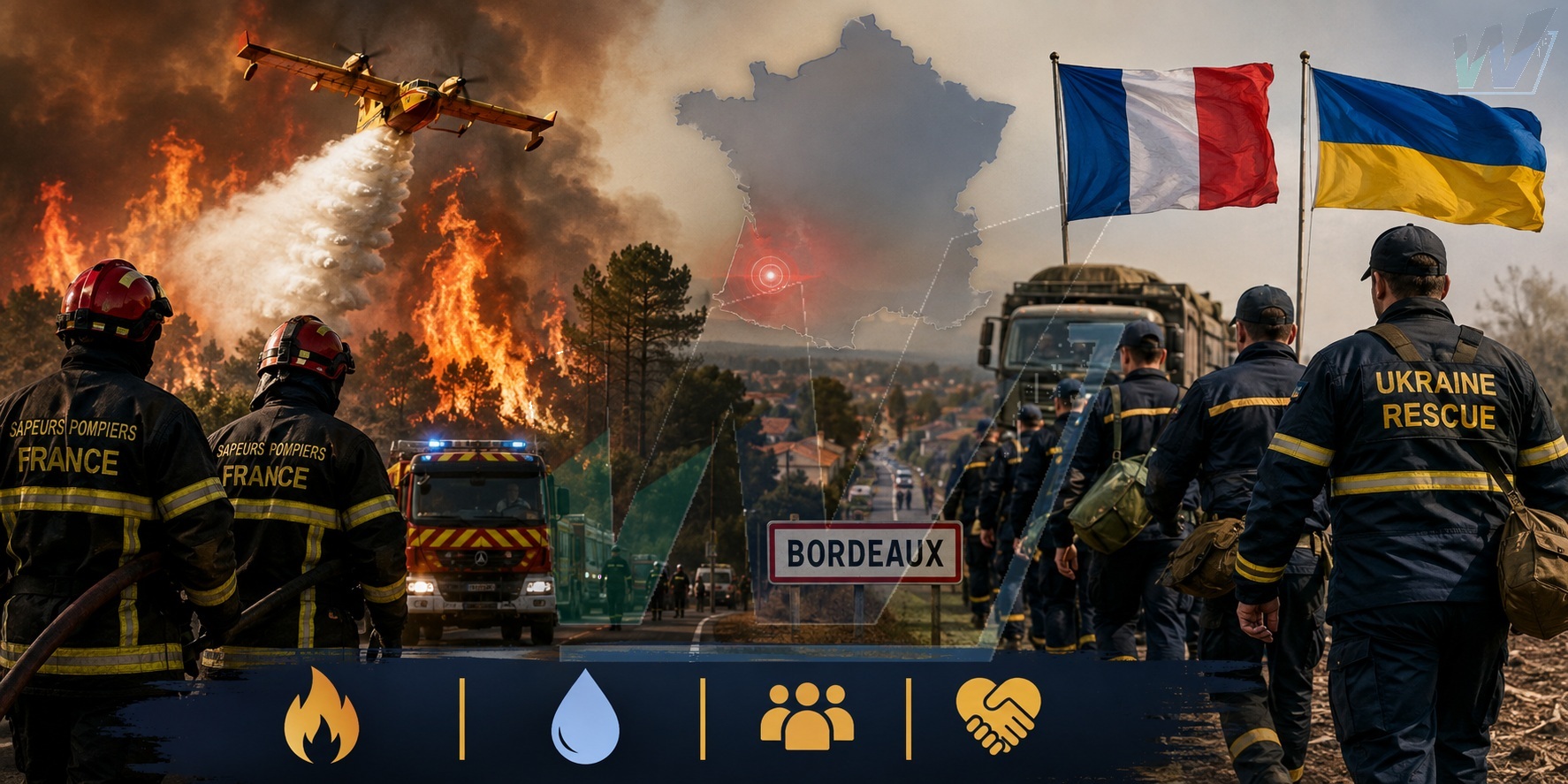
France’s Inferno: Bordeaux Fire Stabilizes as Ukraine Joins Battle Against Europe’s Escalating Wildfire Crisis
Hundreds Arrested Over Suspected Arson, Thousands Return Home, but Scientists Warn the Worst May Still Be Ahead
After days of devastation that turned vast stretches of southwestern France into an apocalyptic landscape, authorities say the country’s largest wildfire has finally begun to stabilize. Yet beneath the optimism lies a far more troubling reality: France remains locked in one of its worst wildfire emergencies in modern history, while investigators uncover a disturbing surge in suspected arson cases and Europe confronts an increasingly combustible future.
As exhausted firefighters continue battling hotspots near Bordeaux, an unexpected ally has arrived from the east. Ukraine, despite fighting its own war, has dispatched elite emergency crews to help France contain a disaster that climate scientists warn could become Europe’s new normal.
The simultaneous stories of courage, criminal investigation, international solidarity, and climate alarm have transformed France’s wildfire catastrophe into one of the defining European crises of 2026.
Bordeaux Fire Finally Slows After Consuming 42,000 Hectares
French emergency officials announced encouraging progress after favorable overnight weather allowed firefighters to gain control over the massive wildfire burning in the Gironde region near Bordeaux.
The blaze, which has already scorched approximately 42,000 hectares (over 103,000 acres), is now considered stabilized rather than fully extinguished.
Authorities stress that stabilization does not mean victory.
Hidden hotspots continue burning beneath vegetation, and shifting winds or renewed heat could quickly reignite active fire fronts.
Fire commander Marc Vermeulen cautioned that the coming days remain critical.
The wildfire’s future, he explained, will depend on:
- Remaining underground hotspots
- Weather conditions
- Wind intensity
- Terrain dryness
- Availability of firefighting resources
More Than 224,000 Evacuated
The Bordeaux fire triggered one of France’s largest civilian evacuations in decades.
At the height of the crisis:
- More than 224,000 residents were evacuated.
- Entire communities emptied within hours.
- Major highways were closed.
- Emergency shelters opened across southwestern France.
Authorities now say over half of those displaced have been permitted to return home across twelve municipalities.
Nevertheless, many families are returning to neighborhoods permanently transformed by fire.
More than 200 homes have been destroyed.
Entire forests have vanished.
At least three firefighters lost their lives while protecting communities.
France Launches Massive Criminal Investigation
As firefighters battled flames, police launched another battle, against those suspected of starting them.
Interior Minister Laurent Nunez revealed that:
- 308 people have been detained nationwide during the wildfire outbreak.
- Roughly two-thirds are suspected of deliberate arson.
- 33 suspects have already been jailed, either awaiting trial or following conviction.
- Several offenders have already received prison sentences.
The unprecedented number of arrests reflects what officials describe as an aggressive nationwide crackdown against wildfire-related crimes.
French authorities have dramatically increased patrols around forests, parks, and vulnerable rural regions.
Investigators are also using surveillance drones, aerial monitoring, and forensic analysis to determine ignition sources.
Not Every Fire Was Intentional
Despite alarming arson figures, investigators emphasize that many of France’s largest fires were accidental.
Early investigations suggest several major blazes originated through everyday human activity.
Among the suspected causes:
Bordeaux
Investigators believe vegetation clearing beneath high-voltage power lines may have ignited dry brush.
The work had reportedly been carried out by a contractor working for electricity operator Enedis.
Landes Region
Another major wildfire near Biscarrosse appears to have begun after a vehicle caught fire alongside a departmental road.
Fontainebleau Forest
Near Paris, prosecutors say repair work on motorway guardrails may have sparked the blaze.
A petrol-powered angle grinder reportedly threw sparks into extremely dry roadside vegetation before flames spread rapidly into the surrounding forest.
Officials say these incidents illustrate how ordinary activities become catastrophic under extreme heat and drought.
Ukraine Sends Firefighters Despite Ongoing War
One of the most remarkable developments has come from Ukraine.
Despite continuing Russian attacks at home, Kyiv announced it is sending emergency personnel to assist France.
Interior Minister Ivan Vygivsky confirmed deployment of:
- 70 rescue specialists
- 15 specialized emergency vehicles
Ukrainian officials say their teams possess unique operational experience gained from responding to missile strikes, drone attacks, collapsed buildings, and large-scale emergency incidents.
That expertise, officials argue, prepares them to operate effectively in rapidly changing and dangerous environments.
The deployment has been widely viewed across Europe as another symbol of Ukraine’s growing international cooperation despite remaining at war.
Europe’s Climate Warning Is Becoming Reality
Scientists say the French disaster is not an isolated event.
Across Europe:
- Record-breaking temperatures
- Severe drought
- Low humidity
- Strong winds
- Dry vegetation
have combined to create ideal wildfire conditions.
Researchers increasingly warn that Europe, already the world’s fastest-warming continent, is entering a new era of “megafires.”
Recent climate studies indicate:
- The number of summer days favorable for extreme wildfires has more than doubled since the early 1980s.
- Southern Europe is becoming significantly more fire-prone.
- Climate change has dramatically increased the likelihood of extreme fire weather.
- Without major emissions reductions, Europe could experience up to ten times more extreme wildfires before the end of the century.
Atmospheric scientist Raúl Cordero described the increase in dangerous fire weather as a direct consequence of global warming rather than natural climate variability.
Europe Faces a Growing Wildfire Front
France is far from alone.
During the 2026 fire season, major wildfires have affected numerous European countries, including:
- Spain
- Portugal
- Italy
- Greece
- Croatia
- Turkey
- Cyprus
Many governments have expanded cross-border firefighting cooperation under the European Union Civil Protection Mechanism, allowing aircraft, helicopters, and emergency crews to move rapidly between countries as conditions worsen.
The arrival of Ukrainian firefighters underscores how wildfire response is increasingly becoming an international security effort rather than simply a domestic emergency.
Recovery Will Take Years
Although fire activity near Bordeaux has eased, experts warn recovery will be measured not in weeks but in years.
Authorities now face enormous challenges:
- Rebuilding destroyed communities
- Restoring damaged forests
- Supporting displaced residents
- Investigating criminal cases
- Preventing future fires
- Strengthening climate resilience
Environmental experts also warn that burned landscapes become increasingly vulnerable to flooding, erosion, biodiversity loss, and long-term ecological damage.
France’s New Fire Reality
The stabilization of the Bordeaux wildfire offers France a desperately needed moment of relief, but not closure.
The combination of record-breaking heat, widespread drought, accidental ignitions, suspected arson, and climate-driven fire conditions signals a profound shift in Europe’s environmental landscape.
As investigators continue searching for those responsible for deliberately igniting fires, firefighters from France and Ukraine now stand side by side confronting another growing threat, one that experts believe will define Europe’s summers for decades to come.
The flames near Bordeaux may be weakening, but the broader wildfire crisis engulfing Europe is only beginning.