

Russia Strikes Kyiv Again After Three-Day Pause as Trump Peace Push Hangs in the Balance
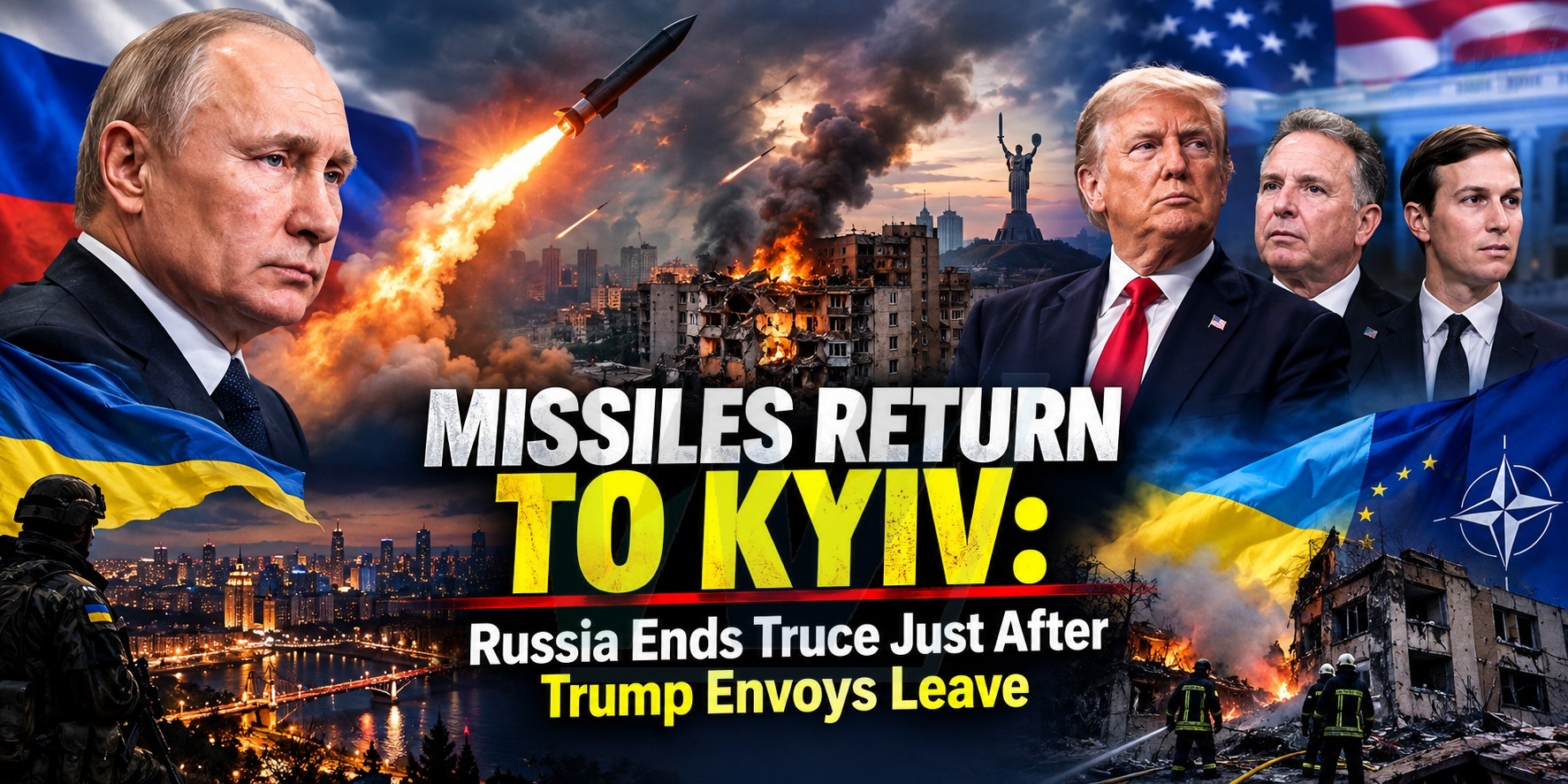
MISSILES RETURN TO KYIV: Russia Ends Truce Just After Trump Envoys Leave
The sirens were back. Then came the explosions.
Russia resumed attacks on Kyiv early Tuesday, firing ballistic missiles and drones at the Ukrainian capital shortly after U.S. peace envoys Steve Witkoff and Jared Kushner concluded their diplomatic mission.
The renewed assault shattered a fragile three-day pause that had temporarily kept Russian and Ukrainian strikes away from their respective capitals while Washington attempted to reopen a path toward peace.
According to Reuters, six people were injured, fires broke out across Kyiv and falling debris damaged a five-story apartment building and a three-story residential block. Ukrainian authorities urged residents to remain in shelters.
The timing was impossible to ignore.
The strikes came immediately after the latest U.S. diplomatic push, turning the Kyiv skyline into a stark reminder that, despite talk of negotiations, the war remains very much alive.
From Moscow to Kyiv, and Back to the Battlefield
Witkoff and Kushner spent roughly three hours with Russian President Vladimir Putin in Moscow before travelling to Kyiv for talks with Ukrainian President Volodymyr Zelenskyy.
The meetings were described by U.S. officials as substantive and constructive, but there were no breakthrough and no final peace agreement.
Washington is now pushing for a return to trilateral negotiations involving the United States, Russia and Ukraine. CNN reported that the envoys expressed optimism about restarting that format, while AP said the talks produced no breakthrough.
The Kremlin has also said it does not rule out restarting three-way negotiations, although Moscow says it is too early to discuss when or where such talks would take place.
That leaves diplomacy alive, but extremely fragile.
Kyiv Gets No Breathing Room
The latest attack follows a brutal escalation around the capital.
AP reported that Russian attacks had already become increasingly relentless, with drones and missiles striking Kyiv during both nighttime and daytime hours and disrupting ordinary life across the city.
Earlier attacks killed at least a dozen people in a prolonged assault lasting more than 12 hours, according to AP, while Russian forces used cruise and ballistic missiles alongside increasingly difficult-to-intercept jet-powered drones.
On September 4, a Russian drone also struck the headquarters of Ukraine’s Security Service in central Kyiv, injuring at least 12 people, according to Reuters. The strike occurred immediately before the latest U.S. diplomatic mission.
The cumulative effect is becoming impossible to hide: Kyiv is facing not isolated attacks, but a sustained aerial campaign designed to keep pressure on the capital.
Poland Scrambles as the War Presses Toward NATO’s Door
The danger did not stop at Ukraine’s borders.
As explosions shook Kyiv, Poland activated military aviation measures to protect its airspace against the possibility of a violation, according to Reuters. Poland is both a NATO and European Union member.
The move illustrates one of the war’s most dangerous dynamics: every major wave of Russian missiles and drones creates another possibility of debris, miscalculation or an accidental crossing into NATO territory.
For Europe’s eastern flank, Ukraine’s air war is no longer simply a Ukrainian problem.
Ukraine Strikes Back Inside Russia
While Russian missiles were hitting Kyiv, Ukraine continued its own long-range campaign against targets inside Russia.
Reuters reported that a Ukrainian drone attack in Saratov, hundreds of kilometers inside Russia, caused injuries and damage to civilian infrastructure. The region hosts major industrial and military facilities, including a Rosneft oil refinery.
The New York Post also reported that Ukrainian drones targeted Russian oil-refining facilities following the U.S. diplomatic mission, highlighting the growing role of energy infrastructure in the conflict.
The pattern is becoming increasingly clear: as the frontline remains difficult to shift decisively, both Moscow and Kyiv are relying more heavily on long-range strikes to impose economic, military and psychological costs far behind the battlefield.
The Peace Track Is Alive, But the War Is Louder
The diplomatic opening is real.
The Kremlin says it does not rule out renewed trilateral negotiations. U.S. officials say they are working to narrow differences between Moscow and Kyiv. Zelenskyy has signaled willingness to continue diplomatic engagement while demanding stronger air-defense capabilities and support ahead of winter.
But the fundamental disputes remain.
Russia continues to demand major territorial and security concessions, including conditions concerning Ukrainian territory and NATO membership. Ukraine rejects surrendering territory and insists that any settlement must provide credible security guarantees. The Guardian reported that these fundamental disagreements remain unresolved after the latest diplomatic meetings.
That is the contradiction now confronting Washington:
The diplomats are talking while the missiles are flying.
Winter Could Become the Next Battlefield
Zelenskyy has already warned that Ukraine needs substantial Western assistance for the coming winter, particularly air-defense systems and energy support.
Axios reported that Washington is exploring possible winter de-escalation measures while Kyiv presses for what it calls a broader winter package, including air defense and energy assistance.
The concern is straightforward.
Russia has repeatedly targeted Ukraine’s energy infrastructure during previous winters. If the aerial war intensifies as temperatures fall, Ukraine could face a combined pressure campaign against its electricity, heating, transportation and civilian infrastructure.
That makes the coming months potentially decisive, not necessarily because either side expects an immediate military victory, but because both may try to shape the conditions under which future negotiations take place.
A Pause That Proved How Fragile Peace Really Is
For three days, Kyiv had something increasingly rare: relative silence.
American negotiators arrived. Putin met them in Moscow. Zelenskyy received them in Kyiv. Washington talked about reopening trilateral negotiations.
Then the pause ended.
Russian missiles returned to the capital.
Ukraine continued striking deep inside Russia.
Poland activated military aviation measures.
And the prospect of peace once again collided with the reality of war.
The Trump administration may have reopened a diplomatic channel that had been frozen for months. But Tuesday’s attack delivers a brutal warning:
A negotiation table can be rebuilt in hours. Ending the war is another matter entirely.
For now, Kyiv remains under fire, and the next diplomatic move may determine whether this week’s fragile opening becomes the beginning of a genuine peace process or simply another pause between barrages.