

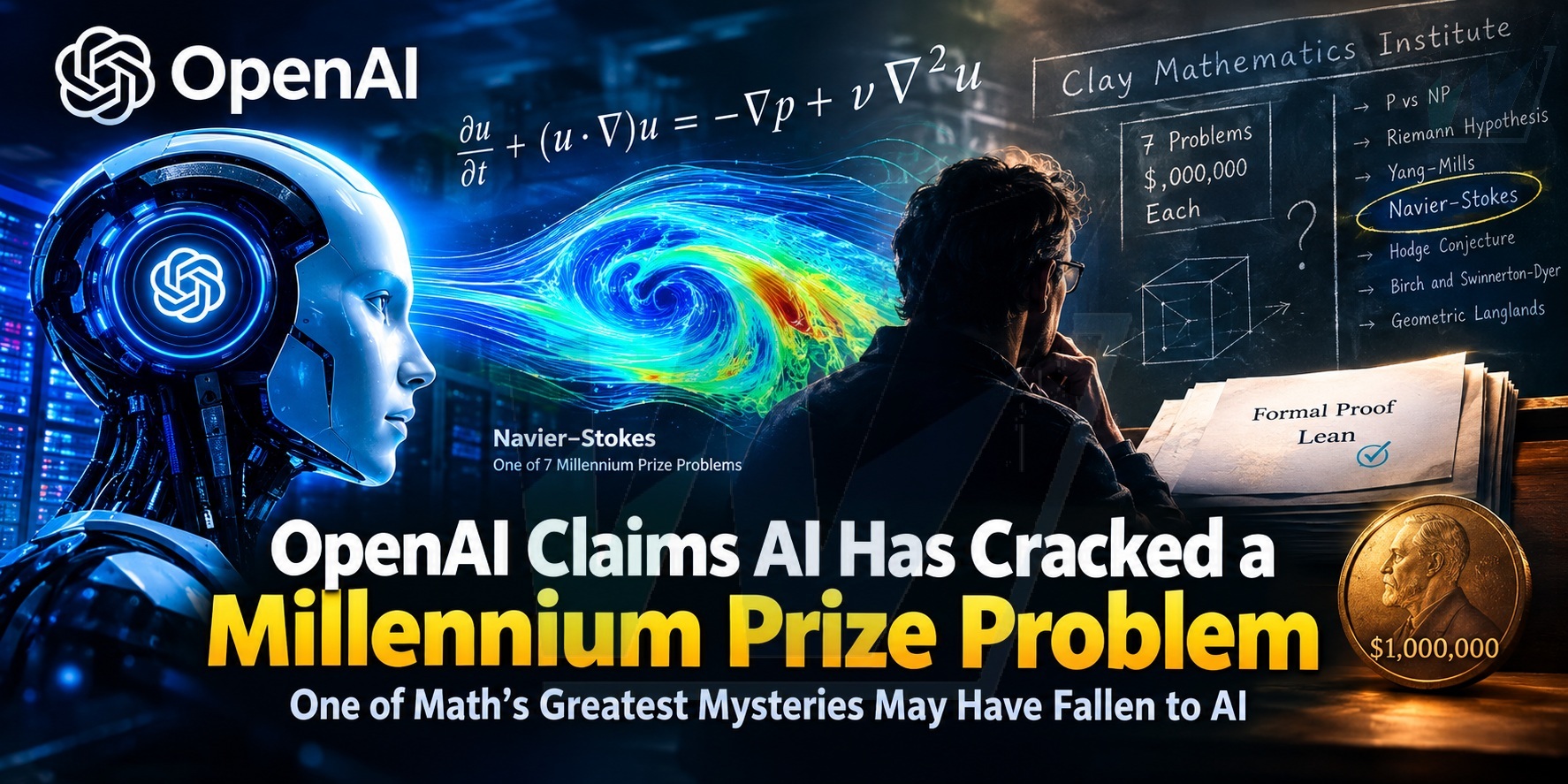
One of Math’s Greatest Mysteries May Have Fallen to AI
AI has entered one of mathematics’ last great frontiers. OpenAI says its latest system has produced a solution to the Navier–Stokes problem, but mathematicians now face the ultimate test: can they break the proof?
Artificial intelligence may have just crossed a historic mathematical boundary.
OpenAI says an unreleased AI system has generated a solution to the Navier–Stokes existence and smoothness problem, one of seven Millennium Prize Problems carrying a $1 million prize.
The claim is extraordinary, but it is not yet an officially recognized solution.
The Navier–Stokes problem asks whether the equations governing fluid motion can remain smooth indefinitely or develop a mathematical singularity, sometimes described as a “blow-up.” The equations underpin models of everything from water and airflow to atmospheric and engineering systems.
OpenAI says its AI system found a finite-time singularity and produced formalized proof in Lean, a computer-assisted framework designed to verify mathematical reasoning.
According to reports from The Wall Street Journal and Quanta Magazine, OpenAI deployed thousands of AI agents in a massive computational effort lasting roughly 88 hours. The system generated lengthy proof while agents exchanged millions of messages and explored competing mathematical approaches.
But producing proof is only the beginning.
The Million-Dollar Test
The Clay Mathematics Institute, which established the Millennium Prize Problems in 2000, has not declared Navier–Stokes solved.
Under Clay’s rules, a proposed solution must be published through an appropriate mathematical channel, survive at least two years and gain broad acceptance among mathematicians before the $1 million prize can be awarded.
That means the real battle is now moving from AI servers to the mathematical community.
Can human experts find the flaw?
If they cannot, the consequences could extend far beyond one equation.
AI vs. the Mathematics Frontier
OpenAI’s announcement arrives amid a rapidly escalating AI race in mathematical research.
Researchers at OpenAI, Anthropic and Google are increasingly using AI systems to generate conjectures, construct proofs, discover counterexamples and formalize mathematical arguments.
The emerging model is radically different from traditional computer-assisted mathematics.
Instead of a machine simply calculating what humans already understand that thousands of AI agents can explore possible strategies simultaneously, challenge failed approaches and refine promising ones.
That raises a profound question:
Is AI becoming a tool for mathematics, or a new kind of mathematical collaborator?
A Fight Over Credit
The announcement has also triggered controversy over intellectual credit.
Mathematicians Tristan Buckmaster and Levent Alpöge had been working on related fluid-dynamics problems with AI assistance. Their research overlapped with the direction pursued by OpenAI, raising questions about how closely the efforts converged and whether unpublished research could have influenced AI development.
OpenAI has denied access to the researchers’ private work and says its system reached its result independently.
The dispute highlights a growing problem in AI-assisted science: researchers increasingly rely on commercial AI systems while simultaneously worrying that their unpublished ideas could somehow contribute to the next generation of competing models.
The Bigger Breakthrough
The most important consequence may not be whether OpenAI eventually wins a $1 million prize.
It may be what happens if the proof survives.
For centuries, advanced mathematics has depended on human intuition, creativity and painstaking proof construction. AI is now beginning to attack problems that have resisted generations of mathematicians.
If the Navier–Stokes proof withstands years of scrutiny, it would represent a landmark demonstration that AI can contribute not merely to solving known problems, but to expanding the boundaries of mathematical knowledge.
For now, however, the verdict remains with the mathematicians.