

France Turned Grey from Orbit: An Astronaut’s View of a Changing Earth
From 400 kilometers above Earth, French astronaut Sophie Adenot sees a planet changing before her eyes, while recalling the “miracle” mission that pushed her through two difficult spacewalks to repair the International Space Station.
PARIS/WASHINGTON — August 28, 2026; From space, climate change is no longer an abstract graph or distant scientific projection.
You can see it.
That is the striking message from French astronaut Sophie Adenot, speaking exclusively to RFI and France 24 from aboard the International Space Station, around 400 kilometers above Earth.
Her view of the planet has changed dramatically since she arrived in orbit in February.
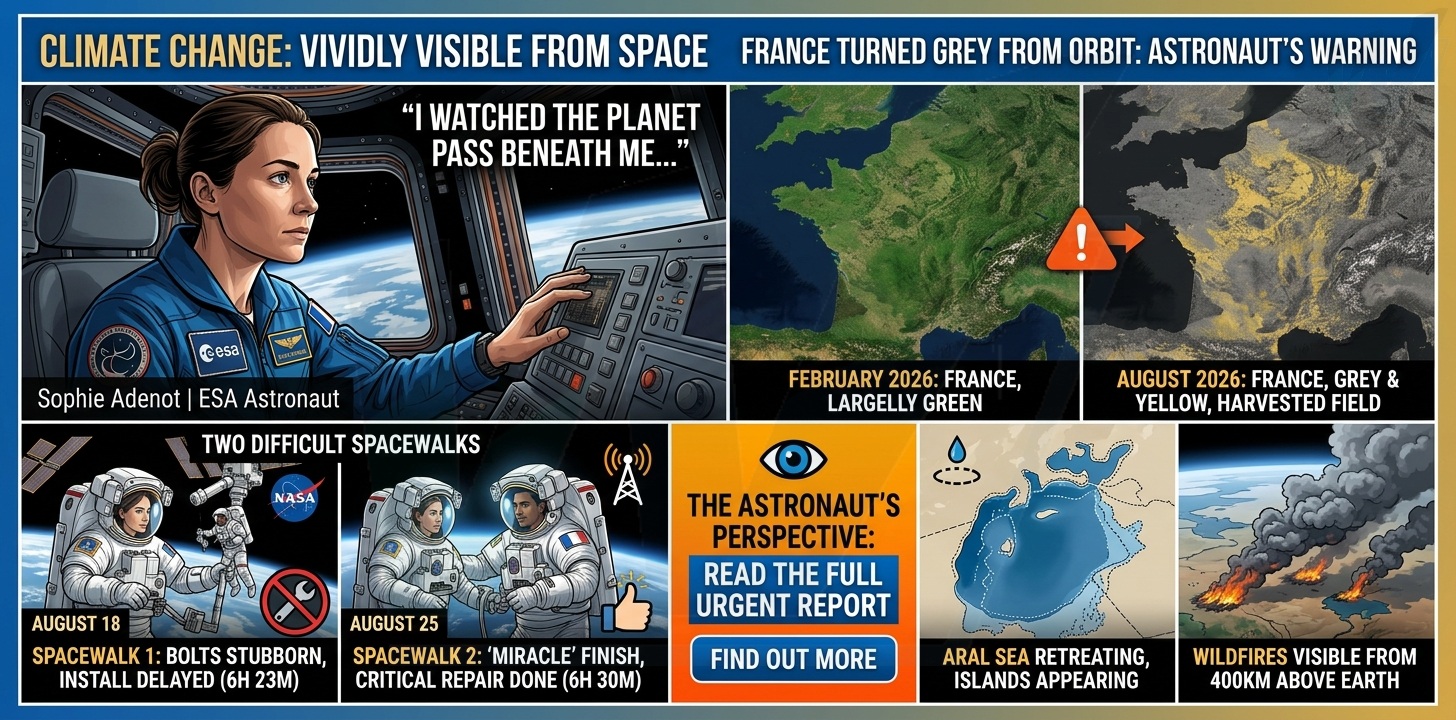
France, she recalled, appeared largely green when she left Earth. By summer, it looked dramatically different from orbit, grey and yellow, like a harvested field.
Then came the fires.
From the ISS, Adenot could see enormous smoke plumes rising from wildfires and stretching across the landscape with the wind.
For her, the transformation was impossible to miss.
Earth Looks Different from Orbit
Adenot also pointed to other changes visible from space: shrinking lakes, the rapidly retreating waters of the Aral Sea, and islands appearing beneath only a thin layer of water.
“These consequences are very visible from space,” she explained during the interview.
Her observations do not constitute a scientific attribution of any single event. But they offer something different: the perspective of someone watching the entire planet pass beneath her every 90 minutes.
And that perspective can be unsettling.
Two Spacewalks. One Critical Repair.
While Adenot was observing Earth’s changing face, she was also making history.
On August 18, she became the first French woman to conduct a spacewalk, joining NASA astronaut Anil Menon outside the ISS.
Their mission was to replace a failed Space-to-Ground Antenna, a critical communications system used to transmit high-speed data between the station and mission control.
But the repair immediately turned into a battle with stubborn hardware.
Bolts would not cooperate. Electrical connectors caused delays. The astronauts ran into so many technical complications that the planned installation could not be completed during the first six-hour-and-23-minute excursion.
The antenna would have to wait.
So would Adenot’s mission.
Back Into the Void
One week later, she went outside again.
On August 25, Adenot and Menon returned to the station’s exterior for a second spacewalk.
This time, they finished the job.
Over six hours and 30 minutes, they retrieved the spare antenna, installed and connected it, and secured the failed unit. Initial checks showed good power and data transmission, with further testing continuing afterward.
Adenot later described the result as a “miracle”, given the number of mechanical problems encountered during the operation.
The success was also a demonstration of something spaceflight repeatedly demands:
When the plan breaks, the team must adapt.
“A Leap into the Unknown”
For Adenot, the first spacewalk was not simply a technical assignment.
It was an emotional threshold.
She described the moment the air lock opened as a mixture of intense joy and apprehension, a literal leap into the unknown.
The second outing was different.
After the difficulties of the first attempt, there was pressure to finish the repair.
She drew confidence from advice sent by veteran French astronaut Claudie Haigneré: trust the teams, trust the training, trust the procedures and trust the safety systems.
That confidence mattered.
Because outside the ISS, there is no room for improvisation without discipline.
Every movement is exhausting. Every tool must be secured. Every mechanical problem has consequences.
And every minute counts.
The View Changes the Mission
Adenot says the ISS experience has transformed the way she sees Earth.
From orbit, borders disappear.
What remains is one planet, its oceans, its forests, its fires, its drying lakes and its changing colors.
She hopes to bring that perspective home.
Her message is not simply about space exploration.
It is about Earth observation from a place where the planet can be seen as one interconnected system.
And that may be the most powerful part of her mission.
The Next Chapter Is Already Coming
Adenot’s work in orbit is not finished.
NASA has planned another spacewalk before September 1, this time involving Adenot and her crewmate Jessica Meir.
But her most lasting contribution may extend beyond the hardware she repairs.
From 400 kilometers above Earth, Adenot has watched a familiar planet become visibly different.
Green turned grey. Lakes shrank. Fires became smoke trails.
The astronaut’s warning is simple but difficult to ignore:
Climate change may be debated on Earth. From space, its fingerprints are increasingly visible.
And as Adenot prepares eventually to return home, she says she wants to share that orbital perspective and inspire people to care more deeply about the only planet astronauts can call home.