

Green and Pink Stars? Scientists Reveal the Hidden Colors of the Universe
A Dead Star Glows Green as Scientists Find Clues to Destroyed Planets
Astronomers Discover a Green Star, and Its Bizarre Chemistry May Reveal the Death of a Planetary System
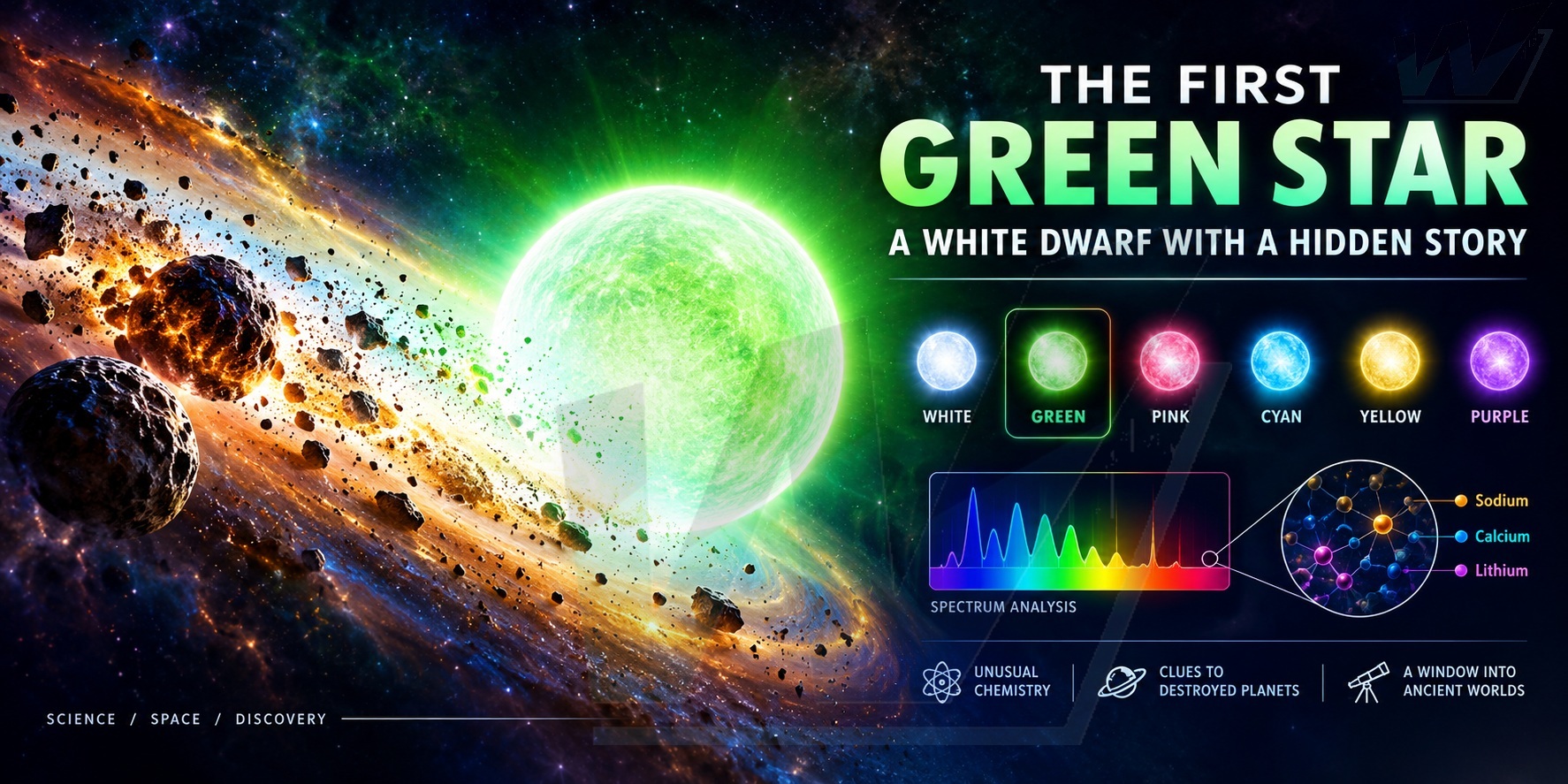
The discovery challenges conventional ideas about star colors and offers a remarkable way to investigate the remains of distant planetary systems. Images are illustrative or model-based, not direct photographs of the stars appearing as colored discs.
For generations, stars have been associated with familiar shades of blue, white and orange. Now, astronomers say they have identified a remarkable exception: a stellar remnant whose light would appear green to human eyes.
The object, known as WD J1330+6435, is a white dwarf whose unusual atmospheric chemistry produces a chartreuse-green appearance in scientific models. The finding, led by astrophysicist Mark Hollands of the University of Warwick, was published on October 15 in RAS Techniques and Instruments.
But the discovery is more than an unexpected color. The star appears to have accumulated material from rocky planetary debris, leaving chemical clues that could help scientists reconstruct the history of a planetary system long after its original star exhausted its fuel.
The cosmic mystery is written in the light itself.
Chemistry is behind the green glow
White dwarfs are the extraordinarily dense remnants left behind when Sun-like stars reach the end of their lives. Although roughly Earth-sized, they contain a substantial fraction of a star’s former mass.
Most white dwarfs appear white or bluish, with their colors largely governed by temperature. Yet under the extreme conditions of a white dwarf’s atmosphere, trace elements can alter how light is absorbed, producing unexpected colors.
In WD J1330+6435, sodium plays a crucial role. Interacting with the dense helium-rich atmosphere, it absorbs a broad range of orange and red wavelengths, shifting the modeled appearance toward green. Calcium and lithium are also present in the star’s atmospheric chemistry.
The result is an extraordinary reminder that the universe does not always follow the visual rules suggested by familiar stars.
A stellar crime scene: evidence of destroyed planets
The green dwarf may hold another, more dramatic secret.
As a star evolves into a white dwarf, its planetary system can be disrupted. Asteroids and other rocky bodies may stray too close to the remnant, where intense gravity can tear them apart. Their debris can then fall onto the star, contaminating its outer layers with elements associated with rocky material.
By analyzing those elements, astronomers can investigate the composition of planetary fragments that no longer exist as intact worlds.
Adam Burgasser, an astronomy and astrophysics professor at the University of California San Diego who was not involved in the study, has described this kind of investigation as resembling a cosmic crime scene: scientists’ piece together the evidence left behind to reconstruct a planet’s former nature and formation.
In other words, a dead star can preserve clues to the life, and destruction, of worlds that once surrounded it.
Not just green: the universe’s hidden palette
The study also highlights another unusual object: WD J1011+2845, a white dwarf whose modeled appearance is salmon-pink.
Its color is linked to carbon molecules brought from deep inside the star into its outer layers. Those molecules alter the light escaping from the stellar remnant, producing a striking pinkish appearance rather than the familiar white or blue.
The findings suggest that white dwarfs can display a broader palette, including green, pink, cyan, yellow and purple, depending on their temperature and atmospheric composition.
To investigate the phenomenon, Hollands and his colleagues examined stellar spectrum and used models to calculate how the objects’ light would be perceived by human vision. A spectrum acts like a chemical fingerprint, revealing which wavelengths are absorbed or emitted.
The distinction matters: the researchers calculated the stars’ apparent colors; they did not photograph their surfaces as colorful discs. The green appearance is a scientific prediction based on available data, not a naked-eyed observation from Earth.
What happens next?
The discovery opens a new avenue for studying stellar remnants and the planetary systems they leave behind.
Hollands expects expanding spectroscopic surveys to provide many more white dwarf spectrums for analysis. A larger sample could help researchers determine how common unusual atmospheric compositions are, identify additional green candidates and investigate the relationship between stellar color, temperature and chemical makeup.
The implications reach beyond astronomy’s color charts. White dwarfs can preserve evidence of planetary material that has been broken apart, offering researchers a rare opportunity to study the chemistry of worlds that may have disappeared long ago.
The green star is therefore both a visual curiosity and a potential scientific clue: a remnant of stellar death that may help reveal what once existed around it.
And as astronomers examine more of these stellar embers, the next surprise may already be hidden in their light.