

Pope Leo XIV Has Lung Cancer: Vatican Confirms Surgery, Recovery Begins
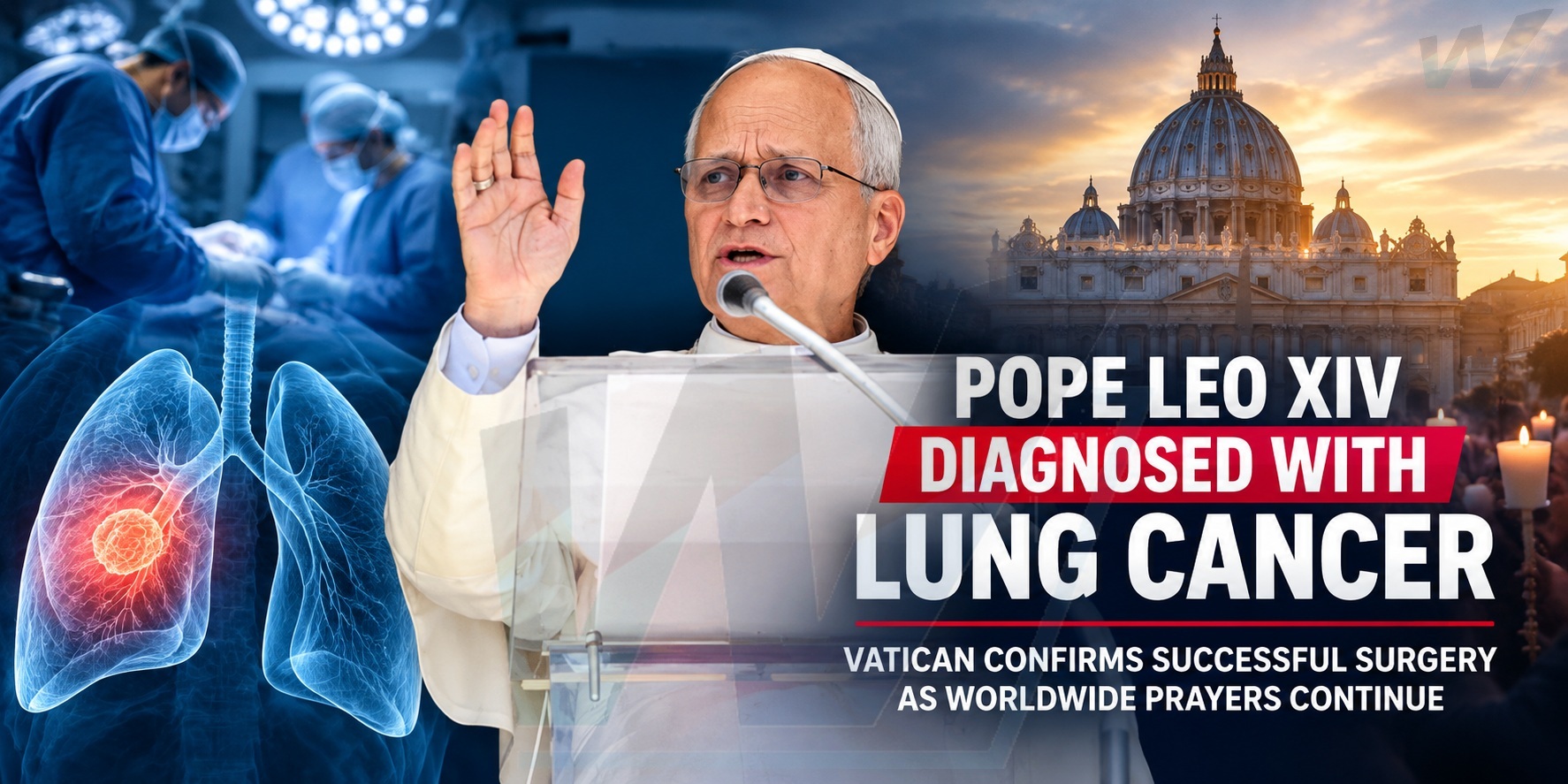
Pope Leo XIV Diagnosed with Lung Cancer: Vatican Confirms Successful Surgery as Catholics Worldwide Pray for His Recovery
VATICAN CITY \ October 14, 2026 \ Health, Vatican & World News
Pope Leo XIV has been diagnosed with lung cancer after surgeons removed the lower lobe of his right lung at Rome’s Gemelli Hospital. The Vatican confirmed that the operation on October 13 was successful and ended without complications, bringing relief to Catholics worldwide while leaving critical questions about the pontiff’s treatment and long-term recovery unanswered.
The 71-year-old pope’s diagnosis was confirmed during surgery, when an examination of the removed tissue identified lung adenocarcinoma, a common form of lung cancer. The Vatican had previously disclosed that doctors found a localized lung nodule and recommended surgery after medical tests raised suspicions.
The immediate medical outcome is encouraging. But the next phase will depend on information that has not yet been fully disclosed, including the cancer’s precise stage, whether it has spread and whether additional treatment will be necessary.
A successful operation, but the full diagnosis remains unknown
According to the Vatican’s medical bulletin, the pope spent approximately three hours in the operating room, with the surgical procedure itself lasting around 90 minutes. Surgeons used a video-assisted technique to remove the lower lobe of his right lung in an operation intended to eliminate the cancerous tissue.
Afterward, Leo XIV regained consciousness normally and returned to his hospital room. The Vatican reported no complications.
Successful operation marks an important first step. It does not, however, establish that the cancer has been completely cured.
Doctors need further information, particularly the final assessment of the tumor and lymph nodes, to determine whether the disease remained confined to the removed tissue. The Vatican has not announced a definitive cancer stage or confirmed whether further treatment will be required.
What is lung adenocarcinoma?
Lung adenocarcinoma is the most common subtype of lung cancer. It develops in glandular cells and can occur in smokers and non-smokers alike.
Treatment and prognosis depend on several factors, including the tumor’s size, its biological characteristics and whether cancer cells have spread beyond the original site.
When the disease is localized and can be completely removed surgically, an operation may be curative. If further testing reveals lymph-node involvement or other spread, additional treatment may be considered.
The crucial distinction is that the cancer has been confirmed, but its stage and the pope’s individual prognosis have not yet been publicly established.
The Vatican enters a period of uncertainty
The pope’s diagnosis comes as he continues his second year as leader of the Catholic Church. Elected in May 2025, Leo XIV is the first American pope and has maintained an active schedule of public audiences, religious celebrations and diplomatic engagements.
The Vatican has canceled his public appointments through October 20 and indicated that he is expected to remain at Gemelli Hospital for approximately a week. His planned November 6–17 visit to Uruguay, Argentina and Peru is now uncertain, with his recovery likely to determine whether the demanding international itinerary can proceed.
The immediate priority is recovery. Beyond the hospital, the diagnosis raises questions about the pope’s capacity to maintain his demanding schedule, although the Vatican has announced no change in the Church’s governance.
The pope remains in office during his illness. Vatican administration continues through its established structures, while matters requiring his personal approval may have to wait if he is unable to address them.
A worldwide Church responds with prayer
Even before the cancer diagnosis was confirmed, the announcement of the pope’s impending surgery prompted prayers and messages of support from Catholic communities and other Christian leaders.
Vatican News reported that church leaders and faithful across different countries had joined in prayer for the pope’s recovery and for the medical team treating him. In Rome, Cardinal Baldassare Reina, the pope’s vicar for the Diocese of Rome, called for a Rosary at Gemelli Hospital, while religious communities were invited to unite in prayer.
The response reflects the spiritual significance of the papacy for millions of people, extending beyond the Vatican’s diplomatic and institutional role.
For Catholics, the news has brought together concern for the health of their spiritual leader and hope that the successful surgery will be followed by a complete recovery. Yet, as the medical team awaits further results, the Church must balance that hope with the uncertainty that remains.
The next medical update will matter most
The immediate news is encouraging: the operation was successful, the pope regained consciousness normally, and no surgical complications were reported.
But the most consequential answers are still to come. Final pathology and lymph-node findings will help establish the extent of the disease and guide decisions about any additional treatment.
Until those details are available, it would be premature to declare the pope cancer-free or to predict the outcome of his illness.
For now, Pope Leo XIV faces a period of recovery at Gemelli Hospital as Catholics around the world continue to pray for his health. Successful surgery has opened a path toward recovery; the next medical findings will help determine what lies ahead.