

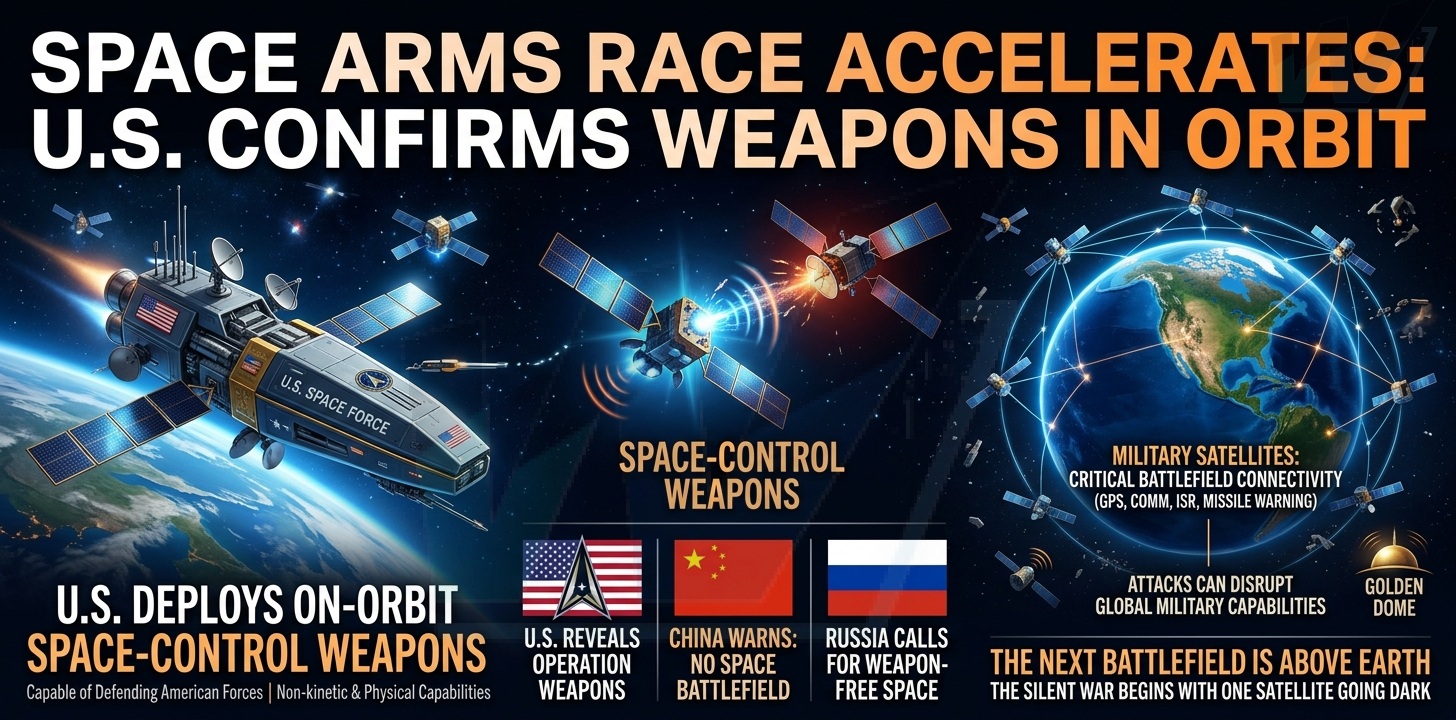
Washington reveals operational space weapons for the first time as China warns against turning orbit into a battlefield and Russia calls for a weapon-free space
September 16, 2026
The next battlefield may already be above Earth.
For the first time, the United States has publicly confirmed that weapons are deployed in orbit, revealing that the U.S. Space Force possesses operational systems capable of defending American forces against hostile action in space.
The disclosure marks a dramatic escalation in the global space arms race, as Washington, China and Russia develop increasingly sophisticated capabilities to protect — or disrupt — the satellites modern militaries depend on.
But Washington is keeping its most important cards hidden.
The Space Force says it has “on-orbit space control weapons” capable of both defensive and offensive operations. Officials have not revealed their number, exact location, deployment date or specific capabilities.
That silence may be deliberate.
America’s orbital weapons remain a mystery
The Pentagon has confirmed its capability without exposing the technology behind it.
Space-control weapons can include systems designed to jam signals, disrupt communications, interfere with satellites or potentially disable hostile spacecraft. Some technologies can operate without physically destroying a satellite and creating dangerous clouds of orbital debris.
The United States has not confirmed which systems are currently deployed.
What it has confirmed is more consequential:
The weapons are already in space.
China and Russia react
Washington’s announcement immediately sharpened the competition with its two principal strategic rivals.
The U.S. Space Force says China is expanding its space and counter-space capabilities as part of its military modernization, while Russia increasingly views space as a potential warfighting domain.
China has warned against turning outer space into a battlefield, while Russia has called for space to remain free of weapons.
But the military race is already accelerating.
The United States, China and Russia are developing spacecraft and technologies capable of maneuvering near, monitoring and potentially interfering with other satellites.
And the stakes are enormous.
The satellites behind modern warfare
GPS and navigation are only part of the picture.
Military satellites provide communication, intelligence, surveillance, reconnaissance, missile warning and battlefield connectivity.
Destroy or disable enough of them, and an advanced military could suddenly lose critical capabilities on Earth.
That makes orbit an increasingly important strategic high ground.
And the first attack may not look like an attack at all.
A satellite could suddenly stop responding.
A signal could disappear.
A spacecraft could change orbit without explanation.
No explosion. No warning. Just darkness.
The Golden Dome factor
The revelation comes as Washington also pushes ahead with space-based elements of its proposed Golden Dome missile-defense system.
The Space Force is developing orbital capabilities designed to detect and track threats, while the Pentagon is examining future space-based interceptors.
The United States has also awarded SpaceX a multibillion-dollar contract for a constellation designed to track airborne threats from orbit.
The direction is unmistakable:
America wants the high ground before a rival can take it.
A treaty, but not a weapons ban
The 1967 Outer Space Treaty prohibits nuclear weapons and other weapons of mass destruction from being placed in orbit.
But it does not ban every conventional or non-kinetic weapon in space.
That legal gap has become increasingly important as nations develop systems capable of disabling satellites without necessarily destroying them.
And there is a major danger in any physical attack.
A shattered satellite can produce thousands of fragments traveling at extreme speeds, threatening other spacecrafts and potentially triggering a cascading chain of collisions.
The new battlefield
The militarization of space began with the Cold War.
But today’s technology has transformed the contest.
Commercial satellites now support military operations. Private companies provide launches, communications and imagery. Artificial intelligence is accelerating military decision-making. And countries can deploy increasingly sophisticated spacecraft faster than ever.
The result is a battlefield that may never be visible from Earth.
The first shot in a future space war may never be seen.
It could be a satellite suddenly going silent.
The space race is over. The space arms race has begun.
America has now publicly acknowledged that weapons are already orbiting Earth.
China is warning against a battlefield in space.
Russia is demanding a weapon-free orbit.
And the world’s major powers are racing to control the infrastructure circling the planet.
The next great military confrontation may not begin with tanks crossing a border.