

Battlefield
KYIV / MELITOPOL / MOSCOW —
The explosion lasted only seconds.
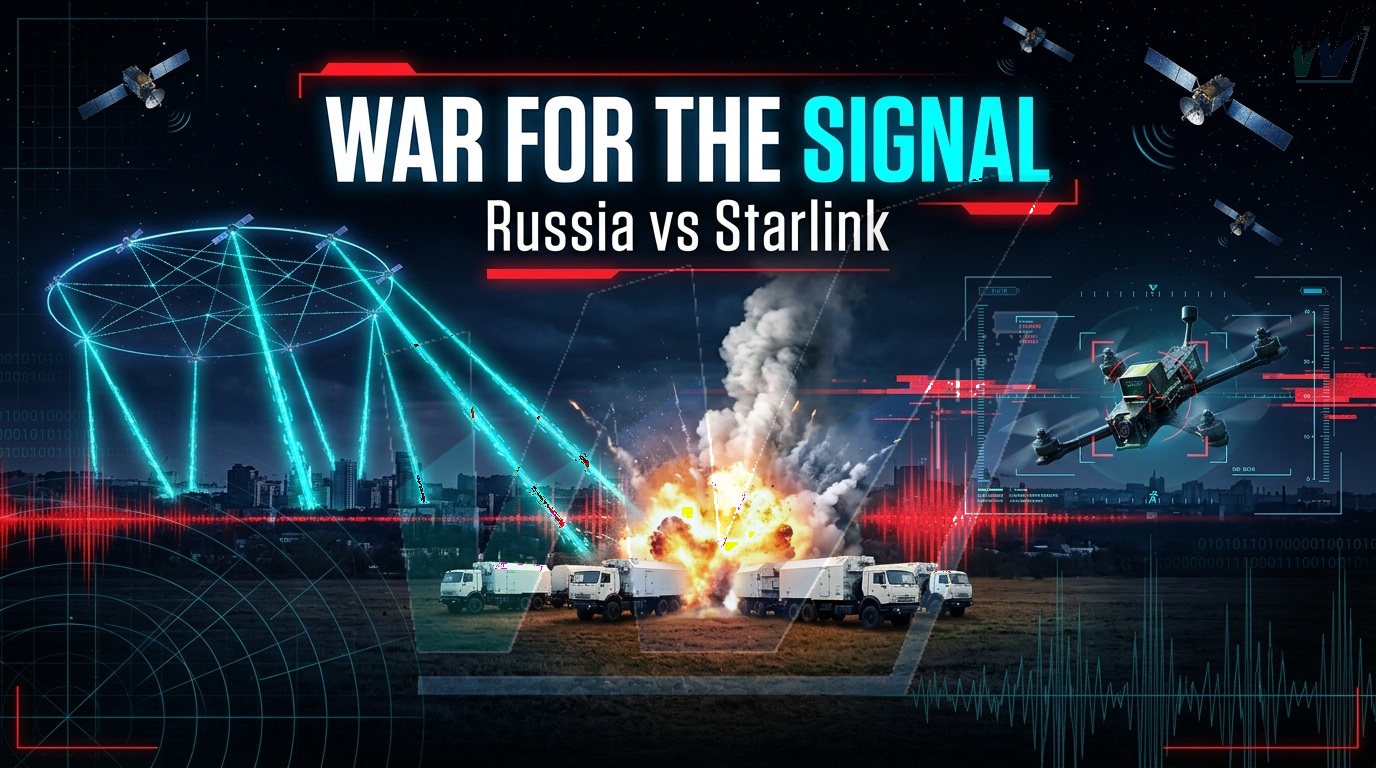
A drone descended from the summer sky, silent and precise, before slamming into a row of white trailers parked in occupied southern Ukraine. Then came the flash.
Fire.
Smoke.
Metal twisting under heat.
Within moments, one of Russia’s most secret electronic warfare systems was burning.
But this was no ordinary military strike.
According to Ukrainian electronic warfare specialists, the target was a sophisticated Russian system designed for one mission: bring down Starlink.
And in modern warfare, destroying communications can be as decisive as destroying tanks.
The war in Ukraine is no longer fought only with artillery, missiles, and drones.
It is now fought in orbit.
The battle above the battlefield
Since SpaceX activated Starlink over Ukraine in February 2022, the satellite network has become one of Kyiv’s most critical military assets.
Starlink dishes allow Ukrainian units to communicate in real time, coordinate artillery, stream drone footage, and maintain battlefield internet even when terrestrial infrastructure is destroyed.
In practical terms, it gave Ukrainian forces something priceless:
Connectivity anywhere.
A drone operator in a forest.
An artillery team near the front.
A command center inside a bunker.
All could stay connected within minutes.
Military analysts widely credit Starlink with helping Ukraine modernize command-and-control operations and dramatically accelerate battlefield decision-making.
That made one fact unavoidable.
Russia had to find a way to stop it.
Moscow’s new weapon: “Blind the satellite”
New drone footage circulating among Ukrainian defense circles appears to show the destruction of a Russian electronic warfare complex known as Volna Kupol Garant.
According to Ukrainian expert Serhii Beskrestnov, known by the call sign “Flash”, the system consists of six trailer-sized modules, each reportedly housing specialized antenna arrays designed to attack Starlink from the ground.
Unlike traditional jammers that interfere with radio links between soldiers or drones, this system reportedly targets something far more ambitious:
The satellite itself.
The concept sounds almost cinematic.
The jammer emits extremely powerful “parasitic signals” toward orbit, flooding the satellite with noise.
Imagine trying to hear a whisper while someone screams directly into your ear.
That is the principle.
If the interference is strong enough, the satellite can no longer distinguish legitimate signals from Starlink terminals on the ground.
In theory, users lose connectivity.
In practice, that is far harder than it sounds.
Why Starlink is so difficult to jam
Electronic warfare experts say Russia faces a brutal physics problem.
Starlink is not a single satellite.
It is a constantly shifting constellation of more than 10,000 low-Earth-orbit satellites, flying roughly 500 kilometers above Earth.
Signals move rapidly from satellite to satellite.
That creates a nightmare for anyone trying to jam them.
To successfully disrupt Starlink, an attacker must:
- Identify which satellite is currently serving the terminal
- Track that satellite in real time
- Aim a highly focused interference beam precisely at it
- Maintain sufficient signal power to overpower legitimate transmissions
- Repeat the process continuously as satellites move
Miss one step, and the connection survives.
Electronic warfare specialist Thomas Withington of Royal United Services Institute says the challenge is immense.
Starlink’s beam between satellite and terminal is extremely narrow.
That means the jammer must align with near-perfect precision.
And battlefield conditions make such precision difficult.
The closer a jammer gets to Ukrainian terminals, the easier it becomes to locate, and destroy.
Exactly what happened in Melitopol.
Ukraine strikes back
That vulnerability may be Russia’s biggest weakness.
The very signals needed to jam Starlink can expose the jammer itself.
Large electronic warfare systems radiate powerful emissions.
They generate thermal signatures.
They require generators or dedicated power infrastructure.
In short:
They glow on the battlefield.
That makes them prime targets for drones, missiles, and special operations.
According to Ukrainian sources, at least up to a dozen such systems have been detected in recent weeks, many positioned near logistics corridors and strategic infrastructure.
These sites appear to form defensive electronic umbrellas over high-value Russian assets.
But there is a major tradeoff.
The more Russia deploys these systems, the more targets it creates.
The economics of signal warfare
Even if technology works, cost presents another challenge.
Each Volna Kupol Garant unit reportedly costs around $1.5 million.
And according to Russian reporting, each installation protects only about 20 square kilometers.
That creates a harsh equation.
Protect one depot?
Possible.
Protect an entire front line stretching over 1,000 kilometers?
Almost impossible.
Space-security analysts say Russia must choose carefully where to deploy such systems.
Defending every logistics route or command hub would require enormous financial and industrial resources, both increasingly strained by war, sanctions, and military losses.
And every deployment invites attack.
A jammer can quickly become an expensive pile of scrap metal.
Elon Musk’s network adapts
Russia’s challenge is compounded by constant software adaptation from SpaceX.
Early in the war, reports suggested Russian jamming briefly affected Starlink terminals.
But software updates rapidly hardened the network.
Engineers modified signal processing.
Anti-jamming resilience improved.
GPS dependency was reduced.
Terminals became smarter about switching satellites.
Modern Starlink dishes can rapidly reroute traffic through backup satellites if signal degradation is detected.
This means even partial jamming may only cause temporary disruption.
The network heals itself.
And that resilience frustrates Russian planners.
A war moving into space
This struggle reflects something larger.
Ukraine is not merely defending territory.
Russia is not merely attacking infrastructure.
Both sides are now fighting for control of invisible systems that shape modern warfare:
Signals.
Bandwidth.
Orbit.
Data.
The next decisive battle may not be won by tanks.
It may be won by whoever controls the electromagnetic spectrum.
Moscow clearly understands this.
That is why Russian efforts to neutralize Starlink continue despite repeated setbacks.
But analysts remain skeptical that Russia has found a true game changer.
There is still a vast gap between wanting to jam Starlink…
…and actually, doing it.
The signal still holds
For now, Starlink remains operational across much of Ukraine.
Drones still fly.
Units still coordinate.
Video feeds still stream from the front.
Orders still move at digital speed.
Russia may possess increasingly sophisticated electronic warfare tools.
But so far, the constellation above Ukraine remains stubbornly alive.
And if the signal survives, so does one of Kyiv’s greatest technological advantages.
The battle for Ukraine is being fought in trenches, cities, and skies.
But increasingly, victory may depend on something no soldier can touch.
An invisible thread of data racing through space.
Whoever cuts that thread first may shape the future of war.