

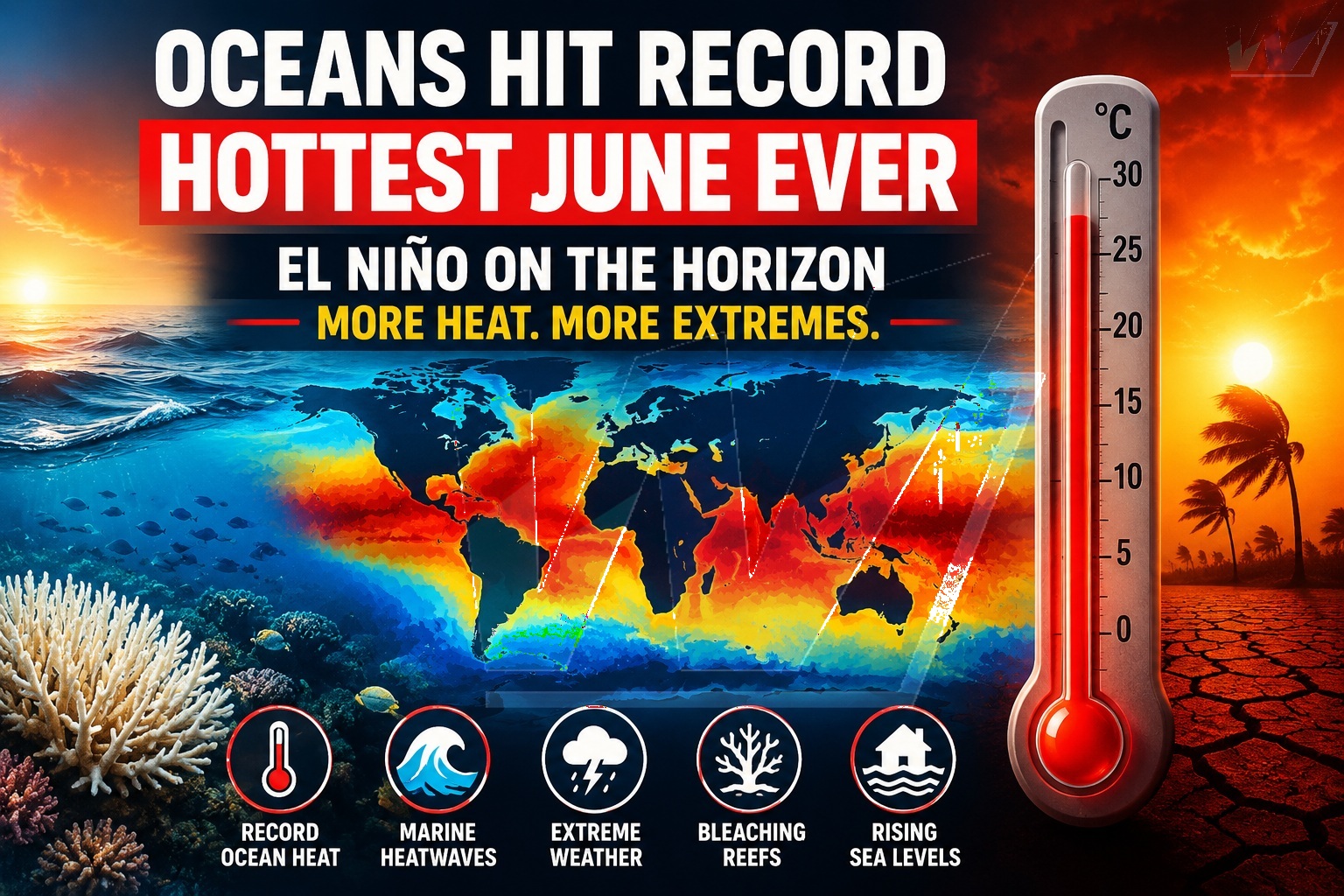
Oceans Hit Record June Temperatures as Emerging El Niño Raises Fears of Global Climate Shock
PARIS / WASHINGTON / GENEVA / SYDNEY –
The warning did not come with sirens.
No explosions. No collapsing buildings. No smoke on the horizon.
Just numbers.
But the numbers are terrifying.
The world’s oceans, Earth’s great climate regulator and silent heat absorber, have just recorded their hottest June ever, a milestone scientists say may mark the beginning of a dangerous new phase in the global climate crisis.
According to the Copernicus Climate Change Service and the Copernicus Marine Service, global average sea surface temperatures in June reached 20.98°C, surpassing previous highs set in 2023 and 2024. What sounds like a small numerical increase is, in climate terms, a profound alarm bell.
Scientists across major research institutions and global media outlets, from Reuters, BBC News, and CNN to Bloomberg, The New York Times, and Agence France-Presse , are converging on one grim conclusion:
The ocean is overheating.
And the atmosphere may be next.
A Silent Furnace Beneath the Waves
The oceans absorb nearly 90 percent of the excess heat trapped by greenhouse gases, acting as Earth’s shock absorber against catastrophic warming. For decades, they have buffered humanity from even more extreme surface temperatures.
But that buffer is showing signs of failure.
For six straight months in 2026, sea temperatures remained near unprecedented levels. Vast marine heatwaves spread across the globe, affecting nearly 82 percent of the world’s oceans — the second-highest coverage ever recorded.
This isn’t merely an environmental anomaly.
It is the heating of the planet’s largest thermal engine.
“Current conditions could indicate the beginning of a new phase, leading once more to uncharted territory,” warned Carlo Buontempo, director of the EU climate monitoring service.
That phrase, uncharted territory, has begun appearing with disturbing frequency in climate science.
Because the next threat is already forming.
El Niño Returns — and It Could Supercharge the Crisis
Across the tropical Pacific, ocean waters are warming in patterns that signal the emergence of El Niño–Southern Oscillation, the powerful climate phenomenon capable of reshaping weather across the planet.
El Niño occurs when abnormally warm Pacific waters release massive amounts of stored heat into the atmosphere. Historically, its arrival has triggered global weather disruptions:
- Torrential floods in Peru
- Severe droughts across parts of Africa
- Intensified wildfire seasons in Australia
- Stronger storms and extreme rainfall worldwide
But this El Niño may arrive under conditions unlike previous cycles.
This time, it collides with already superheated oceans.
That combination worries climatologists.
“2026 will likely be among the warmest years ever recorded,” said lead oceanographer Simon Van Gennip, noting that greenhouse gas emissions continue amplifying every natural warming cycle.
In other words: nature is adding fuel to a fire humans have already started.
The Mediterranean Is Boiling
Among the most alarming hotspots is the Mediterranean Sea, where June temperatures shattered records at 24.3°C.
Nearly 98 percent of the basin experienced marine heatwave conditions in the first half of 2026.
For southern Europe, the consequences are immediate.
Warmer seas mean more atmospheric moisture. More moisture means heavier storms, flash floods, and destabilized weather systems.
A marine heatwave in the northwestern Mediterranean recently reached record intensity, coinciding with punishing heat waves across France, Spain, and neighboring regions.
Scientists warn the sea itself is becoming an accelerant.
Coral Reefs, Wildlife, and Coastlines Under Siege
The danger extends far beyond temperature charts.
Marine heatwaves can devastate ecosystems.
Coral reefs bleach. Fish migration patterns collapse. Oxygen levels fall. Entire marine food chains can destabilize.
Tropical reefs are especially vulnerable.
When seawater remains too warm for too long, corals expel the algae that sustain them, turning ghostly white before dying.
The consequences ripple outward:
- Fisheries decline
- Coastal protections weaken
- Biodiversity collapses
- Food security deteriorates
For millions of people dependent on marine ecosystems, warming oceans is not abstract science.
They are an economic and humanitarian threat.
A Deepening Crisis
Last month, a major United Nations scientific assessment warned that the world’s oceans are entering a “deepening crisis.”
That phrase may prove understated.
Hotter oceans do more than absorb heat.
They expand.
As water warms, it occupies more volume, accelerating sea-level rise and increasing coastal flooding risks from Miami to Jakarta, from Pacific islands to Mediterranean ports.
The danger compounds because multiple climate feedback loops are now moving together:
- Rising greenhouse gas concentrations
- Record ocean heat
- Emerging El Niño conditions
- Intensifying marine heatwaves
- Accelerating sea-level rise
Each amplifies the next.
The Heat Is No Longer Waiting
For years, climate warnings spoke in future tense.
Will happen.
Could happen.
Might happen.
That language is disappearing.
Warming is no longer approaching.
It is here.
The ocean — vast, ancient, and once seemingly limitless in its ability to absorb human damage — is sending an unmistakable signal.
The seas are running hotter than ever recorded.
And as El Niño awakens, scientists fear the world may soon discover what lies beyond today’s records.
Because if the oceans stop protecting us from the heat…
The heat comes for everything.