
Mecca Defense Pact: Is the Middle East Preparing for a Future Without the United States?
Saudi Arabia, Türkiye and Pakistan have signed a landmark mutual-defense agreement declaring that an attack on one will be treated as an attack on all. The real question is whether the pact strengthens Washington’s regional position, or marks the beginning of a new security order.
MECCA — A new security architecture is taking shape in the Middle East.
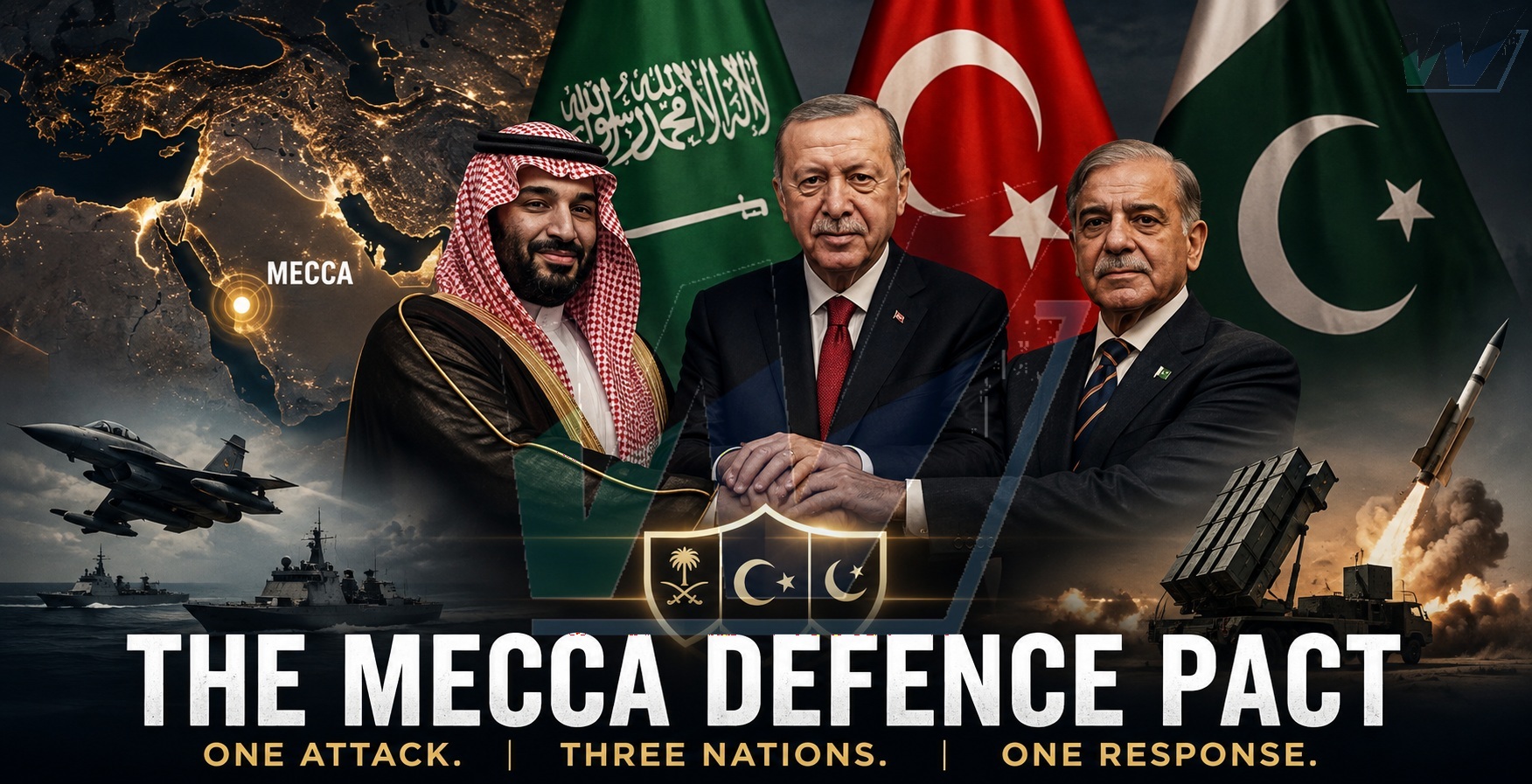
On Friday, August 7, Saudi Arabia, Türkiye and Pakistan signed the Mecca Joint Defense Agreement, committing the three countries to regard an armed attack against any one of them as an attack against all three.
The wording is stark. The implications could be even greater.
The agreement comes after months of war, missile attacks, disrupted energy routes and growing uncertainty over the reliability of traditional American security guarantees. It also follows years of increasingly assertive efforts by regional powers to build military and diplomatic relationships that do not depend exclusively on Washington.
The pact is officially described as defensive, rather than directed against a particular country. But its timing, amid continuing confrontation involving Iran, attacks by Iranian-aligned forces and uncertainty surrounding the future of the US military role in the region, makes it impossible to separate the agreement from the wider strategic upheaval.
And that raises the question now reverberating through foreign ministries from Washington to Tehran:
Is America’s Middle East security system beginning to change?
From Washington’s umbrella to a regional shield
For decades, Saudi Arabia and other Gulf states have relied heavily on the United States for their external security.
American bases, fighter aircraft, missile-defense systems, intelligence capabilities and naval forces have formed the backbone of the Gulf security system.
But the wars and crises of recent years have exposed the limits of that arrangement from the perspective of regional governments.
The latest pact therefore does not necessarily mean Riyadh is abandoning Washington.
Instead, analysts increasingly see the strategy as diversification: maintaining the American relationship while building additional layers of deterrence with regional and extra-regional partners.
That distinction matters.
The Financial Times reported that the new pact reflects a desire for greater regional self-reliance at a moment when confidence in US security guarantees has been tested. The agreement also builds on existing Saudi-Pakistani military cooperation and expanding Saudi-Turkish defense ties.
In other words, Riyadh may not be choosing America or the region.
It may be choosing America plus the region.
The pact that almost didn’t happen
The emergence of the trilateral agreement is particularly significant because, only months ago, Turkish participation was far from certain.
In January, reports suggested Ankara was seeking to join the Saudi-Pakistani defense arrangement. Bloomberg reported that discussions were at an advanced stage, while Pakistan’s defense officials indicated that a draft trilateral agreement had been prepared.
Then came a reversal.
In February, Saudi-linked sources told AFP that the existing Saudi-Pakistani agreement would remain bilateral and that Türkiye would not join it.
That appeared to close the door.
Instead, negotiations continued a separate trilateral framework.
By July, reporting indicated that Saudi Arabia, Pakistan and Türkiye were preparing a new mutual-defense arrangement distinct from the original Saudi-Pakistani pact. Other Gulf states were also exploring new defense relationships with Pakistan.
On August 7, the speculation became reality.
Three very different powers, one strategic calculation
The significance of the pact lies partly in the unusual combination of its members.
Saudi Arabia: money, geography and energy
Saudi Arabia brings enormous financial resources, strategic geography and control over critical energy infrastructure.
For Riyadh, the central concern is straightforward: protect the kingdom from being drawn into another devastating regional conflict.
Iranian missile and drone attacks and threats to Gulf infrastructure have demonstrated how vulnerable oil facilities, ports, desalination plants and transport networks can be during a major confrontation. Disruption around the Strait of Hormuz has also shown how quickly a regional conflict can become a global economic crisis.
Türkiye: NATO experience and defense technology
Türkiye adds something Saudi Arabia cannot easily manufacture on its own: a huge standing military, NATO interoperability and a rapidly expanding indigenous defense industry.
Turkish drones, missiles, naval platforms and other weapons systems have become increasingly important to Ankara’s regional influence.
The Financial Times reported that Saudi-Turkish defense cooperation is already expanding, including cooperation in drone development and defense manufacturing, with Saudi investment in Turkish defense companies.
Türkiye therefore brings both military weight and technological capability.
Pakistan: manpower, and a nuclear shadow
Pakistan changes the equation again.
It possesses one of the world’s largest militaries and is the only nuclear-armed member of the new grouping.
That does not mean the Mecca agreement creates a formal Pakistani nuclear umbrella for Saudi Arabia or Türkiye. The available reporting does not establish such a commitment.
But Pakistan’s nuclear status inevitably gives the pact a strategic dimension that a conventional military alliance would not otherwise possess.
Why Washington should pay attention
The most important consequence may not be what the agreement says about Iran.
It may be what it says about America.
Saudi Arabia remains deeply connected to the United States militarily, economically and strategically. Türkiye remains a NATO member. Pakistan has longstanding security ties with Washington.
That makes the pact fundamentally different from an alliance designed simply to replace the United States.
Instead, it potentially creates a parallel regional security network populated by countries that still maintain relationships with Washington.
That could eventually make America’s role more complicated.
Washington may remain indispensable for advanced missile defense, intelligence, satellite surveillance, logistics and high-end military operations.
But if regional states increasingly develop their own networks for mutual defense, Washington’s ability to act as the region’s sole security guarantor could gradually diminish.
The Guardian has described the broader trend as Gulf states reconsidering their security arrangements after the war, while noting that calls for a wider “Muslim NATO” face major political and strategic obstacles.
Iran is the question nobody can avoid
The three governments insist the agreement is defensive.
That matters.
Türkiye and Pakistan both have complicated relationships with Iran and have repeatedly supported diplomacy and de-escalation. Pakistan has played a mediation role between Washington and Tehran during the conflict.
That makes it difficult to portray the pact simply as an anti-Iran military alliance.
Yet Tehran will inevitably examine one provision above all others:
An attack on one is an attack on all.
If Iranian forces, or an armed group aligned with Tehran, were to launch a major attack on Saudi territory, the new agreement could theoretically create pressure for Türkiye and Pakistan to respond.
That is where deterrence becomes complicated.
A defense pact can prevent war by making aggression more expensive.
But it can also create the possibility that a conflict involving one country rapidly expands into a conflict involving three.
The Houthi factor
The timing is also linked to the increasingly dangerous security environment around Yemen.
Houthi forces have continued attacks involving missiles and drones, while the broader conflict has threatened Saudi territory and maritime routes.
The Guardian reported that the new pact came amid intensified Houthi attacks and a worsening security environment involving Iranian-aligned forces.
For Saudi Arabia, the lesson is painfully familiar:
The threat does not have to originate from a conventional army to become strategically devastating.
Drones can attack energy infrastructure.
Missiles can threaten cities.
Armed groups can disrupt shipping.
And a relatively inexpensive weapon can force a wealthy state to spend enormous sums on interception and defense.
The new pact is therefore about more than tanks and fighter jets.
It is about creating the political certainty that an attack will trigger a wider response.
What does the pact do NOT mean
Despite dramatic comparisons with NATO, caution is essential.
The Mecca agreement is not NATO.
There is no evidence that the three countries have created NATO-style integrated command structures, automatic military deployment mechanisms or a common military budget.
Nor does the available reporting establish that Pakistan’s nuclear forces have formally been placed under a collective command.
The agreement’s practical military obligations will therefore be crucial.
A declaration that an attack on one is an attack on all is powerful politically.
But the real test comes later:
What happens when the first missile flies?
Would Türkiye deploy aircraft?
Would Pakistan deploy troops?
Would Saudi Arabia request American assistance simultaneously?
Would the three governments agree on what constitutes an attack?
Those questions remain unanswered.
A security network is already emerging
The Mecca agreement should also be viewed as part of a much larger trend.
Saudi Arabia has strengthened its relationship with Pakistan.
Türkiye has expanded defense cooperation with Riyadh.
Pakistan has increasingly positioned itself as a mediator between Gulf states, Iran and other regional powers.
Other Gulf countries have explored new defense agreements as well. Recent reporting has pointed to interest from Kuwait, Bahrain and Jordan in expanded security arrangements involving Pakistan.
Meanwhile, Saudi Arabia has worked with Türkiye, Pakistan and Egypt on diplomatic efforts surrounding the Iran conflict.
The result is not yet a single block.
It is something potentially more complicated:
a web of overlapping alliances.
And that could become the defining feature of the Middle East’s next strategic era.
China and Russia are watching too
The emergence of a more autonomous regional security system also has implications beyond Washington and Tehran.
Saudi Arabia has maintained close economic relations with China, while Pakistan remains deeply connected to Beijing through strategic and economic partnerships.
Türkiye, meanwhile, has repeatedly demonstrated that it wants room to maneuver between the United States, Russia, China and regional powers.
The new arrangement could therefore provide all three governments with greater strategic flexibility.
But flexibility comes with a price.
The more overlapping security commitments accumulate, the harder it becomes to predict how one crisis will affect another.
A confrontation involving Iran could pull in Saudi Arabia.
A Saudi-Iran confrontation could test Pakistan.
A Turkish military decision could affect NATO.
And a conflict involving Pakistan could create consequences far beyond the Middle East.
The nuclear question hanging over Mecca
Perhaps the most sensitive issue is Pakistan.
Saudi Arabia and Pakistan already signed a Strategic Mutual Defense Agreement in September 2025, under which aggression against one was to be treated as aggression against the other. The exact terms were not publicly disclosed, and questions have repeatedly been raised over whether Pakistan’s nuclear deterrent could have any role in protecting Saudi Arabia.
The Mecca agreement does not, on the evidence currently available, resolve that question.
But it does create a new strategic triangle involving a nuclear-armed state, a major NATO military power and one of the world’s most strategically important energy producers.
That alone is enough to attract intense attention in Washington, Beijing, Moscow, New Delhi and Tehran.
India is watching carefully
Pakistan’s participation also gives the agreement a South Asian dimension.
India has longstanding strategic and economic relationships with Saudi Arabia and other Gulf states. Any military arrangement involving Pakistan, particularly one with collective-defense language, will therefore be closely examined in New Delhi.
At the same time, analysts caution against if the pact automatically transforms every possible India-Pakistan confrontation into a Saudi or Turkish military confrontation.
The treaty’s actual implementation mechanisms will matter enormously.
And the fact that Türkiye is a NATO member adds another layer of complexity.
So, is America losing the Middle East?
Not yet.
That would be an exaggeration.
The United States still possesses military capabilities in the region that Saudi Arabia, Türkiye and Pakistan cannot collectively reproduce overnight.
American intelligence, strategic airpower, missile defense, naval power, logistics and advanced weapons remain extremely difficult to replace.
But something more subtle may be happening.
America may be moving from being the default security provider to being the most powerful partner in a crowded security marketplace.
That is a profound distinction.
The Mecca agreement does not necessarily announce the end of the American era in the Middle East.
It may announce the end of the idea that regional states must depend on Washington alone.
The real test begins now
The signing ceremony in Mecca was the easy part.
The difficult part will come when the alliance faces its first crisis.
If the pact succeeds, it could become a model for a new Middle Eastern security architecture, one based on regional partnerships, shared deterrence and overlapping alliances rather than exclusive dependence on Washington.
If it fails to produce meaningful military cooperation when a member is threatened, critics will dismiss it as another diplomatic declaration with little operational weight.
And if the pact is invoked during a major confrontation with Iran or another armed actor, the consequences could be enormous.
Because the sentence at the heart of the agreement leaves very little room for ambiguity:
An attack on one is an attack on all.
The Middle East has spent decades building security around outside powers.
The Mecca pact suggests that its leading states may now be trying something different.
They are building security around each other.
And Washington will have to decide whether that represents a threat to American influence, or the emergence of regional partners capable of carrying more of the burden themselves.