
The Strait Could Become a Nightmare
If Chinese forces ever cross the Taiwan Strait, they may not encounter the conventional battlefield Beijing has spent decades preparing for.
Instead, the sky and sea could suddenly fill with thousands of small, expendable machines.
Some would search. Others would jam, scout, mine, track or strike. Unmanned surface vessels could race toward ships. Underwater drones could threaten the invasion fleet from below. Cheap aerial drones could arrive in waves, forcing Chinese commanders to defend against threats coming from multiple directions at once.
The objective would not be to build a military capable of matching China ship-for-ship or aircraft-for-aircraft.
It would be something more brutal and asymmetric: make the invasion so chaotic, slow and expensive that Beijing cannot achieve its objective.
That is the logic behind what U.S. defense analysts have called a Taiwanese “Hellscape” strategy.
And as Taiwan’s largest annual military exercises enter their final stages on August 14, 2026, the concept is moving from military theory toward something increasingly visible in Taiwan’s defense planning.
From Ukraine to the Taiwan Strait
The idea gained renewed momentum from the experience of Ukraine.
The war against Russia demonstrated that inexpensive drones could transform how a smaller force finds targets, attacks expensive equipment and disrupts logistics. Taiwan has been studying those lessons while attempting to build a domestic drone ecosystem capable of surviving a war in which communications, GPS and conventional military infrastructure could all come under attack.
A February 2026 report from the Center for a New American Security, “Hellscape for Taiwan: Rethinking Asymmetric Defense,” argues that Taiwan should evolve beyond its traditional “porcupine” defense strategy and build a layered network of aerial, surface and underwater unmanned systems.
The central calculation is simple:
China has more ships, aircraft, missiles and manpower. Taiwan does not need more of everything. It needs enough relatively cheap weapons to make China’s most important military assets vulnerable.
That means quantity matters almost as much as sophistication.
Taiwan Is Building Arsenal
The strategy is no longer purely theoretical.
Taiwan’s defense plans include a huge expansion of domestically produced unmanned systems. Under a proposed special procurement program, the Ministry of National Defense has sought funding for 208,200 coastal attack drones, 1,446 coastal reconnaissance drones and 1,320 unmanned surface vessels. The proposed program has a ceiling of approximately NT$210 billion, or $6.6 billion, running from August 2026 through 2031.
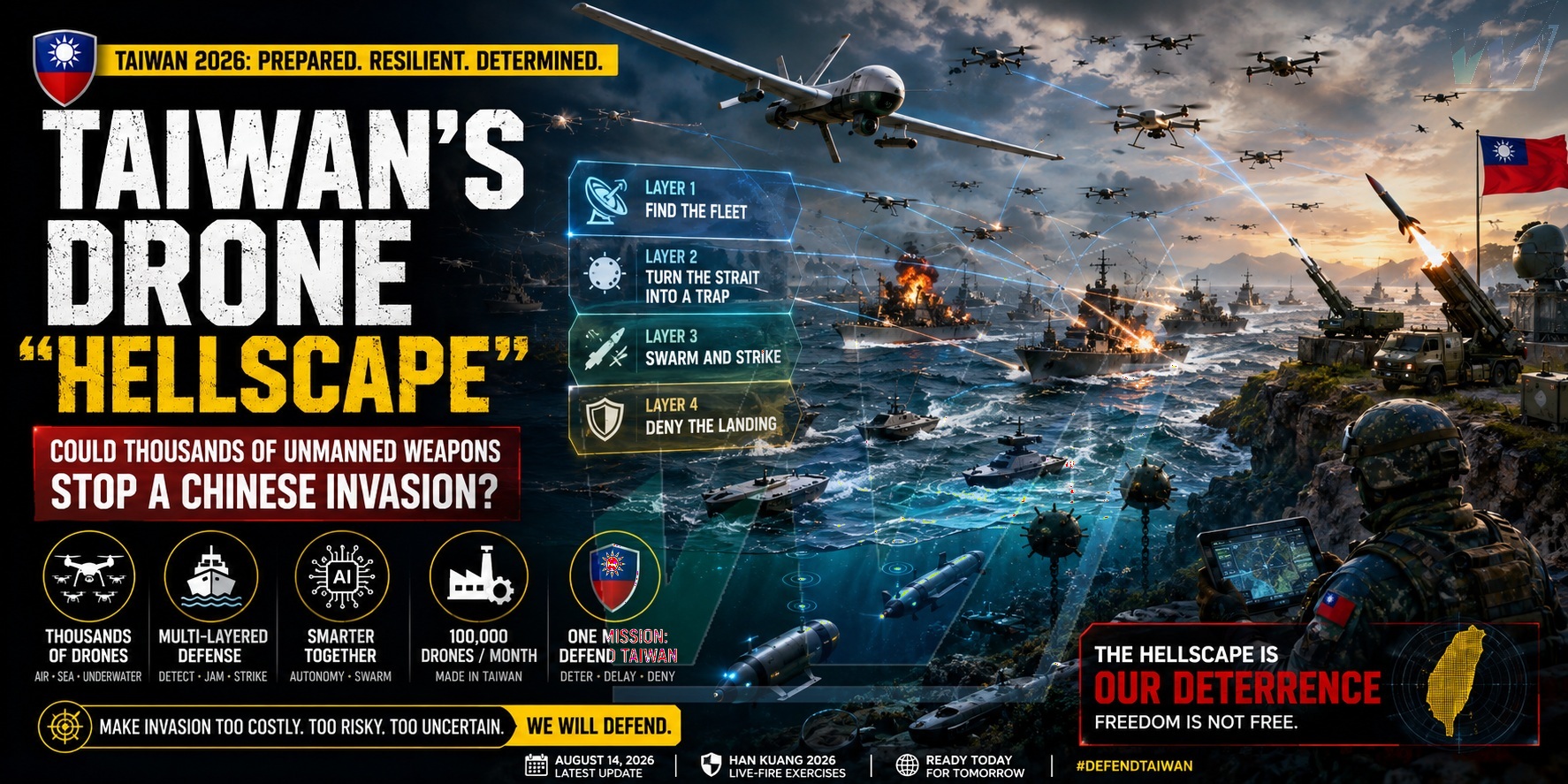
Taiwan has also set an extraordinarily ambitious industrial target: producing 100,000 drones per month by 2030.
That is not merely a military procurement program. It is an attempt to build an industrial war machine capable of replacing losses quickly.
Because in a prolonged conflict, the crucial question may not be:
How many drones does Taiwan have on Day One?
It may be:
How many can Taiwan build, repair, modify and deploy on Day 30?
Recent reporting indicates that Taiwan’s drone industry is expanding rapidly. A government-backed UAV research and development hub in Chiayi now hosts more than 50 companies and institutions, while Taiwan is cultivating partnerships with the United States, France, Poland and the Czech Republic to develop trusted, non-Chinese supply chains. Taiwan’s drone-industry output reached NT$12.9 billion in 2025, according to data cited by Focus Taiwan.
The “Hellscape” Is Not Just a Swarm
The most important misunderstanding is that Hellscape simply means launching enormous numbers of kamikaze drones.
It doesn’t.
The concept envisioned by CNAS is a layered defense system combining unmanned aircraft, drone boats, underwater vehicles, mines, missiles, mobile air defenses and conventional weapons.
Think of it as a series of increasingly dangerous gates.
Layer One: Find the Fleet
Far from Taiwan’s coastline, long-range unmanned systems could help locate and track Chinese naval forces.
The purpose would be to expose the invasion fleet and disrupt its carefully coordinated movement.
A major amphibious operation requires extraordinary organization. Troop transport, landing craft, escorts, aircraft, logistics vessels and command elements must arrive in a coordinated sequence.
Break that sequence, and the entire operation becomes harder.
Layer Two: Turn the Strait into a Trap
Closer to Taiwan, unmanned surface and underwater systems could work with mines and other defensive weapons.
The goal would be to force Chinese vessels into predictable routes.
That creates a vicious cycle.
The more predictable the route, the easier it becomes to target.
The CNAS concept proposes using unmanned systems to help lay or replenish minefields while attacking vulnerable landing craft as they navigate restricted corridors.
At this stage, Taiwan would not necessarily need to sink the entire Chinese fleet.
It would need to inflict enough losses and confusion to disrupt the invasion timetable.
Then Comes the Swarm
As Chinese landing craft approach the island, the battlefield could become dramatically more dangerous.
Medium-range attack drones could attack vessels carrying troops, weapons and supplies. Smaller FPV-type drones could operate closer to shore.
Taiwan has already demonstrated that this is moving beyond theoretical discussions.
During the 2026 Han Kuang exercises, Taiwan’s navy deployed new medium-class strike drones in a littoral combat scenario. The fixed-wing systems resembled the type of loitering munitions that have become prominent in Ukraine.
That demonstration matters because the Taiwan Strait is a uniquely difficult environment.
Wind.
Salt water.
Long distances.
Electronic warfare.
Heavy Chinese airpower.
And a defender that may have to operate while its communications networks are being attacked.
Taiwan is therefore attempting to develop systems that can continue functioning even when conventional communications become unreliable.
The Communications War Is Already Being Rehearsed
Perhaps the clearest sign that Taiwan is preparing for a radically different kind of war came not from a missile launch, but from an internet slowdown.
During the 2026 Han Kuang exercises, Taiwan deliberately throttled mobile internet service to simulate wartime communications disruption.
The August 13 exercise affected northern areas including Taipei and surrounding jurisdictions, with mobile connectivity reduced while fixed-line services remained available.
The exercise was designed to force civilians and authorities to confront a basic reality:
A modern war could begin with people losing access to the digital systems they normally depend upon.
Taiwan is also preparing for damage to undersea communications infrastructure. The Guardian reported that the island is examining alternative communications systems and satellite connectivity as it confronts vulnerabilities in its submarine cable network.
That matters enormously for drones.
A sophisticated drone force is useless if every aircraft depends upon a fragile communications link that the enemy can jam or destroy.
The answer is greater autonomy, distributed communications and systems capable of completing missions with less dependence on a centralized command network.
Beijing Has a Problem of Its Own Drone
There is another complication.
China is not waiting passively while Taiwan develops its drone strategy.
The People’s Liberation Army is also expanding its use of unmanned systems.
Taiwan News reported on August 13 that the PLA Ground Force conducted a drill involving attack drones targeting unmanned surface vessels, an indication that unmanned warfare is becoming increasingly integrated into Chinese military planning as well.
That creates a dangerous technological race.
Taiwan wants drones to complicate a Chinese invasion.
China wants drones to find Taiwanese defenses, suppress launchers, hunt other drones and help clear the path for its forces.
The future Taiwan Strait battlefield could therefore become a contest between autonomous systems before the first Chinese soldier reaches the beach.
Why Ukraine Matters, But Cannot Be Copied
Ukraine offers Taiwan valuable lessons, but the two battlefields are fundamentally different.
Ukraine has enormous land depth.
Taiwan does not.
Ukraine’s defenders can retreat, regroup and establish multiple defensive lines.
Taiwan cannot retreat across the Taiwan Strait.
And a Chinese amphibious assault would be one of the most complex military operations imaginable.
The invading force must cross water, maintain air and naval protection, unload troops and equipment, secure beaches and then push inland, all while sustaining a huge logistical pipeline.
That creates a potential weakness.
The invasion is most vulnerable before the Chinese force reaches the beach.
This is precisely where the Hellscape concept concentrates its strength.
But the Strategy Has a Huge Weakness
Drones are not magic.
A Hellscape strategy could fail.
China possesses enormous advantages in missile forces, aircraft, naval power, electronic warfare, industrial capacity and military manpower.
The People’s Liberation Army could attempt to destroy Taiwan’s drone production facilities before an invasion begins.
It could attack command centers, communications networks, radar sites, airfields, ports and ammunition stocks.
It could use electronic warfare to interfere with drone navigation and communications.
And Beijing would almost certainly attempt to adapt once the first wave of unmanned systems appeared.
The challenge becomes even greater because China itself is one of the world’s largest sources of commercial drone technology and components , creating supply-chain complications for Taiwan as it tries to build a trusted, non-Chinese ecosystem. Analysts have repeatedly warned that Taiwan cannot assume that simply buying thousands of drones will guarantee battlefield effectiveness.
Quantity Is the Point, But Quantity Has a Price
There is another problem.
If Taiwan spends enormous sums on drones but fails to protect the factories that produce them, those drones could disappear quickly.
The same applies to batteries, motors, communications equipment, sensors, semiconductors, explosives and replacement parts.
Drone war is an industrial war.
Ukraine has demonstrated how rapidly consumption can outpace production. Taiwan is therefore trying to create something larger than a weapons inventory: a national drone manufacturing ecosystem.
Its Chiayi cluster is part of that effort, alongside planned industrial expansion and international cooperation.
The objective is resilience.
Lose 1,000 drones?
Build another 1,000.
Losing a factory?
Move production.
Lose a communications network?
Switch systems.
Lose an operator?
Use greater autonomy.
That is the logic of distributed warfare.
Han Kuang 2026: The Experiment Is Getting Real
Taiwan’s current Han Kuang exercises provide perhaps the clearest snapshot of this transformation.
The 10-day exercises, running from August 5 to 14, have deliberately emphasized less-scripted scenarios and greater uncertainty. More than 20,000 reservists are participating, while Taiwan is testing military command flexibility, civilian resilience, industrial dispersal and communications disruption.
President Lai Ching-Te has also overseen coastal defense exercises involving attack drones, missile boats and Coast Guard vessels.
On August 13, Taiwan’s navy and Coast Guard conducted their first joint anti-blockade drill, practicing the escort of merchant shipping and mine-clearing operations.
The message is unmistakable:
Taiwan is no longer preparing only for an invasion. It is preparing for the entire spectrum of conflict that could precede one.
Block-Ade.
Cyber-attaque.
Dis-information.
Communications disruption.
Missile strikes.
Air raids.
Maritime harassment.
And finally, potentially, an amphibious assault.
The Real Weapon May Be Fear
This is where the Hellscape concept becomes strategically interesting.
Its ultimate purpose may not be to destroy the Chinese invasion force.
It may be to convince Beijing that launching the invasion is simply too risky.
A Chinese leader contemplating war would have to calculate not only whether the PLA could reach Taiwan, but whether enough troops, ships, aircraft and supplies would survive to establish a sustainable beachhead.
If the answer becomes uncertain, deterrence may already be working.
That is the fundamental idea behind asymmetric defense.
Taiwan does not have to defeat China’s military everywhere. It only must prevent China from achieving its political objective.
Could a Drone Hellscape Actually Stop China?
No serious analyst can guarantee that it would.
A Chinese invasion would involve variables impossible to model perfectly: weather, surprise, cyberwarfare, missile attacks, U.S. intervention, Japanese involvement, Chinese political calculations, Taiwanese mobilization and the performance of weapons under combat conditions.
The Hellscape concept itself is an operational proposal, not a proven wartime formula. Analysts at the Modern War Institute have also questioned whether unmanned systems alone can deliver the decisive effects sometimes attributed to them.
But the strategy changes the calculation.
Instead of asking Taiwan to defeat a vastly larger military symmetrically, it asks a different question:
Can Taiwan create enough uncertainty, attrition and delay to make a successful Chinese landing impossible or prohibitively costly?
That is a much more achievable objective.
The Coming Battle May Be Won Before the Beach
The Taiwan Strait is roughly 180 kilometers wide at its broadest points, creating a natural barrier that any invading force must cross.
But geography alone cannot defend Taiwan.
The island needs weapons that can survive the opening bombardment, operate under electronic attack and continue striking after conventional command networks are damaged.
That is why drones have become so important.
They were relatively cheap.
They are replaceable.
They can be distributed.
They can operate across air, land and sea.
And thousands of them can create a problem that even a vastly superior military cannot simply solve with a single missile strike.
Taiwan’s transformation is therefore bigger than a drone procurement program.
It is an attempt to change the mathematics of invasion.
China may possess overwhelming military superiority.
But if every kilometer toward Taiwan means another wave of drones, another minefield, another unmanned boat, another electronic attack and another decision about whether to risk another ship, the invasion timetable begins to collapse.
The “Hellscape” does not promise Taiwan an easy victory.
It promises something potentially more valuable:
a way to make victory for China uncertain.
And in deterrence, uncertainty can be the most powerful weapon of all.
What to Watch Next
As Taiwan’s Han Kuang exercises conclude on August 14, several developments will reveal whether the Hellscape concept is becoming a genuine military doctrine rather than a strategic slogan:
- Drone procurement: whether Taiwan’s large domestic procurement program secures sustained legislative funding.
- Production capacity: whether Taiwan can approach its ambitious 100,000-drones-per-month industrial target.
- Autonomy: whether unmanned systems can operate effectively when GPS, satellites and communications are disrupted.
- Anti-drone warfare: how Taiwan protects its own swarm against increasingly sophisticated Chinese electronic warfare and interceptors.
- Unmanned naval systems: whether drone boats and underwater vehicles can become reliable components of coastal defense.
- Civilian resilience: whether Taiwan can keep communications, energy, transport and government functioning under attack.
- Chinese countermeasures: whether Beijing adapts its invasion doctrine specifically to neutralize Taiwan’s unmanned “hellscape.”
The decisive battle may not begin when Chinese troops land.
It could begin months or years earlier, inside factories, laboratories, software networks and military planning rooms.