

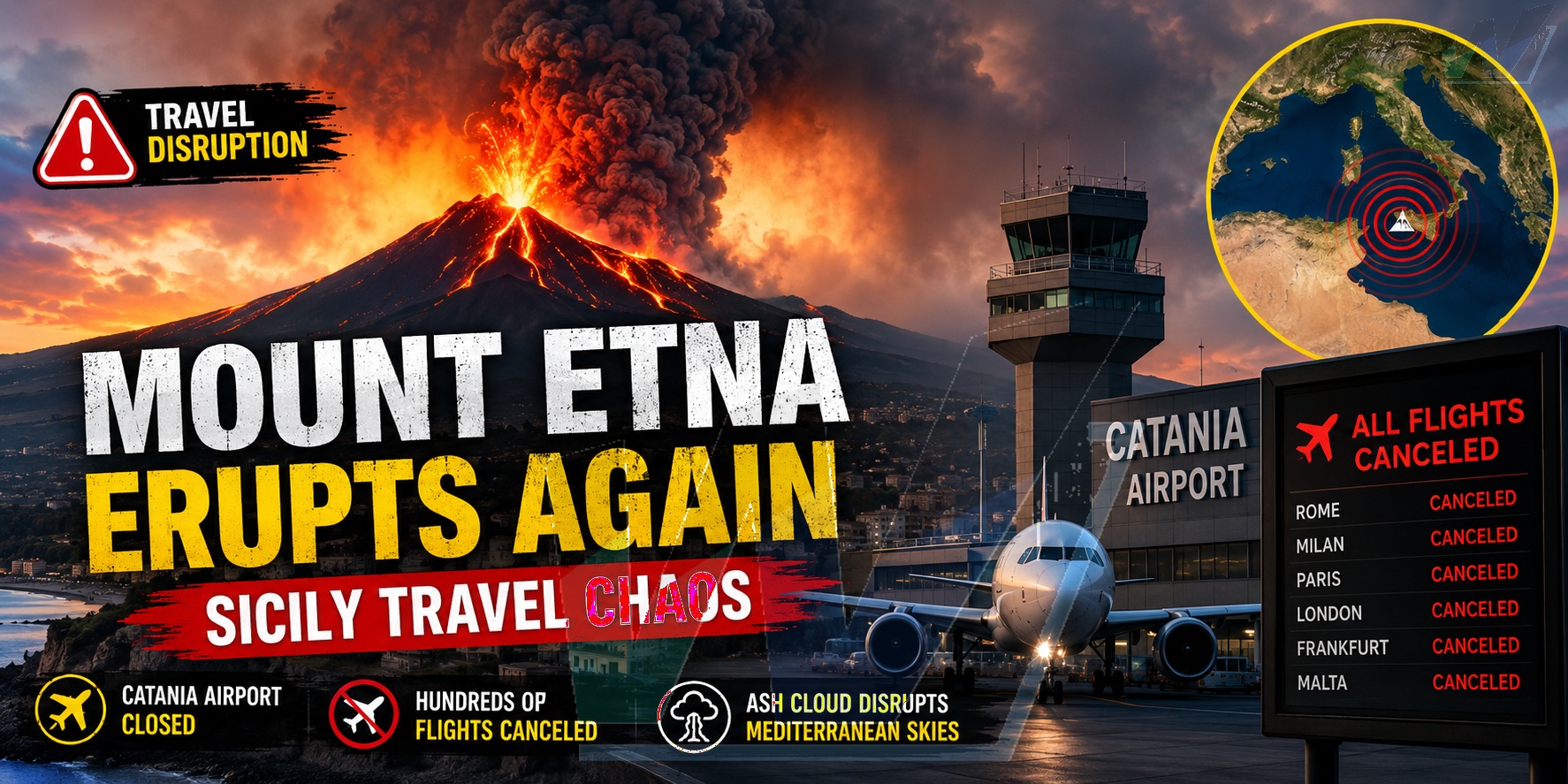
MOUNT ETNA ERUPTS AGAIN, Sicily’s Airport Chaos Deepens as Ash Grounds Hundreds of Flights
CATANIA, Sicily — August 15, 2026: The mountain that has shaped Sicily for millennia is once again dictating the island’s present.
Mount Etna is continuing an unusually prolonged phase of volcanic activity, sending ash into the atmosphere and forcing the shutdown of Catania Airport at precisely the moment Sicily is entering one of the busiest travel periods of the year.
The consequences have spread far beyond the volcano’s slopes.
Flights have been cancelled. Others have been diverted. Thousands of passengers have been forced to change plans, cross the island by road or rail, or wait for an uncertain reopening.
And this time, the disruption is proving unusually persistent.
According to the latest reporting from Reuters, Catania Airport’s suspension has been extended until 3 p.m. local time on Saturday, August 15, as authorities continue to assess the danger posed by volcanic ash.
The Associated Press reports that the airport closure has reached its fifth consecutive day during Italy’s peak Ferragosto holiday period.
For Sicily, this is no longer simply a spectacular volcanic event.
It has become a full-scale summer travel crisis.
A Volcano Turns into an Aviation Crisis
Mount Etna is one of Europe’s most active volcanoes and a familiar presence above eastern Sicily. Periodic eruptions are part of life around Catania.
But the current episode has lasted long enough, and produced enough ash, to create an exceptional challenge for aviation.
The latest eruptive phase began on August 6, with explosive activity and sustained ash emissions. Earlier monitoring had already documented renewed Strombolian activity; lava flows and elevated volcanic tremors during the summer.
The danger to aircraft comes not simply from lava.
It is the ash.
Volcanic ash contains extremely abrasive particles that can enter aircraft engines, damage components and interfere with flight systems. Even when the volcano itself is many kilometers from an airport, an ash plume drifting into an aircraft’s flight path can make normal operations unsafe.
That is why Catania’s aviation authorities have repeatedly imposed restrictions as Etna’s activity and winds changed.
The result has been a frustrating cycle:
Etna erupts → ash rises → airspace is restricted → flights are cancelled or diverted → ash disperses → operations partially resume → the volcano produces more ash.
And then the cycle starts again.
Hundreds of Flights Cancelled as Catania Becomes the Epicenter
The scale of the disruption is becoming clearer.
Reuters reported that between August 6 and August 12, more than one-third of nearly 2,000 scheduled flights at Catania were cancelled, while approximately 630 flights were rerouted.
The AP similarly reported that around 36% of scheduled flights during that period were cancelled and more than 600 rerouted.
That is a huge shock for an airport that serves as one of Sicily’s principal gateways.
Catania is Italy’s fifth-busiest airport, making its disruption particularly consequential during the August holiday rush.
The airport’s closure has pushed airlines and passengers toward alternative gateways, including Palermo and Comiso, while road and rail connections have come under additional pressure.
Sicilian authorities have responded by expanding alternative transport arrangements.
The Sicilian regional government has previously deployed transfers from Comiso and Trapani-Birgi, road connections from Palermo toward Catania and special rail services on the Palermo–Messina–Catania route during Etna-related disruptions.
But moving thousands of people around an island during the height of summer is a logistical battle of its own.
Malta Was Hit Too
Etna’s ash did not stop at Sicily’s shoreline.
On August 11, an ash cloud travelled roughly 220 kilometers south toward Malta, disrupting aviation there as well.
According to Reuters, 19 flights were cancelled at Malta International Airport, with additional flights delayed as authorities monitored the ash cloud.
That development demonstrated the wider regional reach of Etna’s eruption.
The volcano may stand over Sicily, but its ash plume can become an aviation problem across the central Mediterranean.
The AP reported that northerly winds had carried ash as far as Malta and parts of North Africa.
In other words, the disruption is no longer confined to the immediate shadow of the volcano.
The Ferragosto Factor: The Worst Possible Timing
The timing could hardly be worse.
Italy is entering Ferragosto, the traditional August holiday period when millions of Italians travel, cities empty and coastal destinations fill with tourists.
Sicily is one of the Mediterranean’s most popular summer destinations, drawing visitors to Catania, Taormina, Syracuse, the Aeolian Islands and the island’s beaches and historic towns.
Instead of a routine holiday surge, eastern Sicily is facing a transportation bottleneck.
Passengers arriving at alternative airports still must reach their final destinations. Rental cars are in high demand. Taxis are under pressure. Hotel rooms can be difficult to secure.
The AP reported complaints over higher prices for taxis and rental cars amid the disruption, while Italian rail operator Trenitalia has added services to help absorb some of the displaced demand.
The problem is therefore moving through the entire tourism ecosystem.
A cancelled flight becomes a bus journey.
A bus journey becomes a hotel night.
A hotel night becomes a missed ferry.
And a missed ferry can destroy an entire itinerary.
That is how a volcanic eruption becomes a tourism crisis.
Passengers Left Waiting as Alternatives Fill Up
For travelers caught in the disruption, the experience has been chaotic.
Some passengers have faced lengthy waits and crowded airport terminals, while others have been redirected to airports far from their original destination. Reuters reported that thousands have been affected, with some enduring difficult conditions while waiting for information and replacement arrangements.
Travelers have been advised to check their flight status before heading toward the airport.
That warning matters because the situation can change rapidly.
A flight listed as operating can be affected by a new ash plume hours later.
A temporary reopening can be followed by another restriction.
And a diversion to Palermo or Comiso does not necessarily mean the journey is over.
The passenger may still be dozens or even hundreds of kilometers from the destination originally booked.
Why Etna’s Current Activity Is Drawing Scientific Attention
Etna eruptions are not unusual.
What has attracted attention this time is the duration and sustained ash production.
Reuters reported that volcanological experts consider the current episode unusually intense, with deeper, gas-rich magma contributing to heightened ash production.
A Reuters video report also quoted Salvo Gambino, director of the INGV Etnean Observatory, saying that similarly prolonged activity had not been seen since the late 1970s.
The Italian National Institute of Geophysics and Volcanology — INGV — has continued monitoring Etna’s seismic, volcanic and aviation-related conditions. Its Catania observatory maintains a dedicated stream of volcanic communications and monitoring bulletins.
That distinction is important.
An eruption can be spectacular without necessarily presenting the same level of direct danger to populated areas.
But volcanic ash creates a separate hazard, one capable of shutting down a major airport even when lava remains far from urban areas.
The Hidden Weakness: Catania’s Location
The eruption has also revived an uncomfortable question:
How resilient is Catania’s aviation infrastructure when Europe’s most active volcano sits next door?
Catania Airport is strategically essential to eastern Sicily. But its proximity to Etna means volcanic ash has repeatedly interfered with operations.
The latest crisis has reignited debate over whether Sicily needs greater long-term investment in alternative aviation capacity and contingency planning.
Reuters reported that the disruption has generated renewed criticism and calls for longer-term infrastructure planning.
The issue goes beyond building another runway.
It is about creating a system capable of absorbing a sudden loss of a major gateway during the busiest weeks of the year.
That means:
- stronger links between Sicily’s airports;
- larger emergency transport capacity;
- better coordination between airlines, airports and local authorities;
- rapid passenger-transfer systems;
- resilient rail and bus connections;
- and clear communication when volcanic conditions change.
Because Etna is not going anywhere.
Sicily Has Faced This Before, But This Time Is Different
Etna has repeatedly disrupted Catania Airport over the years.
Indeed, ash-related shutdowns are an accepted risk of operating in the shadow of an active volcano.
But the current episode is notable because the disruption has persisted over several consecutive days during one of the most intense travel periods of the European summer.
The AP described the current closure as the longest such event since 2002, highlighting the unusual persistence of the ash-producing activity.
That historical comparison helps explain why the current crisis has become such a major story across European travel markets.
It is not simply another brief airport closure.
It is a sustained stress test of Sicily’s transportation system.
What Travelers Need to Know Now
For anyone travelling to Sicily on or around August 15, the most important point is simple:
Do not assume that a scheduled flight means the flight will operate.
The situation around Catania remains dependent on volcanic ash conditions and aviation restrictions.
Passengers should:
-
Check directly with the airline before travelling to the airport.
-
Check Catania Airport’s latest operational information.
-
Expect possible diversion to Palermo, Comiso or another airport.
-
Allow substantial extra time for ground transportation.
-
Keep receipts for essential expenses caused by disruption.
-
Check rail and bus availability before committing to an alternative airport.
-
Do not approach restricted volcanic areas simply to watch the eruption.
Sicily’s regional authorities have already demonstrated that alternative transport can be activated when Catania is restricted, including road transfers and special rail services.
For travelers, flexibility may be the most valuable reservation of all.
Is Sicily Safe to Visit?
The existence of an eruption does not automatically mean that the entire island is unsafe.
Etna is a monitored volcano, and authorities can impose restrictions according to changing conditions.
The principal immediate problem for many tourists right now is transport disruption, particularly aviation.
However, volcanic conditions can evolve rapidly.
Travelers should follow official instructions, avoid restricted zones and pay attention to local civil-protection and aviation information rather than relying solely on social media images.
The spectacular photographs circulating online can create the impression that the volcano is simply putting on a show.
But behind the glowing lava fountains is a complex natural system capable of changing the conditions of the surrounding atmosphere and transportation network within hours.
A Spectacular Volcano, an Unpredictable Summer
Etna has always been part of Sicily’s identity.
It dominates the landscape. It shapes the soil, agriculture and vineyards. It attracts scientists, photographers and tourists. Its eruptions have become part of the island’s mythology.
But this August, the volcano is reminding Europe of something more fundamental:
Nature does not care about the holiday calendar.
Ferragosto can be the busiest week of the Italian summer.
Airlines can have thousands of passengers booked.
Hotels can be full.
Cruise ships can be scheduled.
Ferries can be packed.
And still, a column of volcanic ash rising above Sicily can bring the system to a standstill.
As of August 15, 2026, the critical question is no longer whether Etna is erupting.
It is how long the eruption will continue producing aviation-threatening ash, and how quickly Sicily can restore a transportation system now operating under extraordinary pressure.
For travelers staring at cancelled-flight notifications, the drama is no longer on the mountain alone.
It is in airports, railway stations, highways and ferry terminals across Sicily.
And above all, Etna is still glowing.
Latest Situation briefly, August 15, 2026
🌋 Volcano: Mount Etna, Sicily
🔥 Current phase: Prolonged explosive/effusive activity with significant ash emissions
✈️ Main disruption: Catania Airport
⏱️ Latest reported closure: Flight operations suspended through 3 p.m. August 15, subject to conditions and official decisions
🚫 Flights affected: More than one-third of nearly 2,000 scheduled flights from August 6–12 cancelled; about 630 rerouted
🇲🇹 Regional impact: 19 Malta flights cancelled on August 11 after ash drifted south
🚆 Alternatives: Additional rail and road connections have been deployed to help passengers diverted to other Sicilian airports
📅 Peak travel pressure: Ferragosto holiday period
⚠️ Key risk: Volcanic ash contamination of aviation airspace