
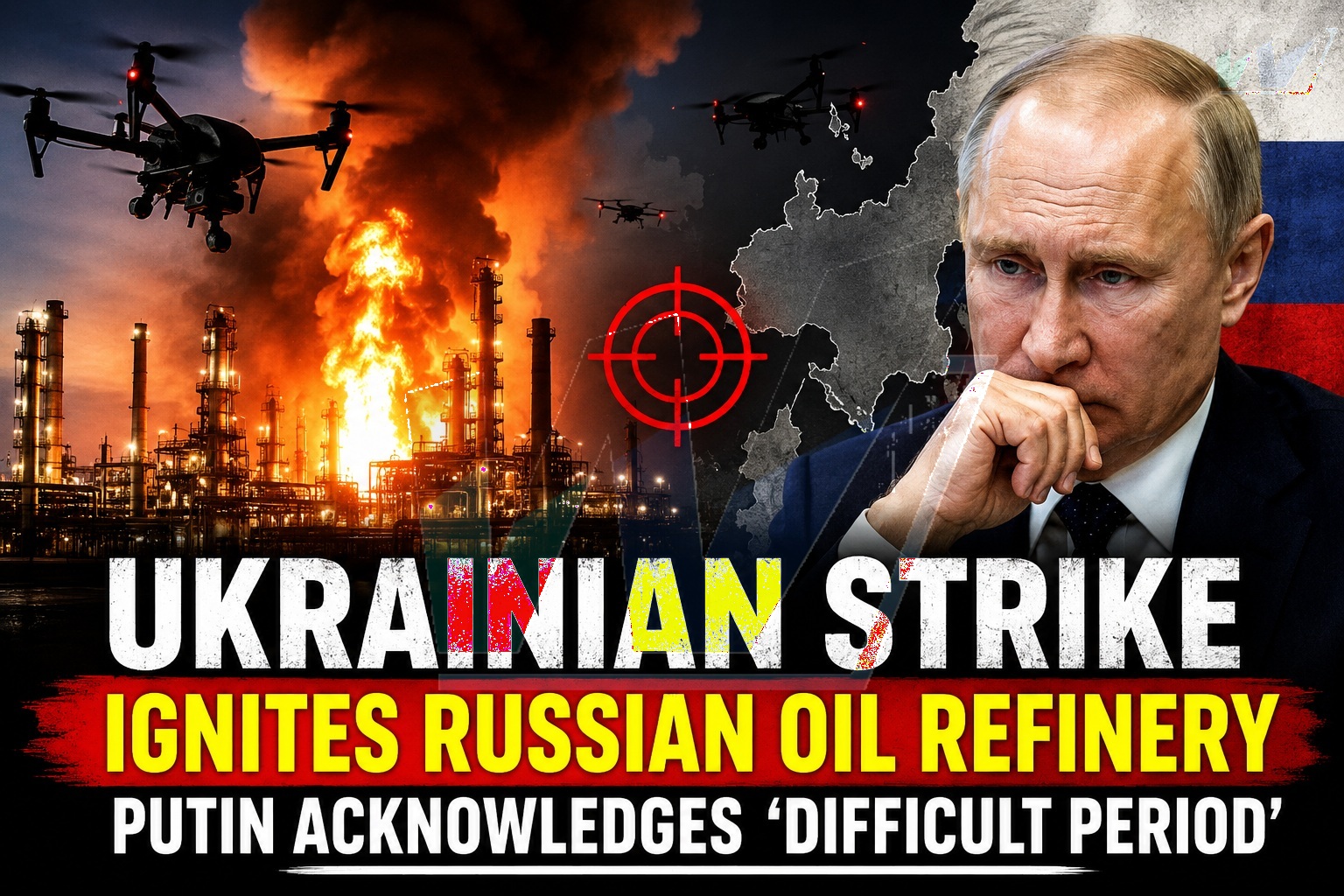
Ukrainian Drone Blitz Ignites Russian Refinery as Putin Admits Russia Faces a “Difficult Period”
MOSCOW / KYIV / KRASNODAR –
The flames rose before dawn.
First came the sirens. Then the explosions. Then fire, towering columns of orange and black cutting through the darkness over southern Russia, visible for kilometers.
Another night. Another strike. Another signal that Ukraine’s war is no longer confined to the front lines.
In one of Kyiv’s most aggressive long-range operations in recent months, Ukrainian drones struck deep inside Russian territory, igniting a major oil refinery and intensifying pressure on the Kremlin’s economic lifelines. The attack landed with devastating symbolism: as infrastructure burned, Russian President Vladimir Putin publicly acknowledged that Russia is enduring what he called a “difficult period.”
That phrase may prove more revealing than intended.
Because behind the Kremlin’s carefully controlled messaging, cracks are widening.
And they are beginning to burn.
The latest strike targeted the refinery in Slavyansk-na-Kubani, a critical industrial hub in Russia’s southern Krasnodar Krai region, strategically positioned east of occupied Crimea. The facility processes nearly four million tons of crude annually and serves as a key supplier of petroleum products exported through Russia’s Black Sea ports.
Fuel oil. Marine fuel. Naphtha.
Products that keep both military logistics and economic revenue flowing.
When drone debris rained onto the site, it triggered a massive blaze. Local authorities reported at least one death and multiple injuries. Emergency crews battled the inferno while residents watched the refinery burn under the night sky.
Kyiv wasted no time claiming responsibility.
Ukrainian President Volodymyr Zelenskyy described the strikes as “long-range sanctions”, a phrase that reflects Ukraine’s evolving doctrine.
Not merely retaliation.
Economic warfare.
“Our long-range sanctions reached two oil refineries in Russia,” Zelensky declared. “Each strike reduces the resources fueling the Russian war machine.”
The second reported target lies even deeper inside Russia, inside the Yaroslavl Oblast region, roughly 700 kilometers from the Ukrainian border.
That distance matters.
It means Ukraine’s reach is expanding.
And so is Russia’s vulnerability.
For months, military analysts have warned that Ukraine’s drone campaign is becoming increasingly sophisticated. No longer focused solely on ammunition depots or command posts, Kyiv is striking what Moscow needs most to sustain prolonged war: fuel, refining capacity, transport corridors, and domestic confidence.
The strategic logic is brutal.
If Russia cannot easily move fuel, it cannot easily move war.
The effects are beginning to spread.
In occupied Crimea, Kremlin-installed authorities recently suspended gasoline sales to civilians after repeated attacks disrupted supply routes, triggering the peninsula’s worst energy crisis since Moscow annexed it in the aftermath of the Annexation of Crimea by the Russian Federation.
Now shortages are surfacing even farther away.
Thousands of kilometers from Ukraine, in Siberia’s Irkutsk region, fuel rationing has begun. Drivers at state-run stations are now limited to 50 liters per day. Private networks have imposed tighter restrictions.
That development sends a chilling message.
The war’s economic shockwaves are no longer regional.
They are national.
Against this backdrop, Putin addressed members of United Russia, projecting resilience while carefully acknowledging strain.
“We are going through a difficult period,” he said.
The statement was measured, but unusually candid.
He promised roads, housing, jobs, and economic support. Yet beneath the promises lies an increasingly difficult balancing act: financing a costly war while preserving domestic stability.
That challenge grows by the day.
Russia’s Deputy Prime Minister Alexander Novak confirmed Moscow is reviewing export agreements to ensure domestic fuel needs remain protected.
Translation: Russia is under pressure.
Severe pressure.
But the battlefield remains merciless on both sides.
While Ukrainian drones penetrated Russian airspace, Russia unleashed a wave of missiles and long-range drones across Ukraine. Overnight bombardments struck multiple regions.
In southern Zaporizhzhia, a Russian aerial bomb killed civilians, including children among the wounded.
In Russia’s border Belgorod Oblast, Ukrainian drone strikes also killed and injured civilians.
The numbers reveal the scale of escalation.
Russia says it intercepted 213 Ukrainian drones in a single night over Russian territory, occupied Crimea, and the Black and Azov seas.
Ukraine reports Russia launched 142 strike drones and eight missiles in return.
The skies over Eastern Europe are no longer merely contested.
They are saturated.
And increasingly automated.
Drone warfare has changed everything.
Cheap enough to deploy in swarms.
Precisely enough to cripple strategic infrastructure.
Psychological enough to spread fear far beyond battle zones.
This is no longer just artillery versus armor.
It is algorithm versus industry.
Machine versus machine.
Endurance versus collapse.
As the war enters its fifth year, both Kyiv and Moscow are confronting an uncomfortable truth:
Victory may not be determined solely by territory.
It may be decided by energy.
By supply chains.
By whom runs out first.
Tonight, refinery workers in southern Russia are still sifting through ash.
Somewhere above the Black Sea, air defenses remain on high alert.
And inside the Kremlin, one reality is becoming harder to deny.
Ukraine’s drones are no longer just weapons.
They are warnings.
Each strike delivers the same message, louder than the last.
Russia may still hold territory.
But increasingly, the war is reaching home.