
Comoros Moves Toward Stronger Maritime Governance as Vanuatu Expert Deepens Strategic Mission
MORONI / COMOROS –
The battle for the sea is no longer fought only on water.
It is fought in control rooms, surveillance centers, ports, and policy chambers—where nations decide whether their maritime wealth will be protected or exploited.
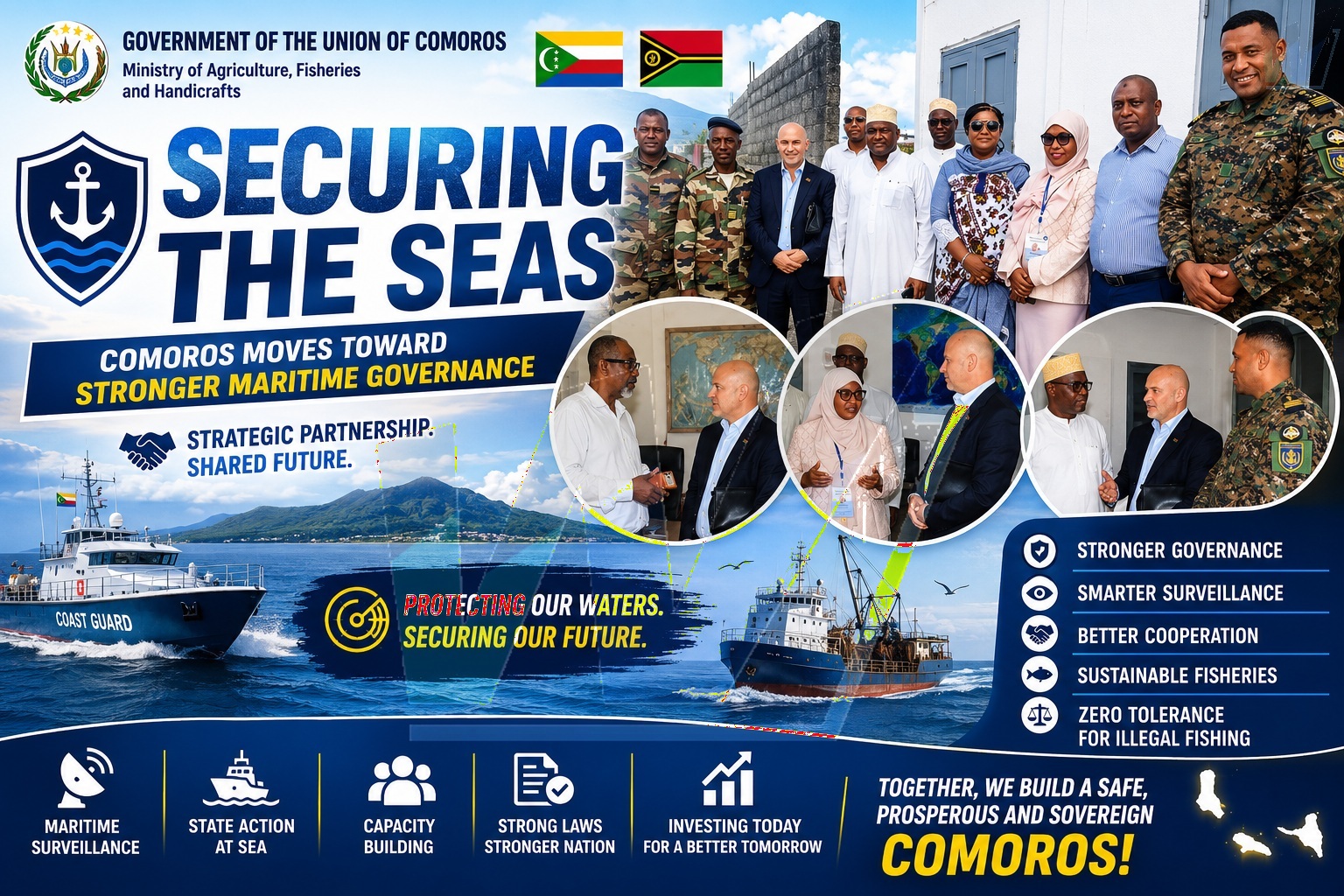
This Thursday afternoon, his Excellency Saade Makhlouf, Special Envoy of Vanuatu, Commissioner for Deep-Sea Fisheries, Maritime Administrator, and internationally recognized fisheries expert, continued his high-level mission in Comoros with a series of strategic working visits to national institutions responsible for maritime affairs and state action at sea.
The mission marks another decisive step in the growing partnership between the two island nations, one centered on maritime reform, security, and sustainable fisheries development.
Present during the meetings were the Minister of Maritime and Air Transport, the Secretary General of the Ministry of Agriculture, Fisheries and Handicrafts Tadjidine Ben Ahmed, representing Agriculture Minister Daniel Bandar, along with technical experts from both ministries.
A Race Against Illegal Activity
The stakes are high.
These discussions come as Comoros intensifies efforts to modernize its maritime registry, strengthen governance, and secure control over one of its most valuable strategic assets, its vast exclusive economic zone.
During his visits, his Excellency Saade Makhlouf engaged directly with institutional leaders and technical teams to gain a clearer understanding of their operations, achievements, urgent needs, and the daily challenges they face.
The conversations quickly moved beyond theory.
Operational limitations, equipment shortages, workforce development, interagency coordination, and maritime surveillance all emerged as critical priorities.
At the heart of the discussions was one pressing concern: monitoring vessels operating inside Comoros’ waters.
In an era of rising illegal maritime activity, surveillance has become a frontline defense.
Fighting Illegal Fishing
Attention was given to the role of the National Center for State Action at Sea, a key institution responsible for information-sharing between national and regional authorities.
Its mission is vital.
The center plays a central role in combating illegal, unreported, and unregulated fishing (IUU fishing), one of the greatest threats to marine sustainability and economic sovereignty.
Working alongside customs authorities and coast guard services, the center serves as a strategic coordination hub for maritime enforcement.
Its effectiveness could determine whether Comoros successfully protects its marine resources or loses them to illicit exploitation.
Discipline, Reform, and Political Will.
His Excellency Saade Makhlouf praised the progress already made by Comorian authorities in modernizing maritime administration and improving security at sea.
But he delivered a clear message.
Maritime reform, he said, is not achieved through ambition alone.
It requires discipline.
Investment.
Legal strength.
And unwavering political commitment.
He emphasized that sustainable reform demands strong institutional frameworks and long-term vision, both of which are essential if Comoros hopes to compete on the international maritime stage.
His Excellency Saade Makhlouf also reaffirmed his willingness to share Vanuatu’s practical experience and continue supporting Comoros in implementing reforms aligned with global standards.
A Strategic Turning Point.
This series of visits reflects more than technical cooperation.
It signals a national shift.
Comoros is moving to modernize its maritime framework, strengthen security at sea, crack down on illicit activities, and unlock the full potential of its fisheries sector.
For the island nation, the sea is more than geography.
It is opportunity.
It is security.
It is sovereignty.
As illegal operators grow more sophisticated and competition for marine resources intensifies, Comoros appears determined to respond with stronger institutions, sharper coordination, and firmer control over its waters.
The message from Moroni is becoming clear:
The nation is no longer merely watching the sea.
It is preparing to govern it.