

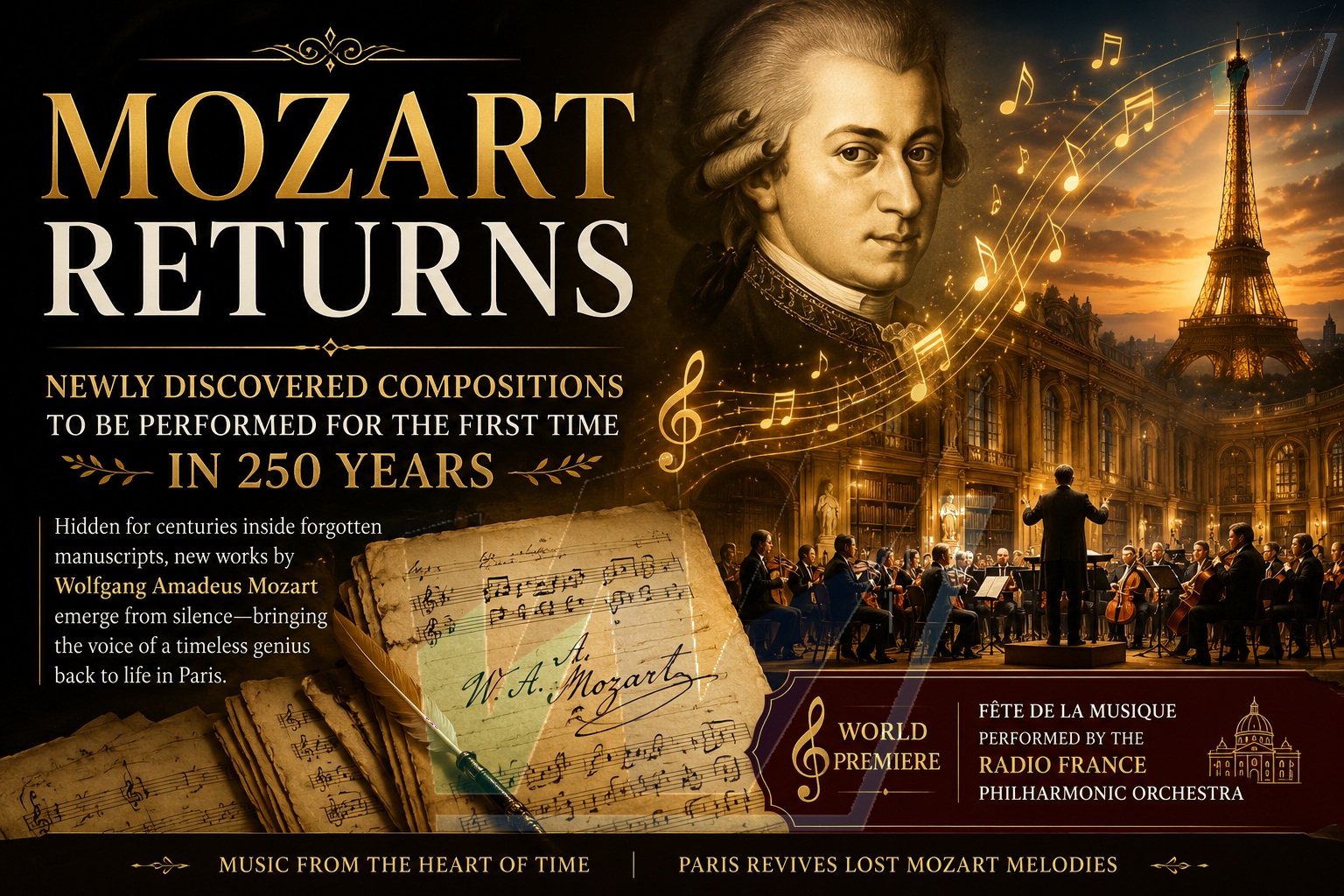
Paris Revives Newly Discovered Mozart Melodies After Two and a Half Centuries of Silence
In an extraordinary event shaking the world of classical music and breathing new life into a genius untouched by time, Paris is preparing to host a rare historic moment: newly discovered compositions by the legendary Wolfgang Amadeus Mozart will be performed before a live audience for the very first time, after remaining hidden within forgotten manuscripts for more than 250 years.
It is a discovery that feels nothing short of a musical miracle—proof, once again, that great art never truly dies. Sometimes, it simply waits for someone to awaken it from its long slumber.
The story began within the quiet halls of the Bibliothèque Nationale de France, where librarian François-Pierre Goy was indulging in one of his favorite pursuits: examining old, unidentified musical manuscripts in search of forgotten treasures. Among twenty untitled notebooks, he selected one that appeared ordinary at first glance, unaware that this simple choice would lead to one of the most remarkable musical discoveries of modern times.
As he turned the pages, time seemed to stop.
There, before his eyes, appeared handwriting instantly recognizable to experts: Mozart’s own.
This was far more than a suspicion or a hopeful guess. International specialists confirmed the authenticity of the manuscripts, including experts from the Mozart Library in Salzburg, the Austrian maestro’s birthplace. What had once been an overlooked notebook was suddenly transformed into a rare artistic treasure, reopening an unknown chapter in the life of one of history’s greatest composers.
The manuscript consists of forty-four pages and contains approximately twelve composition lessons and musical exercises that Mozart gave between May and July of 1778 to his student Marie-Louise-Philippine de Guînes, a gifted harpist from a French aristocratic family celebrated for its deep love of music.
But the greatest surprise did not end with the instructional pages.
The notebook also contains seven compositions for flute and harp, the final piece left unfinished—as if Mozart himself had paused in the middle of inspiration, leaving behind the trace of a moment whose conclusion was never written. These works are more than newly found sheets of music; they are voices from the eighteenth century reaching us today with astonishing purity and warmth.
Even more beautiful is the fact that these treasures will not remain locked away in archives.
As part of the celebration of Fête de la Musique, musicians from the Philharmonic Orchestra of Radio France will give the world premiere performance of these newly discovered works in a grand concert inside France’s National Library, where the original manuscripts and live music will meet in a breathtaking fusion of history and beauty.
This moment transcends music itself.
It is a triumph of human perseverance and a reminder that great discoveries do not always rely on chance. More often, they are born from passion, patience, and the rare ability to see what others overlook.
That a new work by Mozart could emerge in 2026 feels almost like a message from history to the present: genius cannot be exhausted, and true beauty never fades.
More than two centuries after Mozart’s death, his melodies continue to find new paths into the world, as though his artistic spirit refuses silence.
In an age dominated by rapid headlines and endless digital noise, this discovery reminds us of something deeper: some voices are heard not only with the ears, but with the heart.
And when the first notes of these newly discovered compositions rise into the air, it will not be only the audience in Paris that listens.
The whole world will listen.
Because Mozart—even after 250 years—still possesses the power to astonish.