
Zelensky Sends Back Poland’s Highest Honor as Wartime Allies Clash Over History
KYIV / WARSAW — In war, enemies are expected.
What shakes nations is when fractures appear among allies.
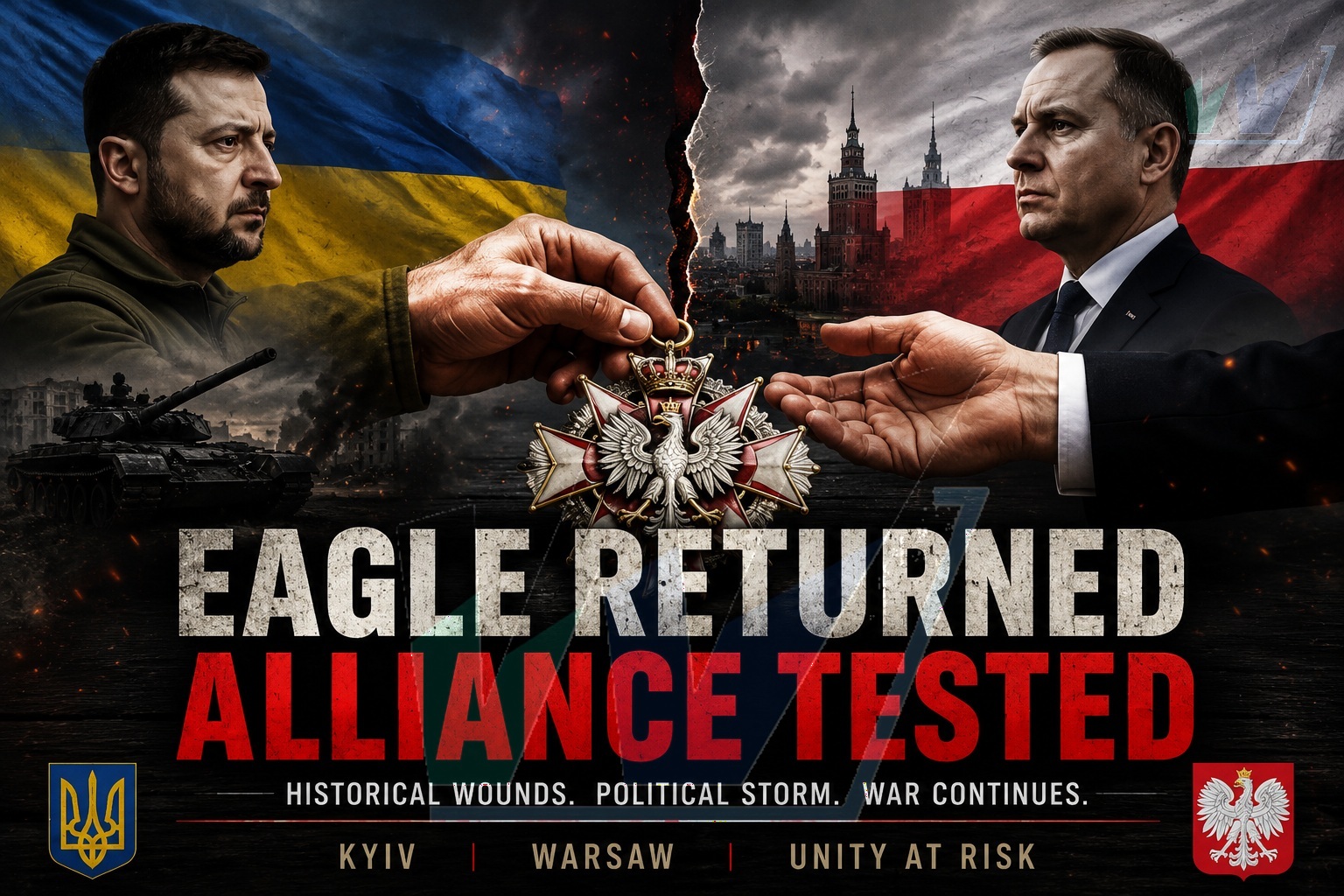
This weekend, a diplomatic shockwave rippled across Europe as Ukrainian President Volodymyr Zelenskyy made a dramatic and highly symbolic move: he returned Poland’s Order of the White Eagle, the country’s highest state decoration, back to Warsaw.
The message was neither emotional nor explosive on its surface.
It was colder than anger.
Sharper than outrage.
And that made it devastating.
“We believed that the Order of the White Eagle was addressed to the Ukrainian people and our army in 2023,” Zelensky wrote in a statement published on his Telegram channel.
“Today I sent the Order to the President of Poland.”
With those words, one of Europe’s strongest wartime partnerships entered its most dangerous political crisis since Russia’s full-scale invasion of Ukraine in 2022.
The White Eagle had once symbolized unity.
Now, it has become a symbol of rupture.
In 2023, then-Polish President Andrzej Duda awarded Zelensky the order for strengthening Polish-Ukrainian relations and for defending democracy, security, and human rights during Russia’s invasion. At the time, Warsaw stood as one of Kyiv’s fiercest supporters—opening borders, delivering military aid, and becoming Ukraine’s strategic lifeline into Europe.
But history—particularly the blood-soaked memory of Volhynia—never truly disappeared.
The current crisis erupted after Ukraine granted honorary recognition to a military unit linked symbolically to the Ukrainian Insurgent Army (UPA), a World War II-era nationalist movement. In Ukraine, many view the UPA as anti-Soviet resistance fighters. In Poland, the memory is radically different: the UPA is associated with the massacres of tens of thousands of Polish civilians during the 1940s. The issue remains one of the deepest historical wounds between the two nations.
Polish President Karol Nawrocki responded by stripping Zelensky of the Order of the White Eagle.
That decision detonated political outrage in Kyiv.
Yet Zelensky’s reply was not a rant.
It was a calculated strike.
In the most quoted —and most viral— part of his statement, Zelensky delivered a stinging line that spread across X, Telegram, and Reddit within hours:
“If this symbol can remain with Catherine the Great, Benito Mussolini and Gerhard Schröder, then we in Ukraine will not argue with this.”
The sentence landed like a missile.
Across social media, users highlighted the uncomfortable historical irony: controversial figures including Benito Mussolini and Gerhard Schröder retained the distinction, while a wartime leader defending Europe from Russian aggression was stripped of it. Many online reactions called Zelensky’s response “brutal,” “surgical,” and “politically lethal.”
The backlash inside Ukraine escalated quickly.
Senior officials began returning their own Polish state honors in solidarity.
Former Ukrainian presidents including Petro Poroshenko, Viktor Yushchenko, and Leonid Kuchma joined the protest, signaling that the dispute had moved far beyond a personal insult to Zelensky. It had become a national issue.
Meanwhile, Polish Prime Minister Donald Tusk attempted to stop the crisis from spiraling.
Tusk publicly warned that the confrontation was a “strategic mistake.”
His concern was clear.
Every hour this dispute dominates headlines, someone else benefits.
Moscow.
Analysts across Reuters, Bloomberg, Axios, and European policy circles increasingly warn that the symbolic rupture between Kyiv and Warsaw plays directly into Russian geopolitical objectives: divide Ukraine from its closest regional backers, fracture NATO cohesion, and weaponize historical trauma for modern conflict.
And that may be the most dangerous dimension of this story.
Because this is not merely about a medal.
It is about memory.
Identity.
Narrative.
Who gets remembered as liberator—and who gets remembered as executioner.
For years, Poland and Ukraine managed to balance painful historical disagreements under the pressure of a larger existential threat: Vladimir Putin and Russia’s war.
Now, that balance is trembling.
Still, Zelensky’s statement left one door open.
He thanked the Polish people repeatedly.
He distinguished Poland’s citizens from its political decision-makers.
And he ended not with retaliation—but with defiance.
“Ukraine never forgets solidarity,” he wrote.
“Ukrainians are doing everything in our power to prevent Europe from losing in this century.”
That final line may prove the real message.
The eagle has been returned.
But the alliance is not dead, at least not yet.
The question now haunting Europe is whether Warsaw and Kyiv can contain the storm before old ghosts become modern weapons.
Because on the front lines of Eastern Europe, history is no longer sitting in museums.
It is fighting in real time.
And tonight, as missiles still fall over Ukraine, one truth is impossible to ignore:
Russia did not create the wounds of the past.
But it knows exactly how to exploit them.
By the numbers: Since 2022, Poland has hosted millions of Ukrainian refugees and served as one of Ukraine’s most critical military and humanitarian corridors—making this diplomatic rupture one of the most consequential alliance tensions of the war so far.