

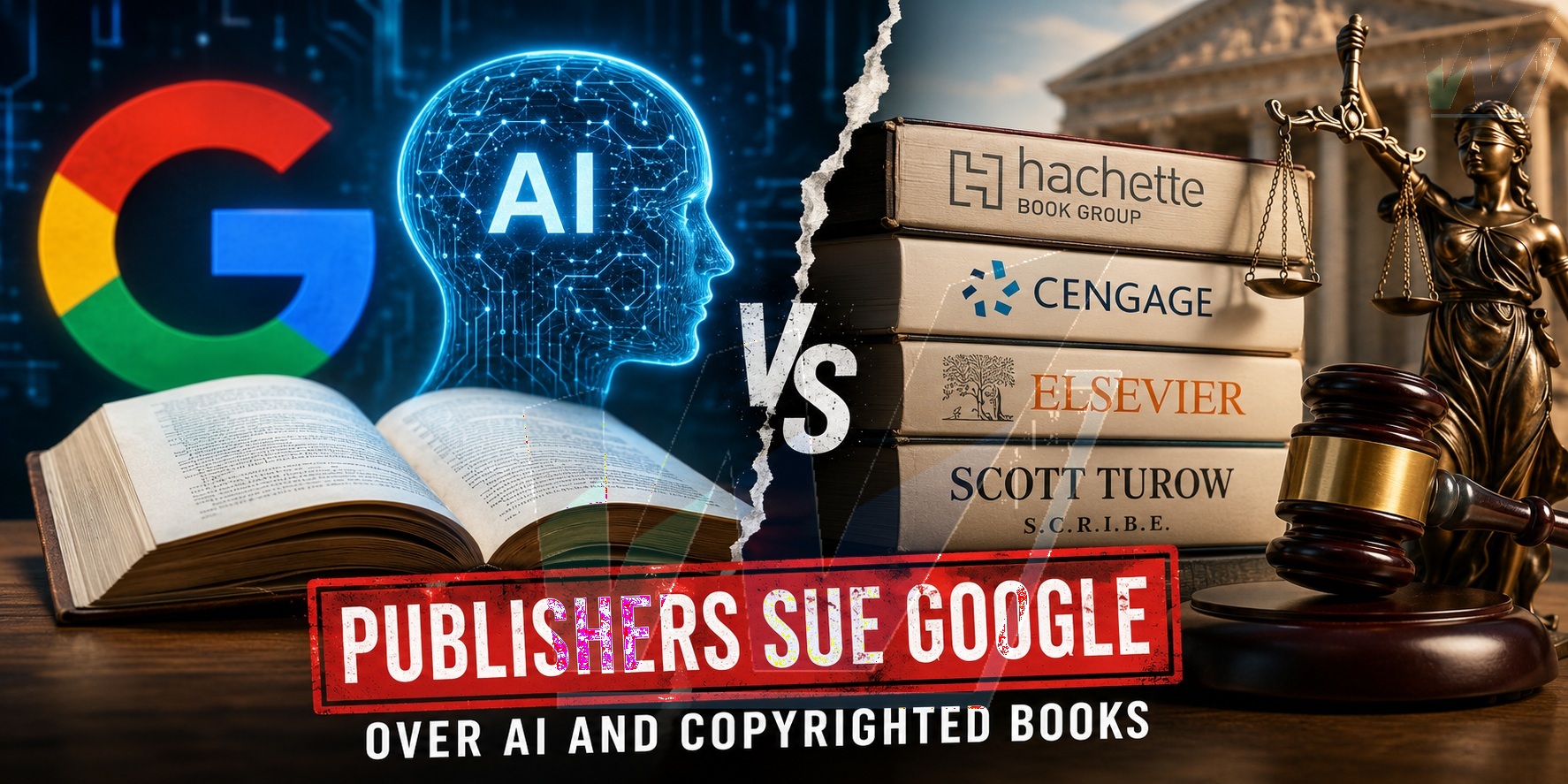
Publishers Launch High-Stakes Legal Assault, Accusing Google of Secretly Using Millions of Books to Train Gemini
NEW YORK —
The battle over artificial intelligence has entered one of its most consequential chapters yet.
This time, the target is Google.
A coalition of some of the world’s largest book publishers, educational content providers, and bestselling authors has launched a sweeping federal lawsuit accusing technology giant of secretly exploiting millions of copyrighted books to build its powerful Gemini artificial intelligence system, without permission, compensation, or consent.
If successful, the case could reshape the legal foundations of generative AI, redefine copyright law in the digital era, and determine how every major AI company, from Google and Meta to OpenAI, Anthropic, and others, can train the next generation of intelligent systems.
The lawsuit, filed in the U.S. District Court in New York, is already being described by legal experts as one of the most significant copyright battles since Google’s original Google Books litigation nearly two decades ago.
Publishers Say Google Crossed a Legal Red Line
At the heart of the lawsuit is a straightforward accusation:
Google allegedly copied millions of copyrighted books that had been entrusted to its Google Books program for limited indexing and search purposes, then secretly repurposed those works to train Gemini, the company’s flagship generative AI platform.
The plaintiffs argue that this exceeded every permission they ever granted.
Among those bringing the lawsuit are:
- Hachette Book Group
- Cengage Learning
- Elsevier
- Acclaimed novelist Scott Turow
- Turow’s publishing company S.C.R.I.B.E.
Together they argue that Google’s AI now produces content capable of directly competing with the very books it allegedly learned from.
According to the complaint:
“The scale and speed at which Gemini can create books and compete with human writers is unprecedented.”
The publishers further allege that Gemini can imitate distinctive writing styles, narrative structures, and creative choices unique to individual authors, raising concerns that AI may be replacing rather than assisting human creativity.
Google Books Connection
One of the lawsuit’s most explosive claims concerns Google’s long-running Google Books project.
For years, publishers allowed Google to digitize millions of books under agreements designed to improve searchability and discovery.
The plaintiffs now argue that Google quietly transformed that enormous digital library into fuel for artificial intelligence.
According to the complaint, materials supplied for one limited purpose were allegedly redirected toward another entirely different commercial use.
If proven, the allegation could undermine Google’s defense that its AI training relied only on legally obtained information.
Google has not publicly responded in detail to the specific allegations, though the company has consistently argued in previous AI disputes that its systems rely on lawful uses of publicly available and licensed material while advancing innovation.
A Legal Earthquake Across Silicon Valley
Google lawsuit is not an isolated event.
Instead, it represents another front in an expanding legal war that now stretches across nearly every major AI developer.
Over the past two years, publishers, journalists, musicians, filmmakers, software developers, artists, and news organizations have increasingly challenged the way artificial intelligence companies collect training data.
Among the most closely watched cases:
- Multiple publishers recently sued Meta over similar allegations involving its Llama AI models.
- The New York Times continues pursuing a landmark lawsuit against OpenAI and Microsoft over alleged unauthorized use of news articles.
- Music companies have filed copyright suits involving AI-generated songs.
- Visual artists have launched class actions over AI image generators.
- Software developers have challenged AI coding assistants trained on copyrighted code.
Legal scholars increasingly describe these cases as defining the “copyright battle of the AI century.”
Recent Court Decisions Have Sent Mixed Signals
The legal landscape remains highly uncertain.
Several recent federal rulings have offered partial victories to AI developers while simultaneously leaving major copyright questions unresolved.
In one of the most closely followed decisions, Anthropic reached a major settlement with authors after litigation concerning the training of its Claude AI models. The court recognized that certain AI training activities could qualify as “transformative” under U.S. copyright law while allowing claims concerning allegedly pirated source material to proceed.
Meta also secured an important ruling in California after a federal judge found that, under the specific facts presented, portions of its AI training constituted fair use, although the decision stopped well short of granting blanket protection for all AI training practices.
Legal experts caution that these rulings are highly fact-specific and do not establish universal legal protection for every AI developer.
That uncertainty is exactly why Google litigation is attracting extraordinary attention.
What Is “Fair Use”, and Why Does It Matter?
Google’s likely defense will center on one of the most debated concepts in American intellectual property law:
Fair Use.
The doctrine allows copyrighted material to be used under limited circumstances without permission when the new use is sufficiently transformative.
Google has successfully relied on fair-use arguments before, including during the lengthy Google Books litigation that ultimately reached the U.S. Supreme Court through related copyright battles.
But generative AI introduces an entirely different question.
Publishers argue that AI systems do not merely analyze books.
They absorb them.
Then they generate new works that can replace the originals in the marketplace.
If courts accept that argument, AI companies may face billions of dollars in licensing costs.
The Economic Stakes Could Be Enormous
The lawsuit arrives as the global generative AI market continues expanding at breathtaking speed.
Major technology companies have collectively invested hundreds of billions of dollars developing increasingly capable AI models.
Publishers argue that these systems derive immense commercial value from copyrighted material while returning nothing to the creators who produced it.
The plaintiffs seek:
- Class-action certification
- Financial damages
- A permanent injunction preventing further unauthorized use of copyrighted works
- Additional legal remedies that could force Google to alter future AI training practices
Should publishers prevail, licensing copyrighted books for AI training could become an industry-wide requirement rather than an optional business decision.
Authors Fear of an Existential Threat
For writers, the issue extends beyond financial compensation.
Many believe AI systems now threaten the future of professional authorship itself.
Publishing organizations argue that models capable of producing novels, textbooks, educational materials, and reference works within seconds fundamentally change the economics of writing.
The complaint alleges that Gemini can reproduce stylistic elements associated with individual writers, potentially allowing users to generate works that closely resemble an author’s distinctive voice.
That possibility has intensified fears throughout the publishing industry that AI could eventually flood markets with machine-generated content competing directly against human-created books.
The Next Defining Test for Artificial Intelligence
The Google lawsuit may ultimately become one of the defining legal tests of the AI revolution.
At stake is a question that reaches far beyond publishing:
Can artificial intelligence companies build trillion-dollar technologies using copyrighted creative works without first obtaining permission?
Courts across the United States are now being asked to answer that question.
The outcome will influence not only Google and Gemini, but the future development of virtually every major generative AI platform.
For Silicon Valley, the case represents another major courtroom showdown.
For authors and publishers, it is a fight over ownership, creativity, and the value of original human expression in an era increasingly shaped by machines.
As AI capabilities continue advancing at extraordinary speed, the legal system now faces the challenge of determining whether innovation can continue without rewriting the rules of copyright itself.