

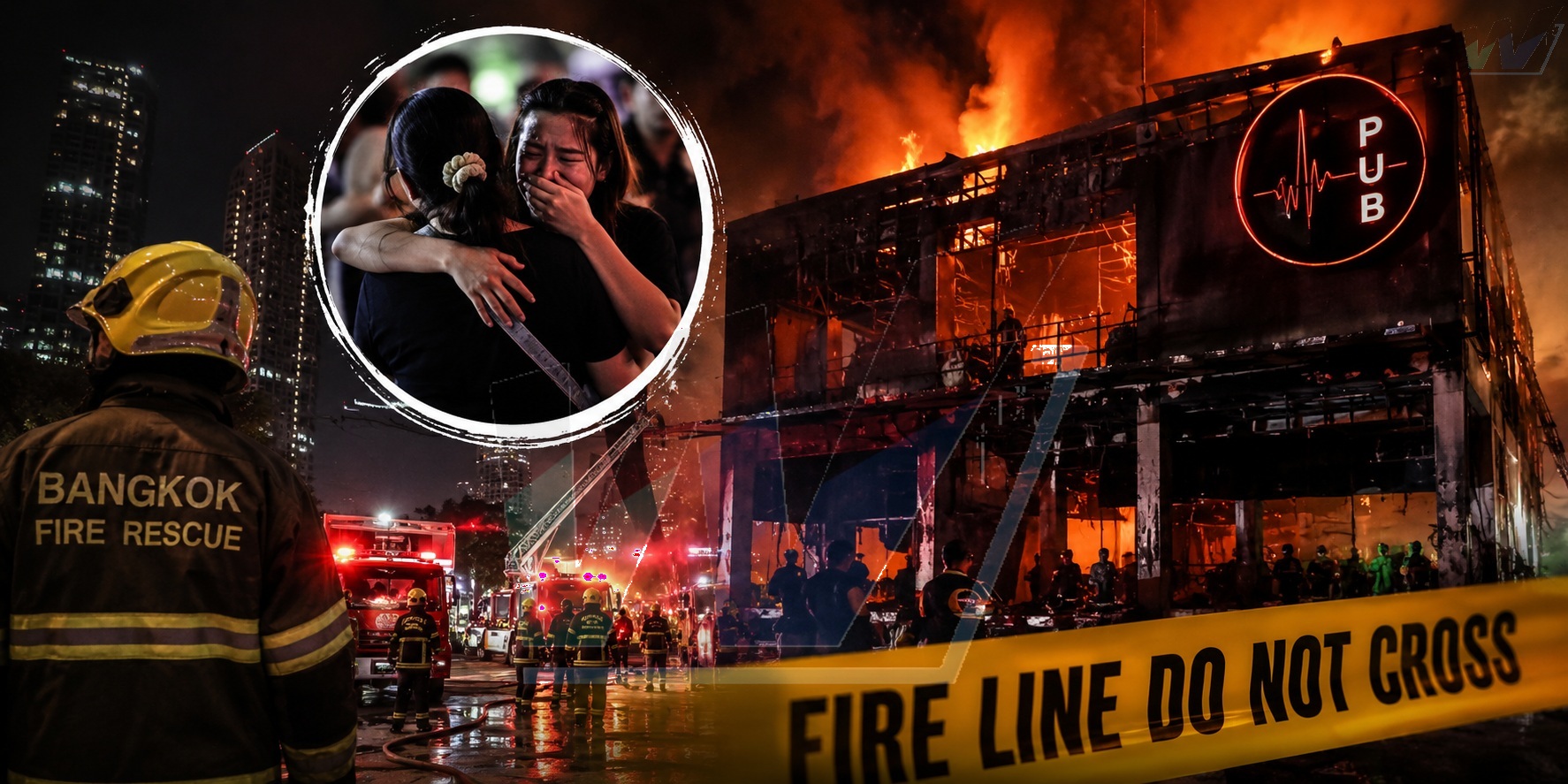
BANGKOK, Thailand — What began as another lively night of music, laughter, and celebration turned into one of Thailand’s deadliest entertainment venue disasters in years.
Within minutes, the lights went out.
Smoke swallowed the room.
Then came the explosion.
By sunrise, at least 27 people were dead, dozens more were fighting for their lives, and Thailand was once again confronting painful questions about whether enough has been done to prevent another nightclub tragedy.
A Night That Descended into Chaos
The fire erupted shortly before midnight Sunday at the Rong Beer Na Lat Phrao (Na Ladprao) pub in Bangkok’s Chatuchak district, a busy area known for nightlife, shopping, and entertainment.
Witnesses described seeing smoke rising near the stage moments before the venue suddenly lost power.
Seconds later, flames burst across the front section of the building.
Panic spread instantly.
Hundreds of patrons scrambled toward exits that quickly became engulfed by thick black smoke.
Many never made it out.
Smoke Became the Deadliest Enemy
Firefighters arrived within minutes and managed to contain the blaze in roughly half an hour.
For many inside, however, those minutes proved fatal.
Authorities said toxic smoke rapidly filled the enclosed venue, reducing visibility to almost zero and leaving guests disoriented in complete darkness.
Numerous victims fled toward the rear restrooms believing they offered safety.
Instead, many became trapped there.
Rescue teams later discovered multiple bodies near the bathrooms, highlighting how quickly smoke, not flames, claimed lives.
Emergency Exits Under Intense Scrutiny
Investigators are now focusing on what may become the central issue of the tragedy: whether people had a realistic chance of escaping.
Preliminary findings indicate that emergency exits were obstructed by furniture and stacked beer crates, severely limiting evacuation routes as panic spread.
Officials are also investigating reports that highly combustible soundproofing materials accelerated the fire after it reached the ceiling near the performance stage.
While forensic teams continue examining the exact ignition source, early indications point toward an electrical malfunction, possibly involving a ceiling-mounted air-conditioning system or electrical equipment near the stage.
Hospitals Overwhelmed
The disaster left 63 people injured, with 22 reported in critical condition suffering severe burns and smoke inhalation.
Medical teams across Bangkok worked through the night treating victims while authorities established emergency registration centers to help desperate families locate missing relatives.
Many victims initially could not be identified because they had fled without identification or were unconscious upon arrival at hospitals.
Painful Echoes of Thailand’s Past
For many Thais, the catastrophe reopened wounds that have never fully healed.
The country has experienced several devastating nightclub and entertainment venue fires over the past two decades.
The 2009 Santika Club fire in Bangkok killed 66 people during New Year’s celebrations.
Another nightclub blaze in eastern Thailand in 2022 claimed dozens of lives.
Each tragedy triggered promises of tighter inspections and stronger enforcement.
Each also reignited debate over whether safety regulations are consistently enforced once public attention fades.
Government Launches Full Investigation
Thai Prime Minister Anutin Charnvirakul visited the scene within hours of the disaster, confirming the death toll and ordering a comprehensive investigation.
Forensic specialists are examining electrical systems, building materials, emergency exits, licensing compliance, and evacuation procedures to determine whether negligence contributed to the high number of casualties.
Authorities have pledged accountability if violations are uncovered.
Fire Safety Once Again Under the Spotlight
The Bangkok pub blaze has already become more than a criminal investigation. It has reignited a broader conversation about fire prevention standards in entertainment venues, not only in Thailand but across Asia, where crowded nightlife districts remain vulnerable to electrical failures, blocked exits, combustible interiors, and inadequate emergency preparedness.
Fire safety experts note that modern building codes are only effective when inspections are rigorous and emergency exits remain fully accessible during business hours.
As investigators search for answers inside the charred remains of the venue, families continue waiting outside hospitals and forensic centers for news they fear may never improve.
For Thailand, the tragedy serves as another heartbreaking reminder that disasters often begin with small failures, until, within minutes, they become national catastrophes.