
Strait of Hormuz Erupts Again as Tanker Attacks Trigger U.S. Strikes, Oil Crackdown, and Fears of a Wider Middle East War
WASHINGTON / STRAIT OF HORMUZ / TEHRAN —
It began with explosions at sea.
Within hours, missiles were flying, fighter jets were in the air, oil markets were on edge, and one of the world’s most strategically important waterways had once again become the epicenter of a rapidly escalating geopolitical crisis.
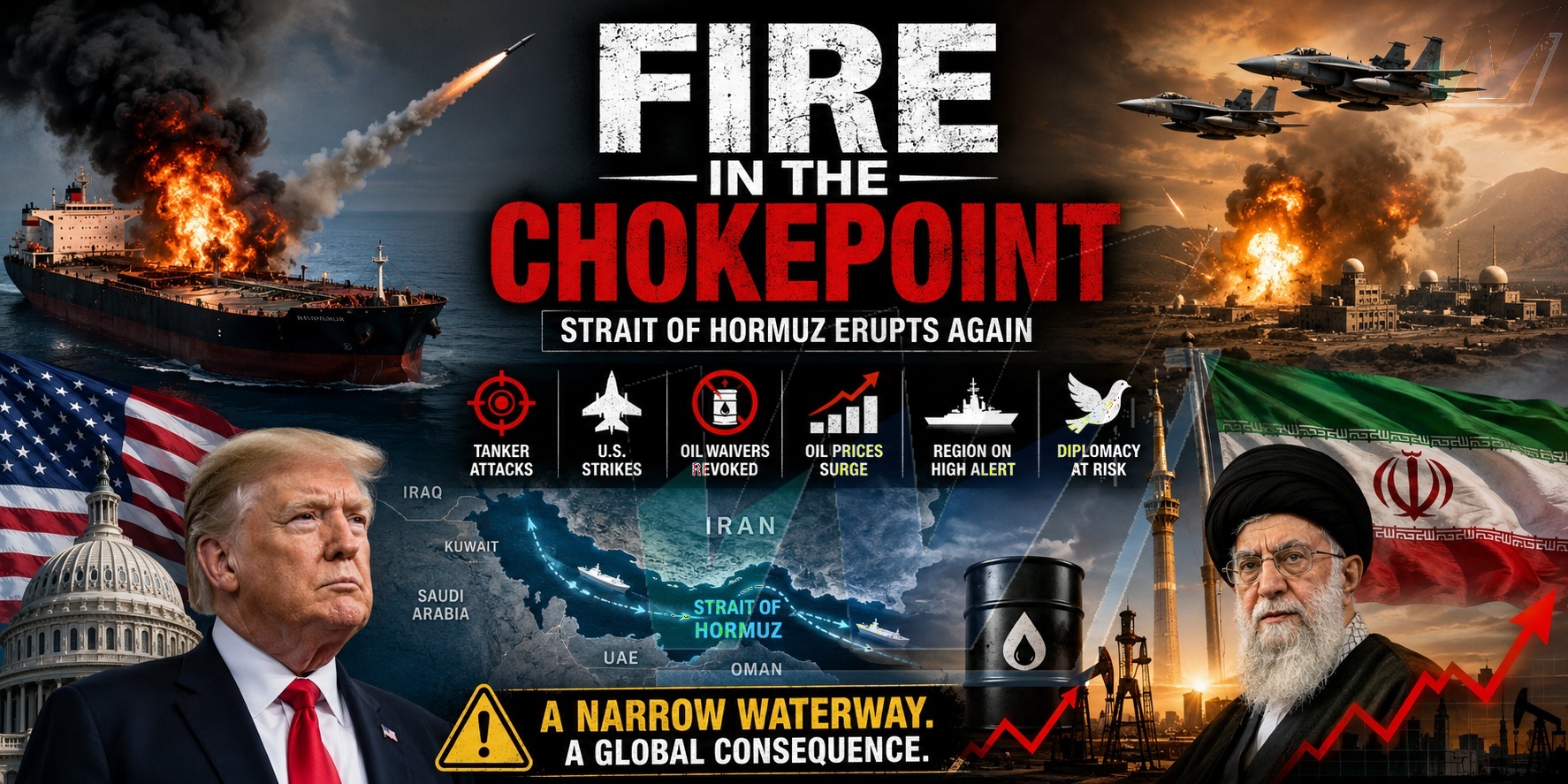
The Strait of Hormuz, the narrow maritime corridor through which a significant share of the world’s seaborne oil and liquefied natural gas flows, has plunged back into turmoil after a series of coordinated attacks on commercial tankers prompted a forceful American military and economic response. The latest confrontation has reignited fears that the fragile ceasefire between Washington and Tehran may be collapsing into a new phase of conflict.
Commercial Shipping Under Fire
The latest crisis unfolded after multiple commercial vessels navigating near the Strait of Hormuz were struck in what U.S. officials describe as deliberate attacks carried out by Iran’s Islamic Revolutionary Guard Corps (IRGC).
Among the vessels reportedly targeted were oil and LNG tankers operating in one of the busiest shipping lanes on Earth. While most crews escaped with their lives, several ships sustained serious damage, immediately raising alarm across the global maritime industry.
Shipping security agencies quickly elevated threat warnings, while insurers reassessed risk premiums for vessels entering Gulf waters. Every passing tanker suddenly became a potential target.
Washington Responds with Military Force
The American response came swiftly.
The U.S. Central Command announced a broad series of retaliatory strikes against Iranian military infrastructure, including drone launch sites, missile positions, air-defense systems, naval assets, and facilities believed to support attacks on international shipping.
According to U.S. officials, the operation was designed to impose “heavy costs” on Tehran while restoring freedom of navigation through international waters.
Officials framed the strikes not as an expansion of the war, but as a direct response to attacks against civilian maritime traffic and a defense of one of the world’s most critical trade arteries.
Economic Warfare Returns
Military action was only half of Washington’s response.
The Trump administration simultaneously revoked key waivers that had temporarily allowed limited Iranian oil sales under a recent understanding reached during ceasefire negotiations.
Those waivers, seen by many analysts as one of Tehran’s few economic lifelines, were withdrawn almost immediately after the tanker attacks.
U.S. officials argued that the arrangement had always been performance-based and that attacks on commercial shipping violated its conditions.
The decision effectively restored tighter sanctions pressure on Iran’s energy exports, targeting one of the government’s primary sources of foreign revenue.
The World’s Energy Lifeline at Risk
Few waterways carry as much strategic weight as the Strait of Hormuz.
Connecting the Persian Gulf with the Gulf of Oman and the Arabian Sea, the narrow passage serves as the exit route for oil exported by Saudi Arabia, Iraq, Kuwait, the United Arab Emirates, Qatar, and Iran.
Any disruption, whether temporary or prolonged, can ripple through global energy markets within hours.
Following news of the attacks and U.S. retaliation, crude oil prices climbed sharply as traders priced in the growing risk of further supply disruptions and additional attacks on shipping.
Regional Powers Brace for Escalation
The crisis is no longer confined to Iranian and American forces.
Reports from across the Gulf indicate heightened military readiness as neighboring states strengthen air defenses, monitor maritime traffic, and prepare for potential retaliation.
International naval forces operating in the region are increasing surveillance while commercial operators review shipping routes, convoy procedures, and emergency response plans.
For global shipping companies, the question is no longer whether the Strait remains strategically important, but whether it can remain reliably open.
Diplomacy Hanging by a Thread
The violence threatens to derail already fragile diplomatic efforts aimed at reducing tensions between Washington and Tehran.
Negotiations that only weeks earlier appeared to offer cautious optimism are now overshadowed by renewed military exchanges, mutual accusations, and rapidly hardening political positions.
Iran has rejected American accusations and condemned both the military strikes and the renewed economic sanctions, warning that further escalation could trigger additional responses.
Meanwhile, Washington insists that freedom of navigation remains non-negotiable and has warned that any future attacks on commercial shipping will meet decisive action.
A Narrow Waterway, A Global Consequence
The Strait of Hormuz has long been one of the world’s most dangerous geopolitical flashpoints.
Today, it once again stands at the center of a confrontation where missiles, sanctions, energy markets, and international diplomacy intersect.
For the crews sailing through its waters, every transit has become a test of survival.
For governments, every military move risks widening the conflict.
And for the global economy, the fate of a waterway only a few dozen miles wide could determine the next chapter in energy prices, international trade, and Middle East stability.
The world’s shipping lane has become the world’s pressure point, and once again, every nation is watching.