

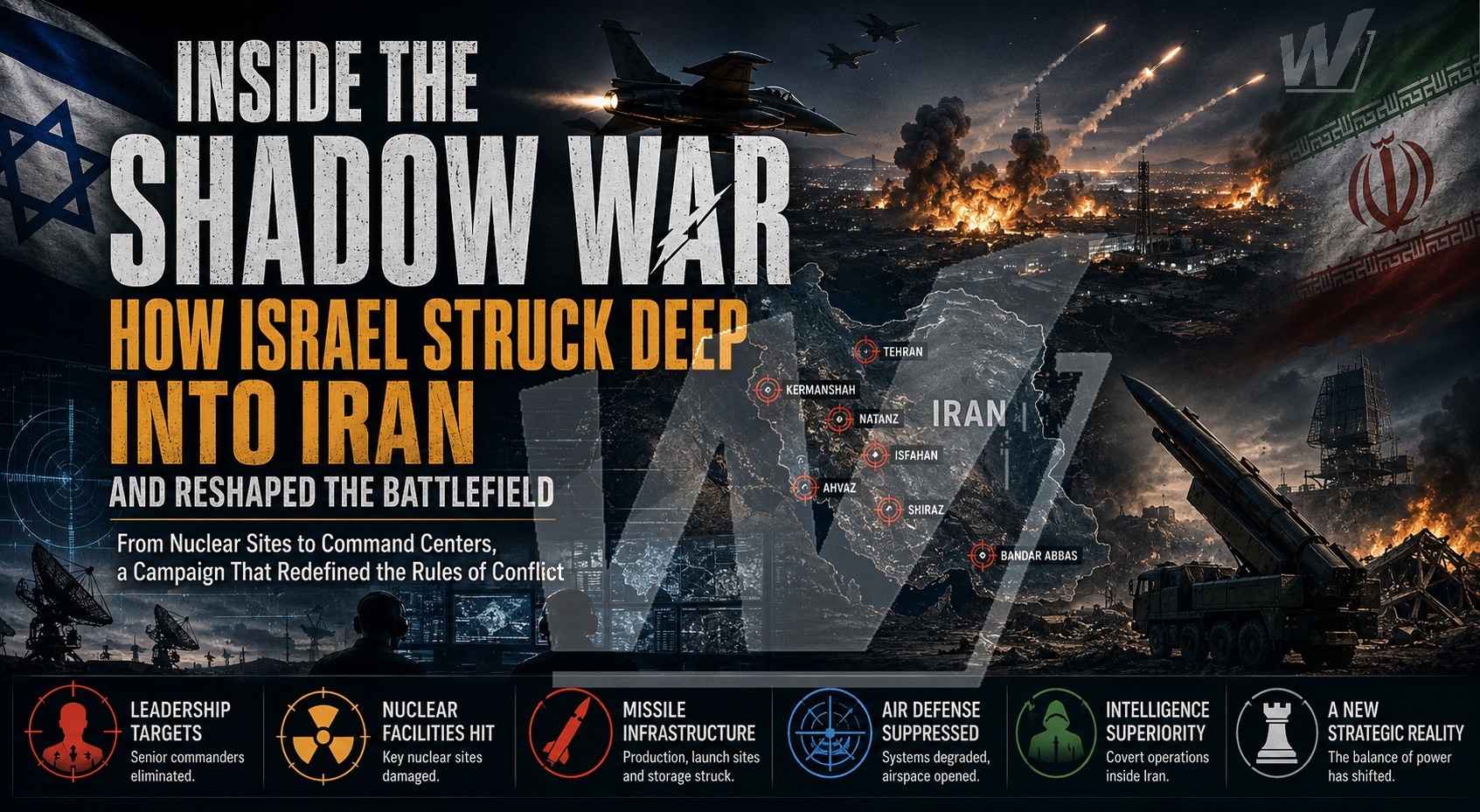
From Nuclear Sites to Command Centers, a Campaign That Redefined the Rules of Conflict
The night skies above Iran lit up with flashes of fire long before dawn.
In a matter of hours, explosions echoed across military bases, missile facilities, command centers, and nuclear-related sites. Senior commanders disappeared from the chain of command. Air-defense networks that had taken years to build suddenly faced unprecedented pressure. Intelligence operations once whispered about in security circles appeared to unfold in full view of the world.
What began as another chapter in the long-running confrontation between Israel and Iran rapidly evolved into one of the most dramatic military campaigns the Middle East has witnessed in decades.
According to reporting by Reuters, Axios, CNN, and statements from Israeli officials, the campaign sought to achieve a strategic objective that had eluded Israeli governments for years: pushing the conflict directly onto Iranian territory while degrading Tehran’s military and nuclear capabilities.
The Opening Blow
When Israeli aircraft and covert assets moved against targets across Iran, the operation was not limited to a single strike.
Reports indicated simultaneous attacks on nuclear-related facilities, ballistic missile infrastructure, military headquarters, and senior leadership targets. Israeli officials described the operation as a preemptive effort to halt what they viewed as growing threats from Iran’s missile and nuclear programs.
The scale of the opening phase stunned regional observers.
More than a military raid, it appeared designed to disrupt the command structure itself.
Reuters reported that several of Iran’s most senior military figures and nuclear scientists were killed during the first wave of attacks, including high-ranking commanders associated with the Islamic Revolutionary Guard Corps and key figures linked to Iran’s nuclear establishment.
Decapitating the Leadership Network
Modern warfare increasingly revolves around information, coordination, and command.
By targeting senior commanders, Israel sought not merely to destroy equipment but to disrupt decision-making at the highest levels.
Reuters later reported that Israeli officials assessed that more than 30 senior Iranian security officials and 11 nuclear scientists were killed during the broader campaign. While those figures originate from Israeli assessments and remain difficult to independently verify in full, they illustrate the scale of the operation as presented by Israeli military sources.
The deaths of senior commanders represented more than symbolic victories.
Military organizations depend on trusted networks, institutional memory, and experienced leadership. Replacing such figures is often far more difficult than replacing hardware.
The Nuclear Program Under Pressure
For years, Iran’s nuclear facilities have stood at the center of international concern and diplomatic negotiations.
Israeli strikes reportedly targeted several of the country’s most sensitive nuclear-related locations, including facilities associated with uranium enrichment and nuclear research. Reuters reported that some installations suffered significant damage, though experts cautioned that assessing the full extent of the impact would require time and independent inspection.
One of the major strategic questions remains unanswered:
Did the strikes merely delay Iran’s nuclear program, or fundamentally alter its trajectory?
The available evidence suggests that important infrastructure was damaged, but the ultimate long-term effect remains the subject of continuing debate among analysts and international inspectors.
Breaking the Missile Machine
Ballistic missiles have long been one of Iran’s most powerful tools of deterrence.
Israeli operations reportedly focused heavily on launch sites, missile-production facilities, storage areas, and associated infrastructure. Reuters and Axios both reported strikes against missile-related targets that Israeli planners viewed as critical to Iran’s ability to sustain large-scale missile operations.
Military analysts note that missile programs depend on complex industrial networks involving manufacturing, transportation, maintenance, and command systems.
Disrupting even a portion of that network can create effects far beyond the immediate physical destruction visible in satellite imagery.
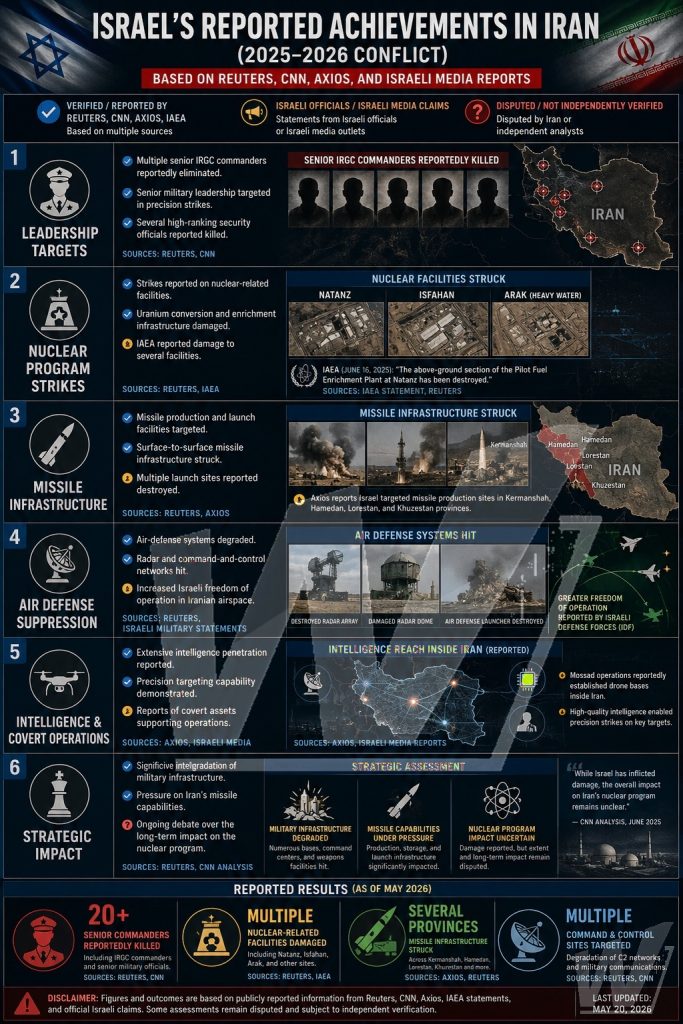
Israel’s reported achievements in Iran conflict
The Air Defense Challenge
Perhaps one of the most significant achievements claimed by Israel involved Iran’s air-defense systems.
Israeli and U.S. officials cited by Axios reported that Israeli forces successfully targeted multiple Iranian air-defense assets, helping create operational freedom for subsequent strikes. Reuters also reported attacks on command-and-control infrastructure and air-defense positions.
For military planners, air superiority is often the foundation upon which every other operation depends.
Without it, aircraft face greater risk. With it, strategic options multiply.
The reported degradation of Iranian air defenses therefore carried implications extending far beyond the immediate battlefield.
The Invisible Front
Not all victories occur in the air.
Some happen in silence.
Reports from Israeli media and international outlets described intelligence penetration, covert operations, sabotage activities, and highly precise targeting that suggested years of preparation. Axios reported operations that combined intelligence gathering with military execution, demonstrating a level of coordination rarely seen in modern regional conflicts.
The campaign reinforced a perception long held by many security analysts: that intelligence superiority can be as decisive as military firepower.
A New Strategic Reality
The broader strategic impact remains contested.
Iran insists that its capabilities remain intact and has continued to demonstrate its ability to launch retaliatory missile attacks. Israeli officials argue that the campaign significantly weakened Iran’s military infrastructure, disrupted elements of its nuclear effort, and reduced immediate threats to Israel.
What is beyond dispute is that the conflict altered the regional conversation.
For years, discussions focused on what might happen if Israel struck Iran directly.
Now the world is analyzing what happened after it did.
The campaign demonstrated the reach of Israeli intelligence, the effectiveness of precision military operations, and the vulnerability of even heavily protected strategic assets. Yet it also highlighted the limits of military power, as questions surrounding Iran’s long-term nuclear ambitions and future military capabilities remain unresolved.
Conclusion
Wars are often measured by territory gained or lost.
This one may ultimately be measured by systems disrupted, leaders removed, facilities damaged, and strategic calculations transformed.
Whether history records the campaign as a decisive turning point or merely one phase in a longer confrontation remains to be seen.
But from command bunkers to nuclear facilities, from missile complexes to intelligence networks, the message of the operation was unmistakable:
The battlefield had moved deep inside Iran, and the consequences are still unfolding.