

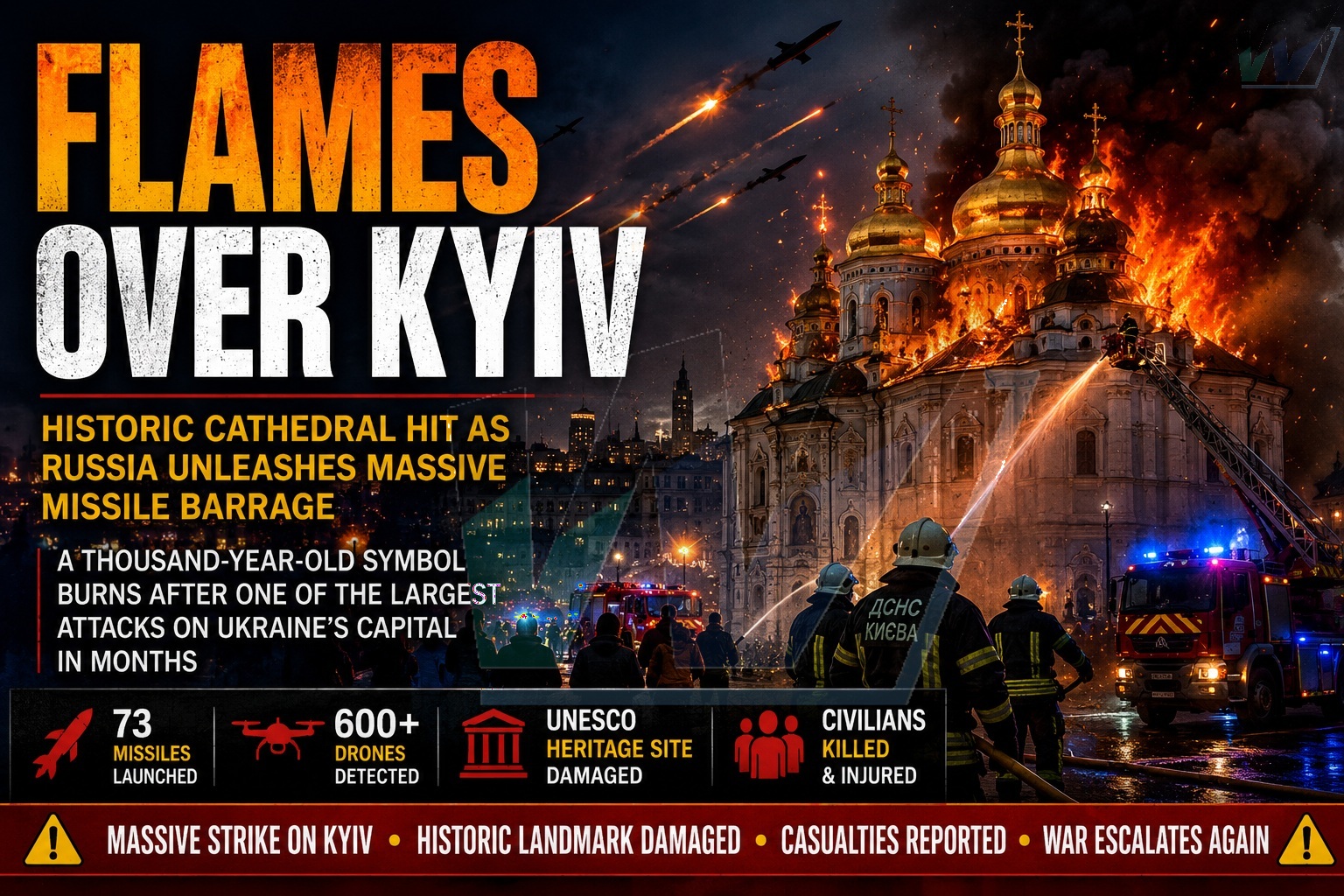
Ancient Sacred Landmark Burned as Missiles Rain Down on Ukraine’s Capital Hours After Trump–Putin Call
KYIV — The first explosions shattered the darkness before dawn.
Then came the sirens.
Then the fire.
As hundreds of drones and dozens of missiles streaked across the Ukrainian sky, residents of Kyiv awoke to one of the most devastating attacks on the capital in recent months—a night of destruction that left historic landmarks burning, neighborhoods shattered, and a nation once again confronting the brutal realities of a war entering another dangerous chapter.
Among the targets was one of Ukraine’s most treasured spiritual and cultural symbols: the Dormition Cathedral, a nearly 1,000-year-old masterpiece nestled within the famed Kyiv-Pechersk Lavra monastery complex overlooking the Dnipro River.
By sunrise, firefighters were battling flames beneath the cathedral’s blackened golden domes.
The images quickly spread across the world.
For many Ukrainians, the strike was more than a military attack. It was an assault on history itself.
“This is one of Russia’s most serious crimes against Christian culture to date,” Ukrainian President Volodymyr Zelenskyy declared as photographs emerged showing fire damage to the UNESCO-listed sanctuary whose origins date back to the 11th century.
A Night of Fire and Steel
According to Ukrainian military officials, Russia launched an overwhelming barrage consisting of 73 missiles and more than 600 long-range drones, making it one of the largest coordinated attacks against Kyiv this summer.
The assault struck across multiple districts of the capital.
Residential buildings were damaged.
Infrastructure was hit.
A major postal sorting center suffered a direct strike.
The nearby Mystetskyi Arsenal museum complex, known internationally for hosting Ukraine’s largest literary festival, was also engulfed in flames.
Emergency crews raced from one impact site to another as explosions echoed across the city.
Authorities reported at least five people killed and more than thirty injured, while damage was recorded at over fifty separate locations throughout Kyiv.
More than 140,000 households lost electricity as emergency teams struggled to stabilize critical services.
For residents sheltering underground during the long hours of bombardment, the attack felt relentless.
Wave after wave of drones arrived, followed by missiles designed to overwhelm Ukraine’s increasingly strained air defenses.
The Cathedral That Survived Centuries
The Dormition Cathedral has endured invasions, wars, occupations, and political upheaval for nearly a millennium.
It survived Mongol invasions.
It witnessed the rise and fall of empires.
Destroyed during World War II, it was painstakingly reconstructed and restored as a symbol of Ukrainian resilience.
Now, nearly a thousand years after its foundations were laid, the cathedral once again stands scared by war.
Witnesses described firefighters climbing through smoke and debris to extinguish flames licking across sections of the historic structure’s roof.
The sight of burning church domes against the morning sky carried powerful symbolism far beyond Ukraine’s borders.
International condemnation followed swiftly.
European leaders denounced the attack, with senior EU officials characterizing the strikes as potential war crimes and warning that the destruction of cultural and civilian sites represented a dangerous escalation.
Beyond Kyiv: The War Expands
The devastation was not limited to the capital.
In Kharkiv, Ukraine’s second-largest city, tragedy unfolded in a particularly brutal manner.
Five rescue workers were reportedly killed in what officials described as a “double-tap” strike—a tactic in which a second attack is launched after emergency personnel arrive at the scene of an initial explosion.
The method has drawn widespread international criticism throughout the conflict because it deliberately endangers first responders rushing to save lives.
Across the country, emergency services remained on high alert as reports of additional strikes continued to emerge.
Diplomacy and Destruction
The timing of the assault has added another layer of geopolitical intrigue.
The strikes occurred only hours after a lengthy telephone conversation between U.S. President Donald Trump and Russian President Vladimir Putin, a call that reportedly focused on the future of the conflict and possible diplomatic initiatives.
According to Kremlin officials, the two leaders discussed upcoming visits to Russia by senior American envoys Jared Kushner and Steve Witkoff.
Meanwhile, Zelenskyy revealed that he too had recently held what he described as a “very good conversation” with Trump.
Yet even as diplomatic channels appear active, the battlefield tells a different story.
The missiles that lit up Kyiv’s night sky offered a stark reminder that negotiations and warfare are proceeding simultaneously—and often in direct contradiction to one another.
The Growing Missile Gap
Military analysts warn that Moscow is seeking to exploit a persistent weakness in Ukraine’s defenses: a shortage of air-defense interceptors.
Ukrainian officials have repeatedly appealed to Western allies for additional missile-defense systems, arguing that Russia’s expanding production capabilities are allowing it to sustain increasingly frequent large-scale attacks.
Recent military assessments indicate that Russia continues to manufacture substantial numbers of ballistic and cruise missiles each month, enabling it to replenish stockpiles despite years of sanctions and battlefield expenditures.
“Ukraine continues to need more missile interception capabilities,” Prime Minister Yulia Svyrydenko emphasized following the latest assault.
Without additional support, experts fear that future attacks could become even larger and more destructive.
Ukraine Strikes Back
Yet Kyiv is not standing still.
While Russia intensifies its missile campaign, Ukraine has expanded its own long-range strike capabilities.
In recent weeks, domestically produced cruise missiles reportedly struck military-industrial facilities hundreds of kilometers inside Russian territory.
Ukrainian drones have also targeted fuel infrastructure, logistics hubs, and supply routes connected to Russian operations in occupied Crimea.
The result is a rapidly evolving war in which both sides increasingly possess the ability to strike far beyond the front lines.
What was once a conflict defined by trenches and artillery has transformed into a contest of reach, endurance, and industrial capacity.
A Thousand-Year-Old Warning
As smoke drifted above Kyiv and workers assessed the damage to one of Eastern Christianity’s most revered landmarks, the symbolism of the attack resonated across Europe and beyond.
The burning cathedral became more than a casualty of war.
It became a warning.
A reminder that in modern conflicts, missiles do not distinguish between military objectives, cultural heritage, or centuries of history.
And as diplomats speak of peace, the skies above Ukraine continue to tell a different story.
For the people of Kyiv, dawn arrived once again with sirens fading into silence.
But the scars left by the night’s fire—on buildings, on lives, and on a monument that has watched over the city for nearly a millennium—will endure long after the smoke has disappeared.