


For decades, the global heartbeat was steady. From the neon-lit boardrooms of Tokyo to the bustling markets of São Paulo, birth rates in high- and middle-income countries from the 1980s through the early 2000s held their ground. Population models were predictable. The future felt mapped out.
Then, roughly fifteen years ago, something broke.
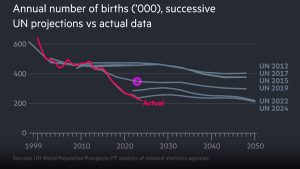
Silently, and almost all at once, a demographic freefall commenced. Across vastly different cultures, regions, and economic realities, the numbers didn’t just dip—they cratered. Today, in more than two-thirds of the world’s 195 nations, the average number of children born to a woman has plunged below the critical replacement rate of 2.1. In 66 countries, that number is staggering closer to 1 than 2. In some corners of the globe, the most common number of children born to a woman is now zero.
The speed of this collapse has caught the world completely off guard. In 2023, Mexico’s birth rate fell below that of the United States for the first time in recorded history. Brazil, Tunisia, Iran, and Sri Lanka quickly followed. Developing nations are now graying before they can even grow rich. When the United Nations projected 350,000 births for South Korea in 2023, they weren’t just slightly off—they overestimated by a staggering 50%. The real figure was a ghost-like 230,000.
Historically, when birth rates fell in the 19th and 20th centuries, we knew why: rising female education, urbanization, industrial shifts, and falling infant mortality. It made sense. But this new, sudden, synchronized global nosedive defies the old rulebooks.
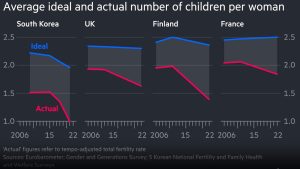
The mystery deepens when you ask young people what they want. On paper, young men and women still say they desire around two children. Yet, beneath the surface lies a stark, growing disconnect. A rising share of youth, particularly young women, now explicitly state they plan to never have children at all.
Demographers have long blamed the economy for empty nurseries. But the data no longer fits the crime. Instead, researchers are suddenly pointing the finger at a different, far more intimate culprit. It is a device sitting right now in the palm of your hand: the smartphone.
The Price of an Empty Tomorrow
Why does a lack of crying babies terrify economists? The answer lies in a simple, cold mathematical reality: fewer children today means a vanished workforce tomorrow.
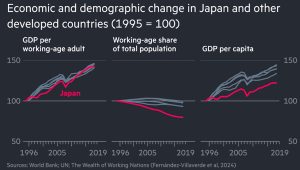
Consider Japan, the world’s poster child for economic stagnation. Japan’s crisis isn’t a lack of productivity; its workers are as efficient and wealthy as ever. The trap is that those workers account for a shrinking slice of an increasingly elderly population. When a society ages rapidly, GDP per capita chokes, and living standards stagnate.
“Fertility decline is the question of our time. Most other global problems flow downstream of it.” — Jesús Fernández-Villaverde, Economist, University of Pennsylvania
With an aging population comes a ballooning bill for pensions and elder care. Governments are forced into a corner: hike taxes, slash infrastructure investments, or both. This economic paralysis breeds a pervasive sense of national decline, fueling the fires of populist politics. You don’t have to agree with Elon Musk’s every pronouncement to realize that low birth rates are already actively fracturing the world’s socio-economic foundations.
The K-Shaped Collapse of the Couple
To understand how this happened, you must dismantle a modern myth. The conventional narrative blames the “career-obsessed woman” or the affluent, dual-income, child-free couples choosing luxury over legacy.
The data tells a much darker story.
Demographer Stephen Shaw has revealed an astonishing anomaly: in most high-income nations, the number of children mothers are having is actually stable or rising. In the US, mothers have an average of 2.6 children today, up from 2.4 thirty years ago.
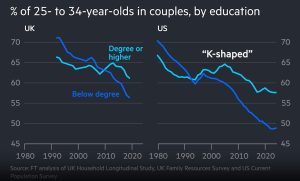
The real driver of the demographic drought? There are simply fewer couples.
U.S. Demographics: A 30-Year Shift
- Share of women having any children: 85% ──> 63%
- Share of single individuals: [CLIMBING STEEPLY]
If marriage and cohabitation rates in America had merely held steady over the last decade, the national fertility rate would be higher today, not lower. Furthermore, this decline isn’t happening at the top, it’s happening at the bottom. Family formation has become brutally “K-shaped.” Among university graduates, coupling and birth rates remain stable or are increasing. The steep drop is concentrated entirely among those with the least education and the lowest incomes.
Progressive policy band-aids have failed to stop the bleeding. Since the 1980s, rich nations have tripled real-term spending on child benefits, subsidized childcare, and parental leave. Fathers are doing more childcare than ever before. Yet, the numbers keep dropping.
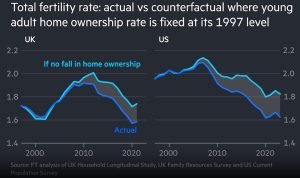
While localized crises like housing explain part of the skyrocketing real estate prices and young adults trapped in their parents’ basements accounted for up to half of the US and UK fertility declines since the 1990s cannot explain the global uniformity of the current collapse. In the Nordic countries, where young adults live independently and economies are stable, fertility is still falling. In fact, across several nations, a chilling historical reversal has occurred: couples who move in together are now more likely to break up than to have a child.
Slow-moving economic shifts, the prolonged climb up the career ladder, extended education, or shifting wage balances, simply happen too gradually to explain a sudden, worldwide synchronized cliff-edge.
The 4G Correlation: Algorithms of Isolation
Frustrated by broken economic models, researchers looked at the digital networks binding the globe together. What they found was a haunting correlation.
A landmark study from the University of Cincinnati tracked the staggered rollout of 4G mobile networks across the US and UK. The findings were undeniable: births fell first and fastest in the exact geographic pockets that received high-speed mobile connectivity earliest.
This isn’t an isolated anomaly. It is a global pattern.
- The US, UK, and Australia:
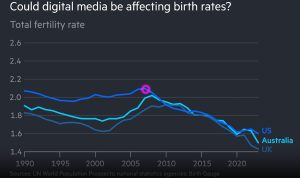
Teen and young adult birth rates flattened in the early 2000s, then began a steep slide around 2007–2008 (the dawn of the smartphone).
- Mexico and Indonesia:
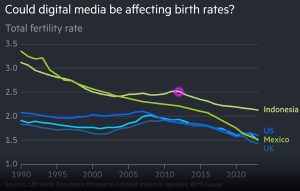
The exact same slide began around 2012.
- Egypt, Iran, and Senegal:
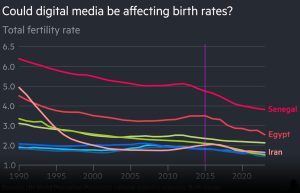
Steady declines turned into sharp cliffs around 2015.
Every single inflection point perfectly mirrors the mass adoption of smartphones in that specific country. Line up these seemingly disparate global timelines by the local arrival of high-speed mobile tech, and they collapse into a single, unified, undeniable trend.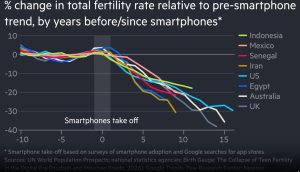
[Smartphone Adoption] ──> [In-Person Socializing Halves] ──> [Fertility Collapses]
How does a screen stop birth? The mechanisms are psychological, cultural, and deeply isolating.
- The Death of the Physical Encounter
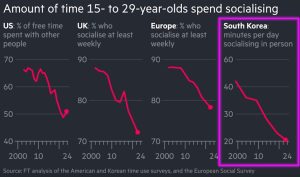
The most direct impact is time displacement. Smartphones have ravenously eaten into the hours young people spend together in the real world. In South Korea, face-to-face socializing among young adults has been cut in half in just two decades. As demographer Lyman Stone notes, finding a partner requires filtering through a crowd. If you stop socializing in person, it takes exponentially longer to find a match—if you find one at all.
- The Instagram Distortion
When young people do look for love, their metrics are broken. Spending time with peers in the real world anchors your romantic standards in reality. Spending hours scrolling through curated, filtered feeds anchors your expectations to an artificial, unattainable illusion of perfection.
- Cultural Leapfrogging
Social media is an ideological accelerator. Alice Evans of Stanford University suggests that platforms like TikTok and Instagram allow young women in deeply conservative or patriarchal societies to bypass local authorities and instantly adopt progressive, egalitarian Western ideals. The friction? The young men in their immediate environments are not ready for this rapid shift, creating a profound romantic stalemate.
- Digital Chasm
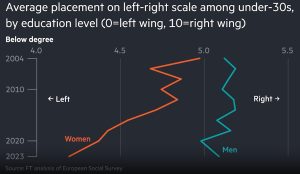
Algorithms thrive on division. Today, young men and women increasingly inhabit entirely different digital ecosystems, fed by algorithmic pipelines that reinforce negative stereotypes of the opposite sex. The ideological divide between the sexes is uniquely a smartphone-era phenomenon: young women have moved sharply leftward, while young men have not. Caught between the rise of the digital “manosphere” and “femisphere,” face-to-face contact has withered, creating intense friction at the exact intersection where relationships used to form.
There is No Uninventing the Screen
We must look at this data with a note of caution. Much of this remains a compelling, highly plausible theory. While qualitative evidence is pouring in from global researchers, definitive, ironclad causal proof is still being assembled.
Yet, the concept that media alters human fertility is rooted in history. In 2001, researchers discovered that television ownership in certain regions was a stronger predictor of falling birth rates than income or education. Watching soap operas that featured small families actively altered women’s reproductive desires. If a shared television in a living room could reduce a population’s libido and family size, the impact of a hyper-addictive, solitary smartphone is bound to be exponentially more devastating.
 Can we fix it?
Governments must first abandon the fantasy of a silver bullet. You cannot uninvent the smartphone. “If someone has bad eyes,” Lyman Stone points out, “we don’t fix their genes. We give them glasses.”
Securing affordable, long-term housing for young couples remains a proven way to foster families. Cash incentives and baby bonuses can help, but they are expensive, and more importantly, they target existing couples. They do nothing for a generation that cannot find a partner in the first place.
The bitter truth is that even if every smartphone vanishes tomorrow, the cultural concrete has already set. The hyper-individualistic ideals, the rewritten expectations of relationships, and the deep ideological distrust between young genders have become the new global default. Reversing this tide will be an agonizingly slow, perhaps impossible, endeavor.
The empty cradle is not merely an economic crisis; it is the physical symptom of a fractured, isolated, and deeply frustrated generation of young adults. Healing that digital rift and bringing them back into the light of the real world may well be the defining struggle of our century.
Source: Financial Times