
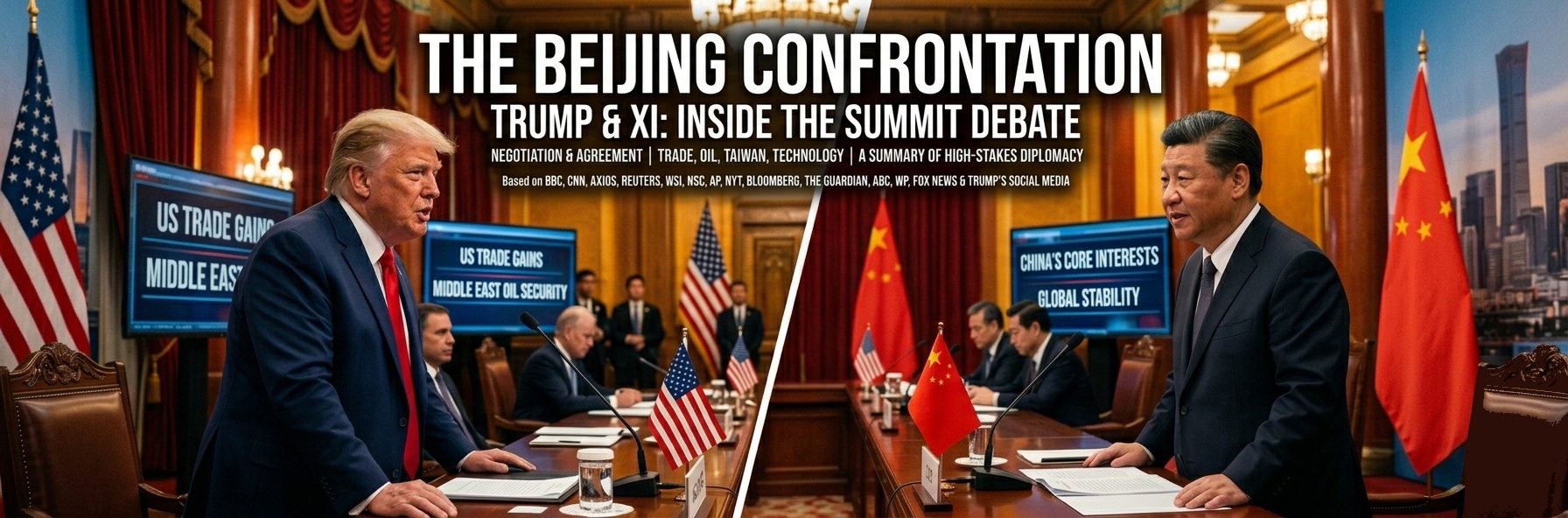
The rain over Beijing did nothing to cool the tarmac at Capital International Airport. As Air Force One touched down, the world held its breath. This wasn’t just another diplomatic photo-op; it was a high-stakes poker game played with the global economy.
Two days. Two leaders. Billions of dollars—and the peace of the world’s most volatile flashpoints—hanging in the balance.
For forty-eight intense hours, President Donald J. Trump and Chinese President Xi Jinping locked eyes behind closed doors. Outside, the world’s press corps was a pressure cooker of rumors. Inside, it was a battle of raw leverage.
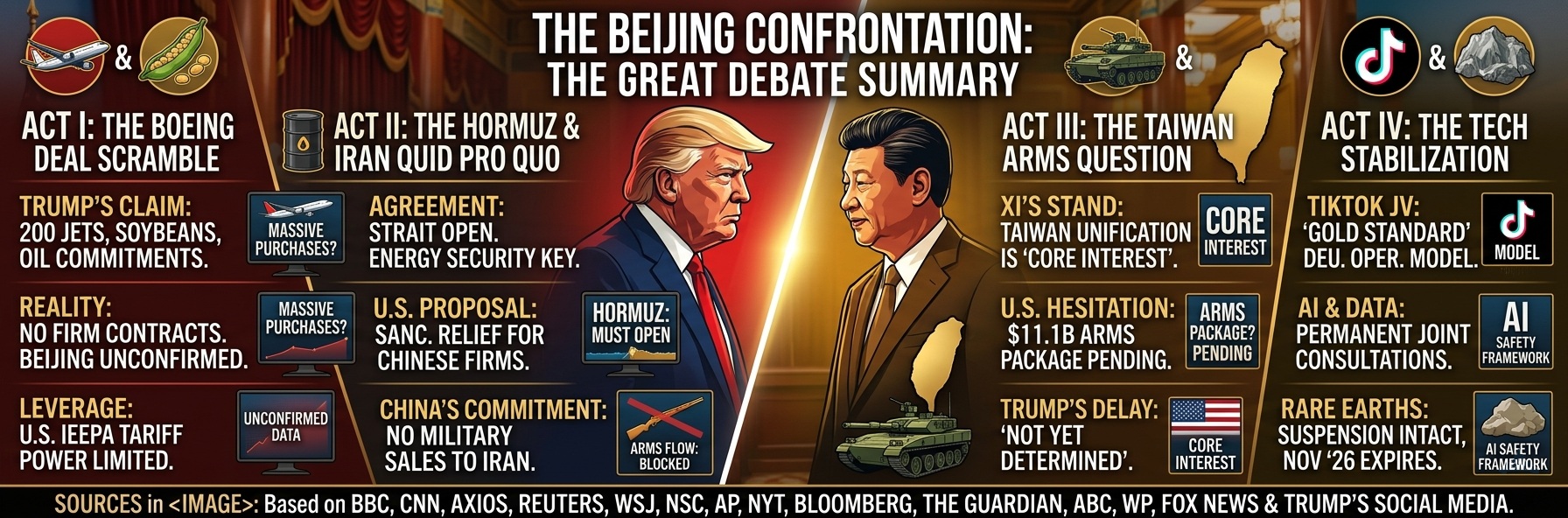
Act I: The Midnight Leverage
The summit began not with a handshake, but with a shadow. Months earlier, a U.S. Supreme Court ruling had quietly stripped Trump of his sweeping tariff powers under the Emergency Economic Powers Act. Beijing knew it. The Chinese delegation sat down at the mahogany table believing they held the upper hand, ready to squeeze concessions from a legally cornered American president.
But Trump had a different kind of leverage in mind: the global energy chokeholds.
With the Strait of Hormuz teetering on the brink of conflict and Iranian oil markets fractured, Trump threw a massive counter-punch. Sources close to the negotiation room reported that the U.S. team laid out explicit intelligence maps of Chinese firms purchasing illicit Iranian crude.
“The straits stay open,” Trump insisted, his voice cutting through the formal translations. “Or the sanctions double. Supreme Court or no Supreme Court.”
Xi didn’t blink. But by midnight on Day One, the first crack in the ice appeared. A tactical truce emerged: Xi offered a verbal guarantee that Beijing would choke off military hardware flowing to Tehran. In return, Trump dangled the ultimate carrot—actively considering lifting sanctions on key Chinese energy buyers. The global energy market, teetering on collapse hours earlier, had a temporary lifeline.
Act II: The Art of the Unconfirmed Deal
As Day Two dawned, the battleground shifted from geopolitical chokepoints to American factories. Trump wanted a victory he could broadcast to the world in 280 characters or less.
Aboard Air Force One, just hours before departure, the President’s thumbs flew across his phone. “Just concluded a MONUMENTAL meeting with President Xi,” the post flashed across millions of screens. “China has agreed to massive, historic purchases. Thousands of tons of American soybeans, Texas oil, and 200 beautiful, brand-new Boeing commercial jets. Maybe 750! No one else could do this!”
Wall Street surged. Trading floors in New York and Hong Kong went wild.
But back in the press briefing rooms of Beijing, the suspense returned with a vengeance. Reporters from Reuters, Bloomberg, and the Wall Street Journal pressed the Chinese Foreign Ministry for confirmation.
The response from the Chinese spokesperson was a masterclass in diplomatic ambiguity: a cold, tight-lipped smile, and a refusal to confirm a single number. No contracts were signed. No ink was put to paper. Trump had claimed a historic economic windfall; Beijing had given only a nod. The “Busan Truce” of 2025—which paused the brutal tariff wars—was surviving, but it was surviving on thin air and verbal promises.
Act III: The Taiwan Gambits
The real suspense, however, wasn’t about Boeing jets or soybeans. It was about a democratic island nation 100 miles off the Chinese coast.
In the final, closed-door session, Xi Jinping drew a hard line in the sand. Taiwan, he reminded Trump with absolute gravity, was a non-negotiable core interest. He demanded an immediate halt to all U.S. weapon sales to Taipei.
The room grew dead silent. National security advisors on both sides leaned forward. Would Trump fold under the pressure of securing his trade deal? Or would he trigger a military standoff?
Trump chose a third path—a calculated, agonizing ambiguity. He sidestepped Xi’s rhetorical trap, refusing to formally concede America’s position. But he didn’t draw a line in the sand either. When pressed by Fox News and New York Times reporters on the tarmac about a pending $11.1 billion U.S. arms package to Taiwan, Trump gave an answer that sent shockwaves through Taipei and Washington alike:
“I have not yet determined what we are doing with that,” Trump said over the roar of the jet engines. “President Xi and I have a great relationship. We’re looking at a lot of things.”
The Aftermath: A Fragile Peace
As Air Force One climbed into the Beijing sky, heading back across the Pacific, the world was left to parse the fallout of a thriller that hadn’t truly ended.
There were no massive tech wars this time; both sides pointed to the January 2026 TikTok joint venture as a ready-made blueprint for future corporate battles. China’s stranglehold on rare earth minerals remained paused—at least until the November 2026 expiration date.
Trump flew home claiming he had tamed the dragon. Mainstream media analysts warned that the U.S. had traded concrete strategic commitments for unconfirmed economic promises.
The two superpowers had averted a catastrophic collision in the spring of 2026. But as the dust settled, one thing was terrifyingly clear: the fuse was still burning, and the clock was still ticking.