
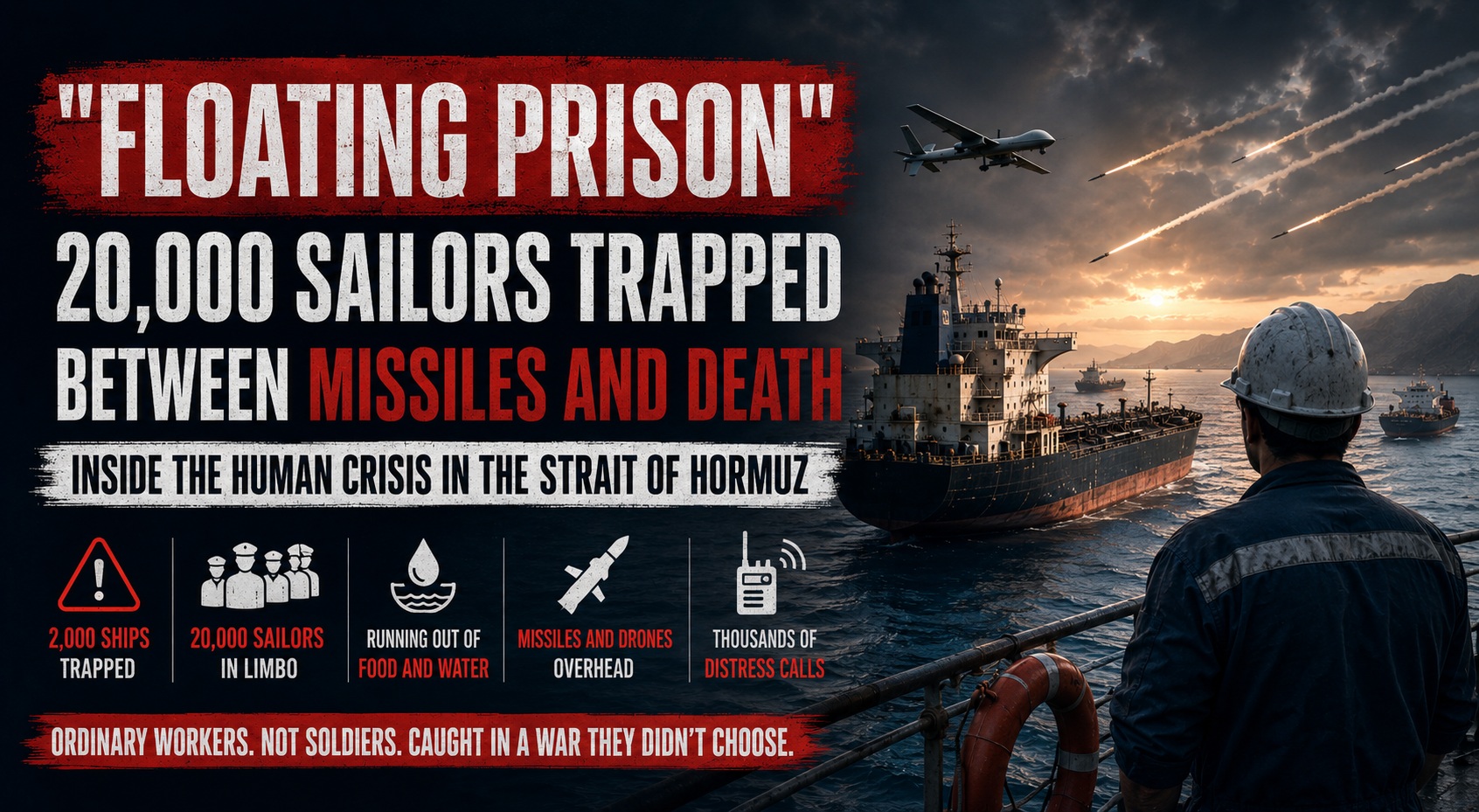
For more than ten weeks, the waters of the Strait of Hormuz have turned into a living nightmare for nearly 20,000 sailors stranded aboard around 2,000 ships, caught in the middle of the escalating U.S.-Israeli war against Iran that erupted on February 28.
What was once one of the world’s busiest maritime trade routes has now become a tense military corridor where fear hangs heavier than the thick Gulf air. Sailors describe sleepless nights under roaring fighter jets, while missiles and drones streak across the sky above their ships — some flying so low that crews can hear the terrifying buzz before they disappear into the darkness.
In a chilling report published by The Times, journalist Rose George paints a grim portrait of life aboard these stranded vessels, calling it a “floating prison” where isolation, exhaustion, and constant fear slowly wear down the crews trapped at sea.
George opens the report with a quote from 18th-century British writer Samuel Johnson, who once described a sailor’s life as “a prison with the chance of drowning.” But even Johnson, she argues, could never have imagined the scale of terror unfolding today in the Strait of Hormuz.
Missiles Overhead and “Floating Bombs”
One stranded sailor recalled watching Iranian drones and missiles pass directly over his ship while the thunder of warplanes shook the night sky.
But for many crews, the greatest fear is not the explosions they can see — it is the cargo beneath their feet.
Many of the stranded vessels are oil tankers carrying millions of barrels of crude oil and highly flammable materials. A single missile strike could instantly transform an entire ship into a massive fireball drifting in open water.
“It feels like we are sitting on floating bombs,” one crew member reportedly said.
According to the International Maritime Organization, the crisis unfolding in Hormuz is unlike anything seen in modern shipping history. Officials say the situation has surpassed even the darkest periods of Somali piracy and the prolonged maritime lockdowns during the COVID-19 pandemic.
Hunger, Isolation, and Desperation at Sea
As the weeks drag on, basic supplies are beginning to disappear.
Some crews have reportedly been forced to boil unsafe water after running out of fresh drinking supplies, while food stocks continue to shrink. Shipping companies are increasingly reluctant to send resupply vessels into the danger zone due to the growing military threat.
Rose George notes that life at sea is already psychologically brutal under normal circumstances. Sailors spend months isolated from their families aboard massive steel vessels with small multinational crews, limited shore leave, and almost no escape from the endless horizon.
Now, trapped in the middle of a war zone, that isolation has become something far darker.
The International Transport Workers’ Federation says it has received more than 2,000 distress calls since the conflict began, including pleas for evacuation, reports of unpaid wages, and urgent warnings about shortages of food and water.
Behind every stranded ship are dozens of terrified families waiting for news. With an average crew of 26 sailors per vessel, tens of thousands of relatives are now living in constant fear, checking phones through the night for messages that may never come.
“Let Me Turn Back!”
Among the most terrifying moments described in the report was the ordeal of the Indian oil tanker Sanmar Herald, which allegedly came under fire from Iranian patrol boats while attempting to cross the strait.
Over the radio, the voice of one panicked officer was captured shouting:
“You gave me permission to cross… why are you firing now? Let me turn back!”
The desperate cry has since become a haunting symbol of the crisis unfolding in the Gulf.
These sailors are not soldiers. They are not part of the war. They are ordinary workers who went to sea to support their families — only to find themselves trapped inside a conflict they cannot escape, in a stretch of water where every passing drone, every distant explosion, and every flicker on the horizon could mean death is drawing closer.
Source: Times