
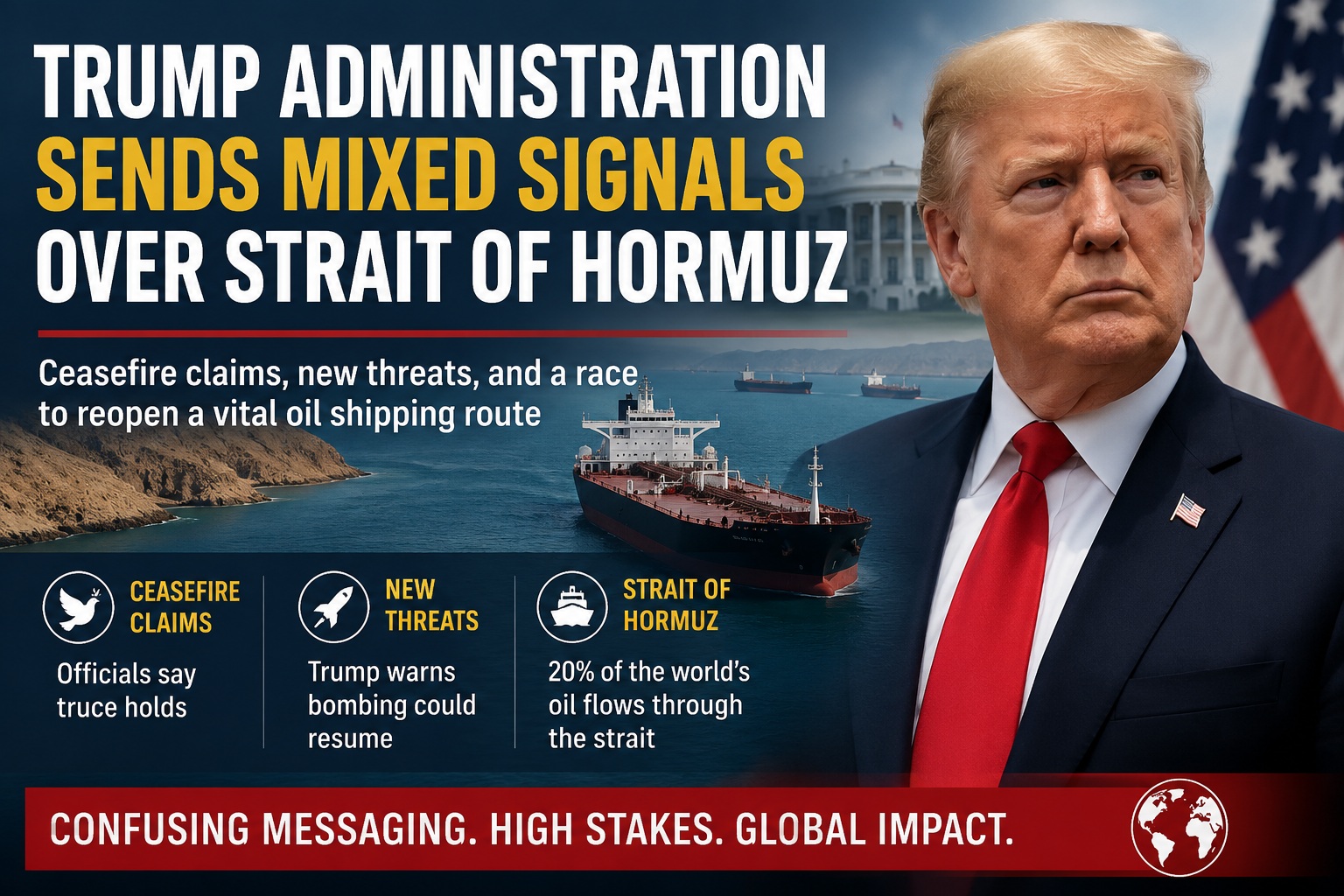
The Trump administration has projected increasingly inconsistent messages regarding the conflict with Iran and ongoing efforts to reopen the Strait of Hormuz, oscillating between declarations that military operations had ended and renewed threats of further escalation.
Within the span of 24 hours, officials shifted from emphasizing a fragile ceasefire to warning Tehran of intensified military strikes if it failed to comply with U.S. demands.
On Tuesday morning, Defense Secretary Pete Hegseth stated that American forces were conducting a defensive mission aimed at protecting stranded commercial vessels navigating the Strait of Hormuz. He maintained that the ceasefire remained intact despite Iranian missile and drone attacks targeting U.S. forces, which reportedly responded by sinking several Iranian fast-attack boats.
Later that day, Secretary of State Marco Rubio announced at the White House that the military campaign had officially concluded and that Washington had achieved its primary objectives. However, he simultaneously stressed that President Donald Trump was still pursuing a diplomatic agreement with Iran to ensure the reopening of the strategic maritime corridor, through which roughly 20% of global oil supplies transit.
By Tuesday evening, Trump declared that operations to escort ships through the strait would be temporarily suspended pending the outcome of negotiations. Yet by Wednesday morning, the president reverted to a more confrontational tone, warning that military strikes would resume — “at a much higher level and intensity” — if Tehran rejected American conditions.
The administration’s rapidly changing narrative throughout the conflict has generated mounting uncertainty about Washington’s broader strategy toward Iran and the future of the Strait of Hormuz crisis. Statements from the president and senior officials have often appeared contradictory, reflecting a policy approach that critics say has evolved dramatically within hours.
Officials are attempting to balance two competing priorities: preserving the ceasefire while restoring safe passage through one of the world’s most critical energy routes. Meanwhile, the economic repercussions continue to grow as rising fuel prices place increasing political pressure on Republicans ahead of upcoming midterm congressional elections.
Concerns Over Strategy and Messaging
Analysts say the administration’s communication difficulties stem partly from the speed and unpredictability of the conflict itself.
Elizabeth Dent, a senior fellow at the Washington Institute for Near East Policy and former State Department and Pentagon official, argued that the war lacked a coherent public strategy from the outset.
“Because it unfolded so rapidly, the administration never effectively explained the conflict to the American public in a convincing way,” Dent said. “Trump now appears focused on preventing a return to large-scale hostilities after recognizing the political costs and public dissatisfaction surrounding the war.”
Throughout the crisis, Trump has repeatedly shifted his definition of success, offered ambiguous interpretations of the ceasefire, and advanced controversial views regarding presidential authority over prolonged military operations without congressional approval.
According to analysts, the confusion has also been amplified by Trump’s tendency to make spontaneous public statements that effectively shape policy in real time, leaving senior officials such as Rubio and Hegseth tasked with clarifying or reframing the administration’s position afterward.
Ali Vaez, Iran director at the International Crisis Group, described the administration’s decision-making process as highly reactive rather than strategic.
“This is not an administration driven by a traditional policy process,” Vaez said. “It operates largely on impulse, and the president now appears both exhausted by the conflict and reluctant to spend additional political capital on it.”
Contradictory Signals on the Strait of Hormuz
Recent developments have highlighted the inconsistencies in Washington’s approach.
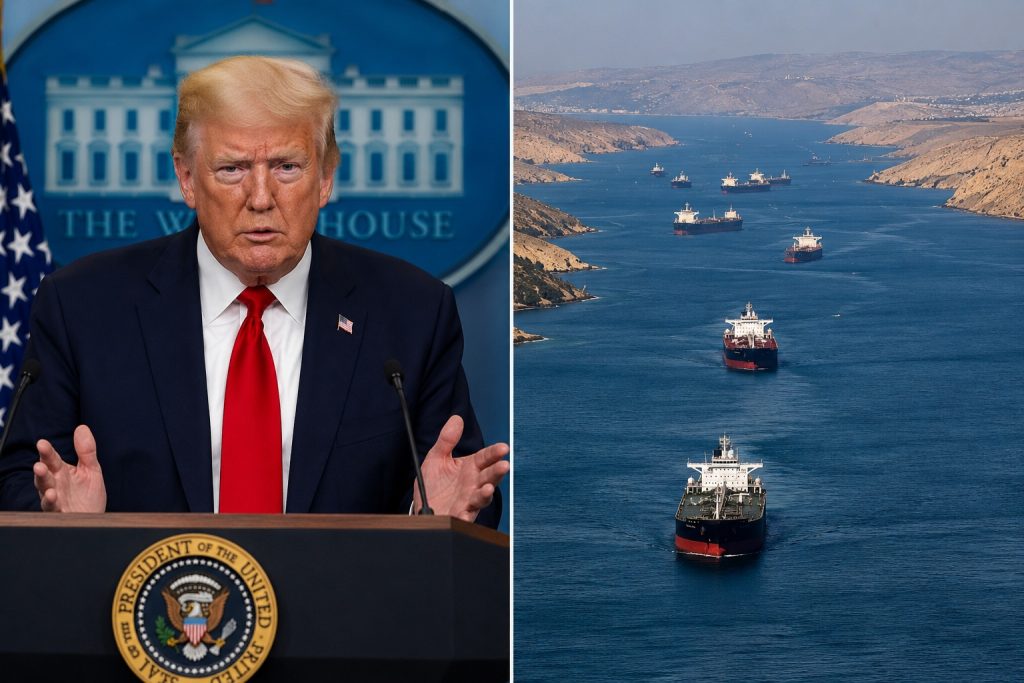
Trump announced Sunday that U.S. forces would guide hundreds of stranded commercial vessels safely through the strait after Iran effectively disrupted shipping traffic through attacks near its coastline.
On Tuesday, Hegseth and Joint Chiefs Chairman Gen. Dan Caine confirmed that two American-flagged cargo ships had entered the waterway as part of the mission. They also revealed that U.S. forces engaged Iranian units after Tehran targeted American vessels, resulting in the destruction of six Iranian attack boats.
Despite the exchange, Hegseth insisted the ceasefire remained in effect, while Caine argued that the Iranian attacks did not constitute a return to “major combat operations.”
Rubio later reiterated that diplomacy remained Trump’s preferred option, emphasizing that “Operation Epic Fury” — the codename for the joint U.S.-Israeli campaign against Iran — had achieved its goals.
“The president would prefer a deal,” Rubio said.
Hopes for progress briefly increased Tuesday night when Trump announced via social media that escort operations in the strait would be paused to allow room for negotiations. However, the president renewed his threats hours later, warning Iran that failure to comply would trigger a far more severe bombing campaign.
Meanwhile, the U.S. military announced Wednesday that it had fired upon and disabled an Iranian oil tanker allegedly attempting to breach restrictions imposed on Iranian shipping.
Allies Reluctant to Join U.S. Efforts
Further uncertainty has surrounded Washington’s attempts to persuade allies to participate in securing the Strait of Hormuz.
Trump has publicly criticized countries reluctant to contribute militarily, at one point telling allies to “go get your own oil” while questioning why the United States should bear sole responsibility for protecting global shipping routes.
Nevertheless, administration officials have quietly intensified diplomatic efforts to recruit international support while moderating their public rhetoric.
Rubio acknowledged that many countries lacked the naval capabilities necessary to participate effectively.
“A lot of countries would like to help, but they simply don’t have the resources or the ability to deploy quickly,” he said.
Following Trump’s abrupt suspension of escort operations, U.S. officials indicated that internal discussions were still ongoing regarding the future of the mission and whether formal requests for allied support would remain in place.
European allies including Britain and France have resisted suggestions that they directly join U.S.-led military operations. However, both countries are reportedly preparing a separate maritime security initiative focused on protecting shipping once immediate hostilities subside. France has already begun repositioning its aircraft carrier strike group toward the Red Sea ahead of a potential joint British-French mission.
The situation has become even more politically sensitive ahead of Trump’s planned visit to Beijing next week.
Analysts warn that traveling to China while the Strait of Hormuz remains partially disrupted could weaken Washington’s strategic position and increase Beijing’s diplomatic leverage.
“Going to China while the strait remains closed places President Trump in an uncomfortable position,” Vaez said. “It effectively forces the United States to seek China’s assistance in resolving a crisis that emerged after the outbreak of war.”
Source: AP news