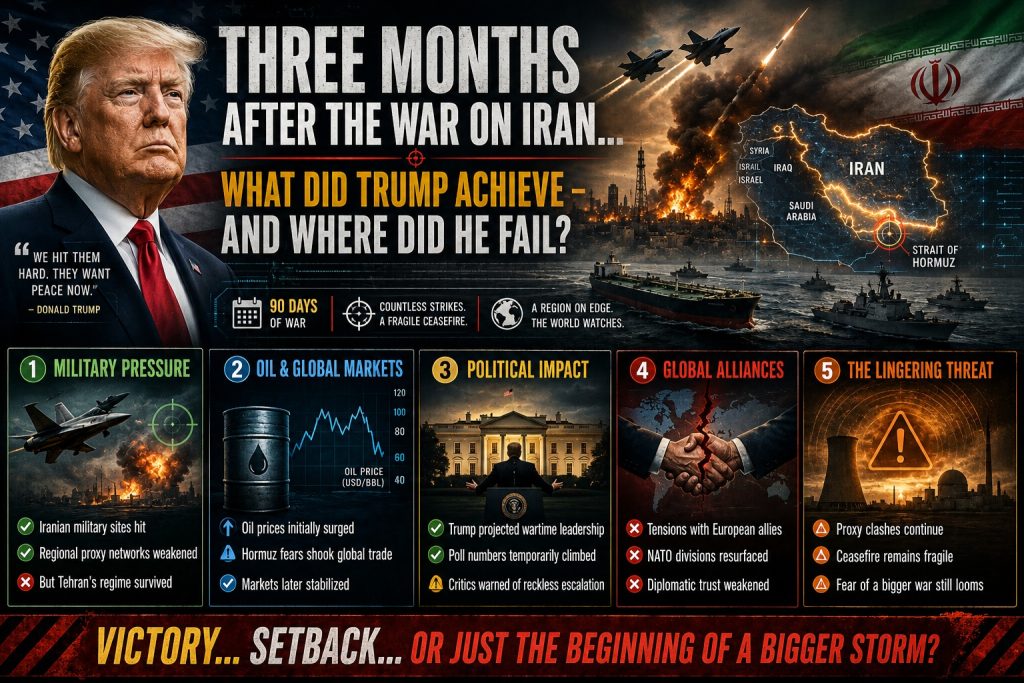

For 90 days, the world held its breath.
From the burning waters of the Gulf to the underground bunkers of Tehran, the war between the United States and Iran reshaped the Middle East in ways few imagined possible. Missiles streaked across the night sky. Oil markets convulsed. Cyberattacks struck critical infrastructure. Diplomats disappeared behind closed doors while military aircraft roared overhead.
And at the center of it all stood Donald Trump — once again commanding a presidency defined by confrontation, spectacle, and high-risk gambles.
Three months after the guns fell mostly silent, a fierce debate is raging across Washington, Tehran, and global capitals alike: Did Trump emerge victorious from the most dangerous conflict of his political career, or did the war expose the limits of American power in a rapidly changing world?
The answer may depend on where one looks.
A Presidency Reforged by War
When the first strikes erupted, Trump framed the conflict as a battle for deterrence and survival. The White House argued that Iran’s expanding regional influence and accelerating military capabilities had crossed a red line that could no longer be ignored.
Within days, the United States launched waves of precision strikes targeting Iranian military infrastructure, missile depots, and Revolutionary Guard facilities. Tehran retaliated with missile barrages, proxy attacks across the region, and threats to disrupt one of the world’s most vital shipping lanes — the Strait of Hormuz.
The danger of regional collapse suddenly felt real.
American bases across the Middle East were placed on maximum alert. Gulf states scrambled air defenses. Israel prepared for escalation on multiple fronts. Intelligence agencies warned that a single miscalculation could ignite a wider war stretching from Lebanon to the Red Sea.
Yet Trump pressed forward.
Supporters inside the administration claimed the aggressive response shattered Iran’s military momentum and forced Tehran back to the negotiating table. In conservative media and among Republican allies, the operation was portrayed as proof that Trump had restored American fearlessness after years of hesitation abroad.
What Trump Achieved
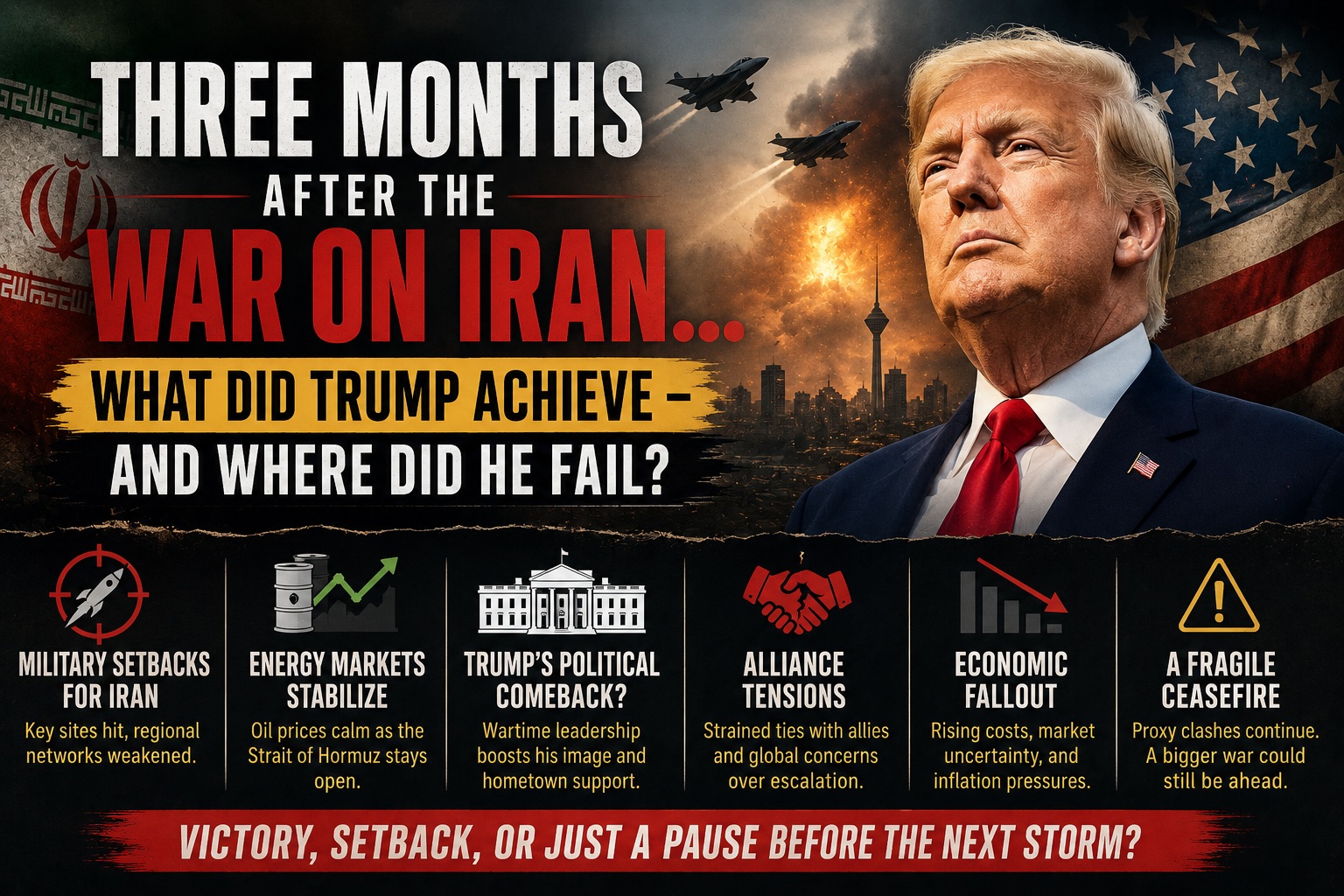
Iran’s Military Network Was Weakened
One of the clearest outcomes of the conflict was the damage inflicted on Iran’s regional military infrastructure. Several key bases, weapons depots, and command facilities suffered significant destruction during the opening weeks of the war.
Iran-backed militias in Iraq and Syria reportedly reduced operations following the strikes, while some commanders went underground fearing further targeting.
For Trump, this became a central political victory: projecting strength through overwhelming force.
Oil Markets Stabilized Faster Than Expected
At the start of the war, global markets panicked. Oil prices surged amid fears that Iran could choke maritime traffic through the Gulf, triggering a global energy shock.
But despite repeated threats, Tehran stopped short of fully closing the Strait of Hormuz. A massive US naval presence and coordinated international pressure helped prevent a worst-case scenario.
By the second month, markets had calmed far faster than analysts predicted — a development the White House eagerly celebrated.
Trump Reclaimed the “Commander-in-Chief” Image
The war dramatically transformed Trump’s political image heading into a deeply polarized election climate.
For months before the conflict, critics accused him of political chaos and weakening American alliances. But wartime optics changed the narrative. Images of Situation Room briefings, military deployments, and high-stakes diplomacy allowed Trump to rebrand himself as a wartime leader commanding a global crisis.
Poll numbers briefly surged as nationalist sentiment intensified across parts of the United States.
But the Failures Were Impossible to Ignore
Behind the triumphant rhetoric, cracks quickly began to appear.
Iran Survived — and Adapted
Despite the devastating strikes, Iran’s government did not collapse.
Its military command structure absorbed the blows faster than many Western analysts expected. Underground facilities remained operational. Missile production resumed in some sectors. And Tehran rapidly shifted toward asymmetric tactics designed to exhaust American pressure over time.
Instead of surrender, Iran entered survival mode.
The regime used the conflict to fuel nationalist anger, portraying itself as the target of foreign aggression. Massive state-organized rallies filled the streets of Tehran, while hardliners gained renewed influence inside the Iranian political system.
For critics of the war, this represented a strategic failure: Trump may have weakened Iran militarily, but he also strengthened the regime politically.
America’s Global Alliances Took a Hit
The conflict exposed deep fractures between Washington and several European allies.
While countries such as the United Kingdom offered varying degrees of support, others privately questioned whether the escalation could have been avoided. International calls for restraint grew louder as civilian infrastructure damage and economic fallout spread across the region.
Behind diplomatic smiles, tensions simmered.
Some NATO officials feared the war diverted attention and resources from broader global threats, including rising tensions with China and instability in Eastern Europe.
The Economic Shock Never Fully Disappeared
Although energy markets stabilized, the broader economic impact lingered.
Shipping insurance costs soared. Airlines rerouted major flights. Global investors shifted assets amid fears of prolonged instability. In the United States, inflation concerns returned as fuel and defense spending climbed simultaneously.
For ordinary Americans already struggling with economic pressure, the war became another source of uncertainty rather than reassurance.
The Shadow of a Bigger War Still Remains
Perhaps the most dangerous reality is that the conflict never truly ended.
The ceasefire remains fragile. Proxy clashes continue across the Middle East. Intelligence officials warn that Iran may accelerate unconventional military programs in response to the strikes.
In Washington, military planners privately acknowledge a chilling possibility: the next confrontation could arrive with even greater intensity.
And unlike the first round, the next one may not remain contained.
The Trump Doctrine: Power Through Pressure
The war ultimately revealed the essence of Trump’s foreign policy philosophy — overwhelming pressure, rapid escalation, and the belief that unpredictability itself can be a weapon.
To supporters, that strategy forced adversaries to think twice and restored American dominance after years of perceived weakness.
To critics, it pushed the world dangerously close to catastrophe without delivering a decisive long-term solution.
Three months later, the battlefield smoke has faded, but the political and geopolitical aftershocks continue to spread.
Trump proved he was willing to gamble.
The question haunting Washington now is whether the gamble bought America time… or merely delayed a larger and even more dangerous confrontation waiting beyond the horizon.