

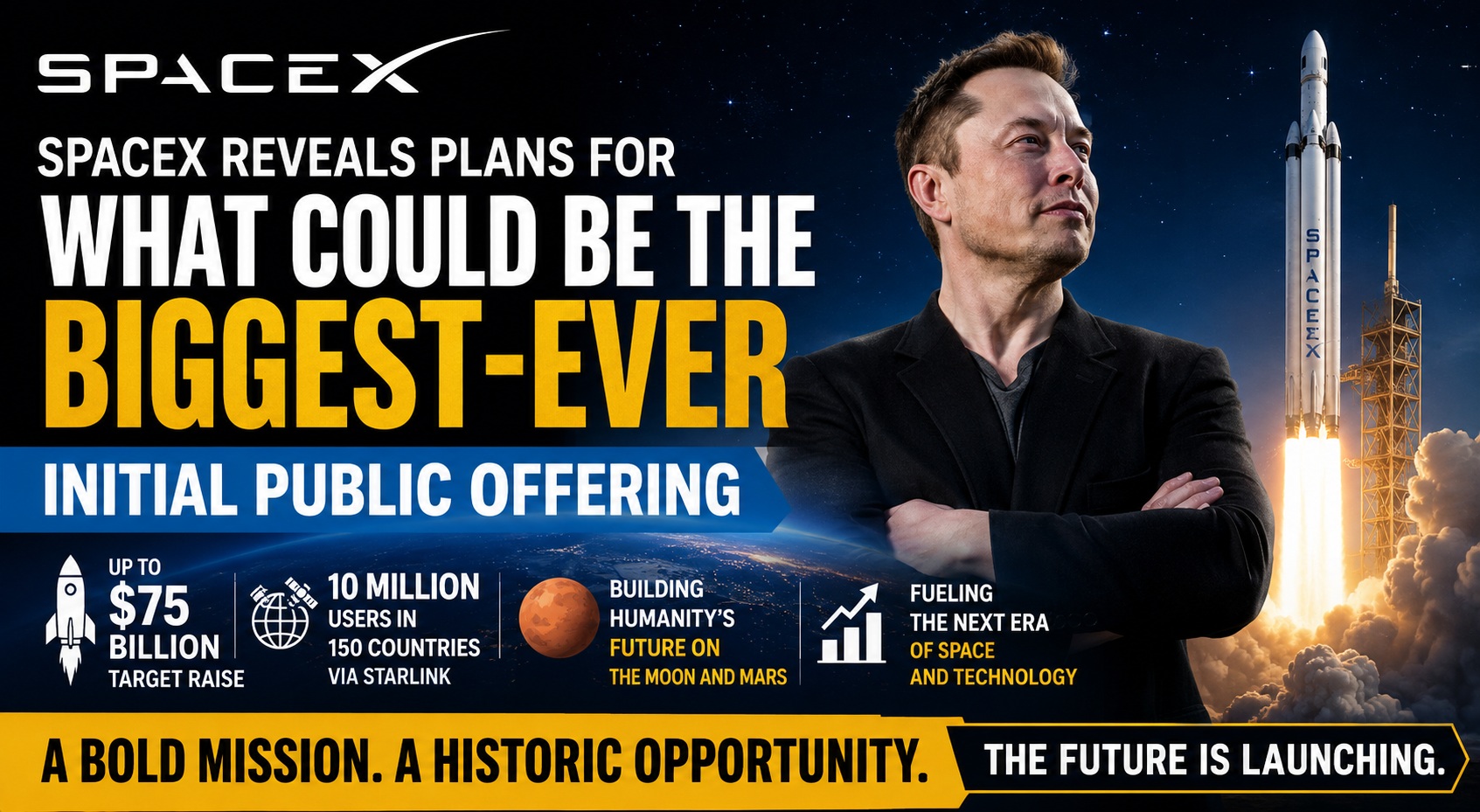
In a move that sent shockwaves through both Silicon Valley and Wall Street, Elon Musk unveiled plans for what may become the most explosive initial public offering in financial history — a colossal stock market launch for SpaceX, the private space empire that has burned through billions while chasing humanity’s destiny among the stars.
Behind the spectacle lies a staggering reality.
Newly released financial documents reveal that SpaceX hemorrhaged $2.6 billion in operating losses last year despite pulling in an enormous $18.7 billion in revenue. And the bleeding hasn’t stopped. Losses reportedly continued mounting in the opening months of 2026, even as Musk prepares to throw open the gates to public investors.
But this isn’t just another tech IPO.
Reports suggest Musk is aiming to raise an astronomical $75 billion — a figure so massive it would shatter records set by Saudi Aramco, whose historic public debut raised $26 billion and once seemed untouchable.
For Musk, however, this isn’t merely about money.
It’s about survival.
Buried inside the prospectus is a chilling declaration of purpose: humanity must become an interplanetary species before catastrophe wipes civilization from existence.
“We do not want humans to have the same fate as dinosaurs,” the filing warns.
The document reads less like a corporate report and more like the blueprint of a sci-fi empire preparing for liftoff. One section outlines extraordinary compensation terms for Musk himself — rewards tied not simply to profits or stock prices, but to the creation of a permanent human colony on Mars housing at least one million people.
If SpaceX succeeds, Musk may not only reach Mars before most governments — he could become the world’s first trillionaire.
According to Forbes, his current fortune already stands at roughly $839 billion.
Yet beneath the roaring rockets and futuristic promises lies a far more dangerous battlefield.
SpaceX’s crown jewel, the satellite internet giant Starlink, has become the company’s financial lifeline, generating $4.4 billion in operating income last year. Using a vast constellation of nearly 10,000 satellites, the system now delivers internet access to 10 million users across 150 countries and territories.
But not every Musk venture is flying smoothly.
The filing exposes severe turbulence inside Musk’s recently absorbed businesses — including X, formerly Twitter, and his artificial intelligence company xAI. Critics among investors have accused Musk of using SpaceX as a rescue ship for failing ventures drowning in losses. The documents reveal xAI alone lost a staggering $6.4 billion in operations last year.
And then comes the political shadow hovering over the launchpad.
SpaceX’s meteoric rise has been fueled heavily by U.S. government contracts worth nearly $6 billion from agencies including NASA and the Defense Department. Nearly one-fifth of the company’s revenue last year came directly from the federal government.
That relationship has ignited growing scrutiny due to Musk’s close ties with Donald Trump. Watchdogs and ethics lawyers are increasingly questioning whether Musk benefited from political favoritism — and whether SpaceX’s golden era could face turbulence once political winds shift in Washington.
Still, Musk appears determined to tighten his grip on the empire.
The filing reveals a powerful dual-class stock structure that would hand Musk and select insiders extraordinary voting control — ten votes per share — effectively allowing them to dominate the company’s future regardless of outside investors.
Potential shareholders were bluntly warned:
“This will limit or preclude your ability to influence corporate matters.”
And perhaps the most surreal twist of all?
Musk’s ultimate reward package only fully unlocks if SpaceX reaches an almost unimaginable market value of $7.5 trillion — and if humanity begins building massive colonies and football-field-sized data centers in space.
The countdown has already begun.
Within weeks, SpaceX could launch its high-stakes “road show,” a global campaign to lure investors into Musk’s most ambitious gamble yet — a bet not just on rockets, but on the future survival of humanity itself.
Source: AP news