
Jensen Huang Reinstated as Nvidia CEO: China Spy Allegations, Trump Intervention and 30% Stock Surge
Imagine running the world’s most influential AI chipmaker. Your technology powers artificial intelligence systems, data centers, military research and the next generation of global computing.
Then, almost overnight, your leadership becomes the center of an international intelligence controversy.
That is the extraordinary situation surrounding Nvidia.
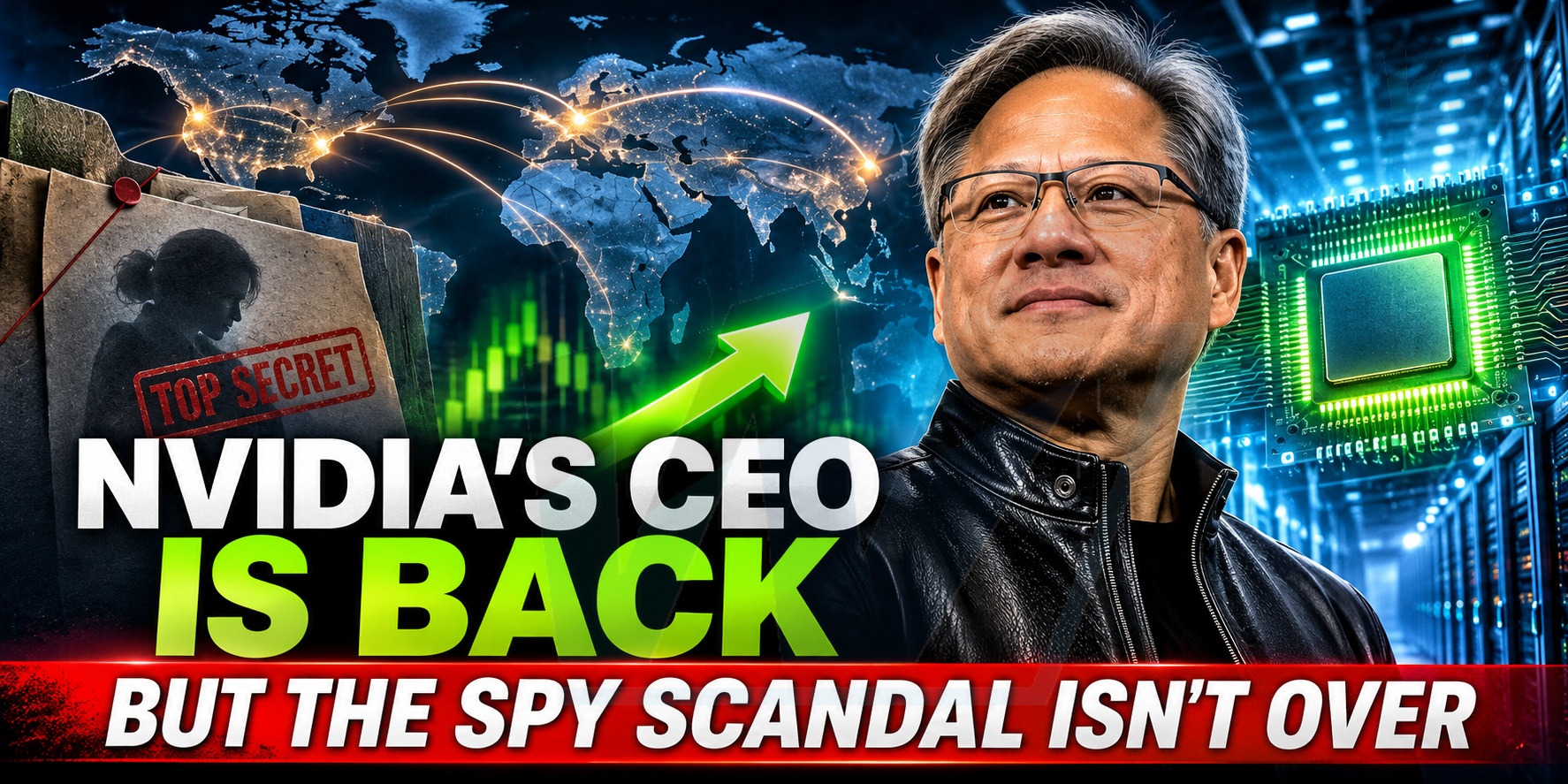
On Monday, November 23, the company announced that Jensen Huang was returning as president, chief executive officer and board member, effective immediately. The decision reverses an earlier rejection of his return and comes just 11 days after his resignation.
The board’s explanation was striking after consulting senior US government officials, directors concluded that Huang’s reinstatement posed no national security risk.
The market’s reaction was immediate. Nvidia shares surged close to 30% in premarket trading, while US technology stock futures rallied sharply.
But beneath the financial celebration lies a much bigger question:
Has Nvidia closed a damaging chapter, or has the most sensitive part of the story only just begun?
The 11-day reversal: How Nvidia changed its mind
The timeline reveals just how dramatically the crisis unfolded.
- November 12: Huang resigned after reports of an extramarital relationship with Alice Huang, a former executive at Singapore-based Megaspeed International.
- November 17: Nvidia’s board publicly ruled out reinstating him, while establishing a new committee to oversee national security and export-control compliance.
- November 19: US lawmakers intensified scrutiny of the government’s handling of the Megaspeed investigation.
- November 22: President Trump publicly called for Huang’s return, describing him as one of the world’s most brilliant minds.
- November 23: Nvidia’s board unanimously reversed its position and reinstated Huang with immediate effect.
The reversal was remarkable not simply because a CEO returned, but because the board had previously insisted that his departure was settled.
Chairman Harvey Jones, who had maintained that Huang would not return, now says directors believe he is the right person to lead Nvidia.
Huang’s response was brief but revealing. He said he accepted the responsibility with humility and renewed commitment, thanking the board, employees, shareholders, partners and his family.
Colette Kress, who had taken over as interim CEO, will return to her position as chief financial officer. Jones will remain chairman.
The company has effectively restored its familiar leadership structure, but the investigation surrounding its former chief executive remains active.
The Alice Huang connection: Where business, intelligence and personal relationships collide
At the center of the controversy is Alice Huang, a Chinese businesswoman formerly associated with Megaspeed International, a Singapore-based company that purchased substantial quantities of Nvidia technology.
The latest revelations have made the situation considerably more complicated.
According to reporting by The New York Times, cited by Reuters, Alice Huang maintained contact with an official from China’s Ministry of State Security between spring 2025 and autumn 2026. This period overlapped with her reported relationship with Jensen Huang.
The intelligence reporting also reportedly links her business associate, Kang Wei, to the same Chinese intelligence agency.
These allegations have not been established in a public criminal finding.
Importantly, US authorities have not publicly established that Alice Huang actually transferred Nvidia’s confidential information to Beijing. ABC News reported that it remained unclear whether intelligence evidence showed that she actively passed inside information to Chinese officials.
That distinction matters.
Contact with an intelligence official, suspected espionage and proven theft of corporate secrets are three different things. Treating them as interchangeable would be misleading.
Jensen Huang’s spokesperson declined to comment on the latest intelligence reporting, according to Reuters.
Megaspeed: The investigation that could become bigger than the scandal
The most consequential part of this story may not be the personal relationship. It may be the business network surrounding it.
In a joint statement dated November 16, the US Departments of Commerce and Justice revealed that the Commerce Department had begun investigating Megaspeed in 2024 after identifying suspicious activity involving the potential diversion of sensitive semiconductors.
Investigators requested records from Nvidia in May 2025 concerning direct and indirect sales to Megaspeed.
A month later, Nvidia placed Megaspeed on its internal no-sell list.
In June 2025, US Commerce Department investigators, working with Singaporean law enforcement officials, conducted an on-site inspection at Megaspeed and interviewed Alice Huang.
The Justice Department subsequently assumed the lead role in the criminal investigation.
This is a crucial distinction: the investigation into Megaspeed concerns potential export-control violations and possible semiconductor diversion. It is not proof that Nvidia knowingly participated in illegal shipments or that Jensen Huang committed an offence.
Megaspeed has said it operates lawfully and takes its compliance obligations seriously.
Washington enters the picture: Trump’s intervention changes the equation
Nvidia’s decision also unfolded against a sensitive political backdrop.
President Donald Trump publicly supported Huang’s return, arguing that Nvidia would benefit from giving its co-founder another opportunity.
On Monday, Trump welcomed the board’s decision, calling it the correct and proper move.
But the political dimension extends beyond the president’s public statements.
US lawmakers have been demanding answers about how the government handled the Megaspeed investigation, including whether Nvidia had been allowed to influence the enforcement process.
On November 19, Democratic lawmakers wrote to Commerce Secretary Howard Lutnick seeking information about the department’s handling of the case.
Their concerns included whether a major corporation had been able to interfere with an investigation into possible violations of American export restrictions.
Nvidia has defended its engagement with government officials, saying American companies routinely communicate with relevant departments to provide information and obtain guidance.
The controversy therefore raises two separate questions:
- Were sensitive American AI technologies adequately protected against diversion to China?
- Were government enforcement decisions handled independently and transparently?
Those questions remain important regardless of Huang’s return.
Beijing pushes back: The espionage allegations remain disputed
China has rejected the allegations involving Alice Huang.
Chinese Foreign Ministry spokesperson Guo Jiakun previously described the so-called Chinese spy narrative as baseless and an attempt to smear China.
Beijing’s response reflects a wider geopolitical conflict over advanced computing, semiconductor exports and artificial intelligence leadership.
For Washington, access to advanced AI chips is a national security issue. For Beijing, restrictions on Chinese access to American technology are part of a broader struggle over technological development and economic sovereignty.
Nvidia sits directly between these competing interests.
The company’s products are not ordinary consumer electronics. Its advanced graphics processing units (GPUs) are essential components in large-scale AI training, scientific research, cloud computing and other strategically important applications.
That makes the question of who can access these chips, and where their computing power ultimately ends up, a matter of international significance.
Wall Street’s verdict: A 30% comeback, but is the danger over?
Investors did not wait for the investigation to finish.
Following the reinstatement announcement, Nvidia shares climbed approximately 29.5% in premarket trading, with other reports putting the increase close to 30%.
The stock subsequently rose approximately 33% at the opening bell, according to the Associated Press.
The reaction reflected the importance of leadership continuity at a company that has become central to the global AI investment boom.
Huang is more than an executive. He is the public face of Nvidia’s transformation from a graphics-chip manufacturer into one of the world’s most strategically important technology companies.
His departure had shaken investor confidence, adding pressure to an already nervous AI market.
His return provided immediate relief.
But one day’s market performance does not settle the company’s longer-term risks.
Nvidia’s next move: An unprecedented focus on national security
Perhaps the most revealing element of Monday’s announcement was what Nvidia did not cancel.
The independent directors’ investigation into whether Huang was targeted by a foreign intelligence effort will continue until completion.
Huang has agreed to cooperate.
In addition, Nvidia has established a separate National Security and Export Control Committee to oversee trade compliance and national security risks.
The company is also beginning a search for a new chief compliance officer, who will oversee compliance across its operations and report to the board’s Nominating and Corporate Governance Committee.
These measures suggest that the board understands that restoring its chief executive is only one part of restoring confidence.
The company must also demonstrate that its governance, internal controls and international trade practices can withstand scrutiny.
Why this story matters far beyond Silicon Valley
This is not simply a corporate scandal involving a powerful executive and a controversial personal relationship.
It exposes the increasingly complicated intersection of five major global forces:
- Artificial intelligence: Advanced chips are becoming the infrastructure of the next industrial revolution.
- National security: Access to computing power can influence military capabilities, intelligence operations and cyber defense.
- US-China competition: Semiconductor exports have become instruments of economic and geopolitical power.
- Corporate governance: Technology companies must demonstrate that commercial relationships do not undermine national security.
- Financial markets: Investors are increasingly sensitive to political decisions, regulatory uncertainty and leadership stability.
For younger generations, the story offers another lesson: the AI revolution is not happening in a technological vacuum. Behind every chatbot, intelligent application and advanced data center is an international network of companies, governments, investors and strategic interests.
For businesses, it is a reminder that relationships, compliance and transparency can carry consequences far beyond the boardroom.
For governments, it is a warning that controlling access to strategic technology is becoming increasingly difficult in a deeply interconnected world.
The final question: Is Jensen Huang back in control, or is Nvidia entering a new era of scrutiny?
Jensen Huang has reclaimed his position.
The board has reversed its decision. Trump has welcomed the move. Investors have responded with extraordinary enthusiasm.
But the independent investigation remains open. The Megaspeed case continues. The allegations surrounding Alice Huang remain contested and unresolved. And Washington’s questions about semiconductor security are not disappearing.
Nvidia may have restored its leadership.
It has not yet restored every element of certainty.