

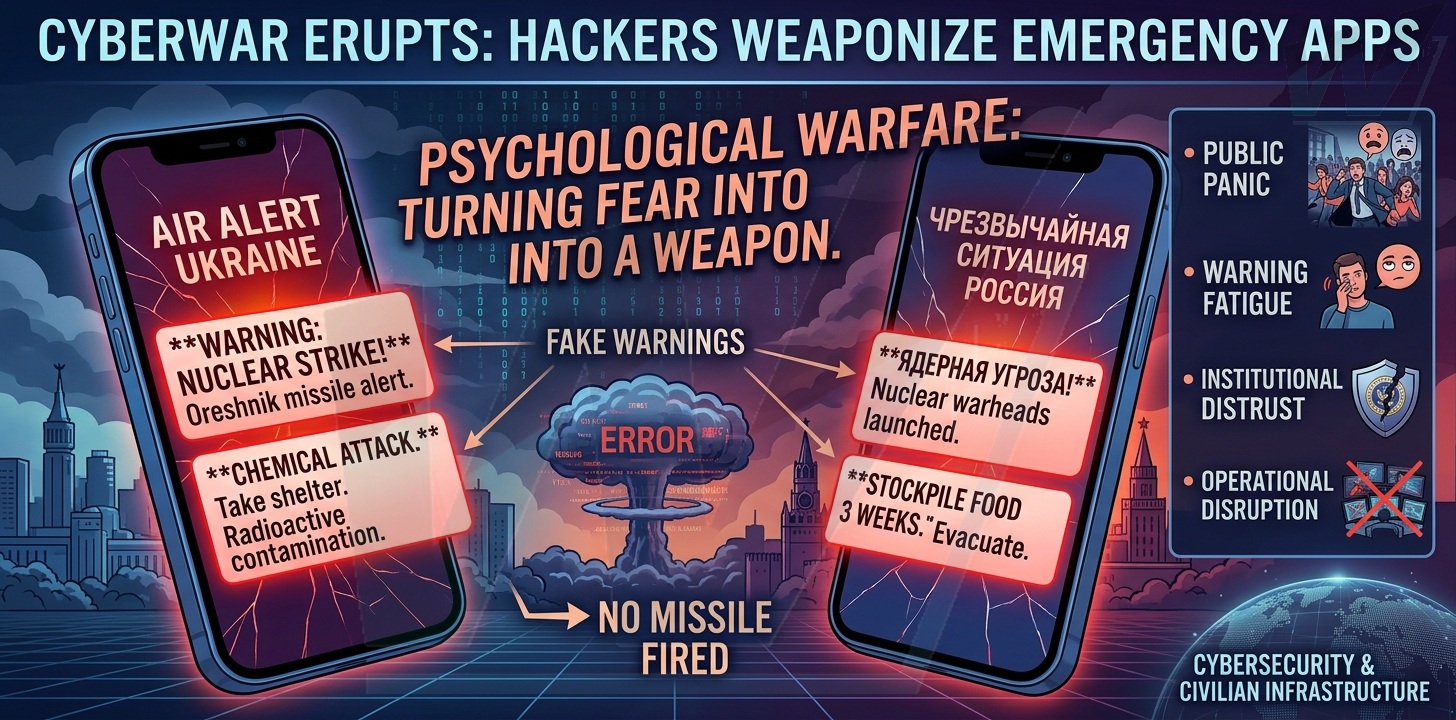
Nuclear Panic Without a Missile: Hackers Breach Emergency Apps in Ukraine and Russia
Cyberattack Shocks Kyiv and Moscow: Fake Oreshnik and Nuclear Warnings Flood Smartphones
From Kyiv to Moscow: Hackers Turn Emergency Warning Apps into Psychological Weapons
KYIV / MOSCOW
A terrifying digital deception struck both sides of the Russia-Ukraine war overnight, as hackers reportedly breached emergency alert applications in Ukraine and Russia, flooding mobile phones with fabricated warnings of nuclear strikes, radioactive contamination, chemical attacks and imminent street battles.
In Kyiv, residents received messages claiming that Russia had launched its nuclear-capable Oreshnik hypersonic missile. Hours later, Moscow confirmed that its own Emergency Situations Ministry application had suffered a massive cyberattack, allowing attackers to distribute false nuclear warnings across Russian regions.
The two incidents have exposed a dangerous new front in the conflict: when emergency warning systems become weapons of psychological warfare, the battlefield can reach directly into civilians’ homes, without a single missile being fired.
Kyiv wakes to fake nuclear and chemical warnings
The first incident unfolded shortly before 11 p.m. on Sunday, November 1, when Ukraine’s nationwide Air Alert application began transmitting a series of alarming false notifications.
Residents in Kyiv and other areas received warnings of radioactive contamination, an impending chemical attack and alleged street fighting in the capital.
One particularly provocative message claimed that Russia had launched its Oreshnik hypersonic missile, capable of carrying a nuclear warhead, and declared a nuclear emergency across Ukraine.
The messages, some written in Russian, appeared to mimic genuine emergency notifications but contained suspicious language and grammatical errors.
Ukraine’s Air Force quickly intervened, warning that the application had apparently been subjected to hostile interference.
“There is no radiation threat,” authorities stressed, urging citizens to remain calm and follow verified military communications.
Ukraine’s Ministry for Digital Transformation suspended the compromised application while specialists addressed the incident. Other emergency communication channels, including conventional air-raid sirens, continued operating.
The application was subsequently restored, according to Ukrainian authorities.
Moscow reports its own cyberattack
The digital alarm spread eastward.
Hours after the Ukrainian incident, Russia’s Ministry of Emergency Situations confirmed that hackers had compromised its mobile application, distributing fabricated warnings to the public.
According to the ministry’s November 2 statement, attackers penetrated the application’s administration panel and sent false notifications across 33 Russian regions.
One fraudulent message claimed that nuclear warheads had been launched against Russian territories, urging residents to stockpile food for three weeks and seek shelter in their cellars.
The message was deliberately provocative, using insulting language and derogatory references to Russian regions.
Russia’s Emergencies Ministry said specialists had isolated the affected services and were working to eliminate the vulnerability and restore normal operations.
Officials also sought to contain public anxiety, emphasizing that the country’s wider emergency warning infrastructure remained functional.
SMS alerts, television and radio broadcasts, sirens and municipal loudspeakers continued operating.
Who hacked the warning systems?
That remains the most important unanswered question.
Ukraine’s Air Force described its incident as hostile interference, while Ukrainian strategic communications officials blamed Russia.
However, no independently verified technical evidence has established who carried out the breach.
In Russia, the Emergencies Ministry confirmed the cyberattack but did not publicly identify the perpetrators.
The Russian Telegram Channel Mash mentioned the hacking group Hitcore in connection with the Ukrainian incident, claiming that the group had acknowledged responsibility. That claim remains unverified.
Pro-Ukrainian hacking group Atesh also circulated material concerning the Russian application.
Yet claims circulating on Telegram are not proof of responsibility, and investigators have not established whether the two attacks were connected, coordinated or carried out by separate actors.
For now, the possibility of competing cyber operations remains open.
The psychological battlefield: Turning fear into a weapon
The significance of the attacks extends beyond compromised software.
Emergency applications occupy a uniquely sensitive position in wartime societies. Citizens rely on them to distinguish between safety and imminent danger, knowing that a genuine warning can mean the difference between life and death.
By inserting fabricated nuclear and chemical alerts into these systems, attackers can undermine public confidence in the very infrastructure designed to protect civilians.
The consequences could be serious:
- Public panic: False warnings can trigger unnecessary evacuations and widespread anxiety.
- Warning fatigue: Repeated false alarms may cause people to ignore genuine emergencies.
- Institutional distrust: Citizens may begin questioning official instructions and emergency communications.
- Operational disruption: Authorities must divert resources to investigate, correct misinformation and reassure the public.
- Psychological warfare: Nuclear language and references to advanced weapons can amplify fear far beyond the immediate area of an attack.
The most dangerous outcome may not be the temporary disruption of an application, but the erosion of public trust in emergency warnings.
The Oreshnik factor: Why the fake message mattered
The reference to Russia’s Oreshnik missile was particularly provocative.
The intermediate-range ballistic missile system has become one of Moscow’s most closely watched strategic weapons because of its potential nuclear capability and role in Russia’s military messaging.
By invoking Oreshnik, the attackers exploited an existing fear surrounding the possibility of nuclear escalation.
But the Ukrainian Air Force explicitly rejected the warning: there was no radiation threat and no confirmation of an incoming nuclear strike.
The fabricated message therefore represented psychological manipulation, not evidence of an actual nuclear attack.
A fragile ceasefire expires as cyberwar escalates
The incidents came at a particularly sensitive moment.
A six-day localized humanitarian ceasefire in the Kherson region, centered on the Russian-occupied town of Oleshky, expired on Sunday, November 1.
The truce had enabled evacuation efforts and humanitarian assistance to civilians trapped in dangerous conditions.
The arrangement followed mediation involving US First Lady Melania Trump and Pope Leo XIV, making it an unusual diplomatic initiative amid the continuing war.
Associated Press reported that the humanitarian operation enabled the evacuation of civilians and the rescue of pets. Ukrainian authorities also warned that renewed fighting could follow the ceasefire’s expiry.
The coincidence between the end of the truce and the cyberattacks has intensified concerns about a broader escalation.
However, there is no established evidence connecting the expiration of the ceasefire to the hacking operations.
A warning for Europe and NATO
The simultaneous incidents carry implications far beyond Ukraine and Russia.
European governments and NATO members increasingly face the challenge of protecting civilian infrastructure against cyberattacks targeting communications, transportation, energy networks and emergency services.
The latest breaches demonstrate that digital infrastructure can become a battlefield even when physical warning systems and military command networks remain operational.
For countries bordering the conflict zone, the message is particularly urgent: emergency communication systems must be protected against unauthorized access, fabricated messages and attempts to manipulate public behavior.
The attacks also reinforce the importance of maintaining multiple independent warning channels so that a compromised mobile application cannot become a single point of failure.
The next front may be inside every smartphone
The immediate nuclear warnings were false. The radiation threat in Kyiv was not real, and Russia’s official statements did not indicate an actual nuclear attack.
But the incident exposed a genuine vulnerability.
In a war where missiles and drones already threaten civilian populations, the integrity of emergency communications has become a matter of national security.
Ukraine and Russia have spent years developing systems to warn their populations about incoming attacks. Now, those very systems have become targets.