

From a Prison Empire to a Fiery Finale in the Jungles of Southern Venezuela
The explosion lasted only seconds.
A projectile streaked across the sky. A small building with a green roof disappeared into a burst of fire and debris. Within hours, officials in Washington and Caracas were delivering a message that would reverberate across the Americas:
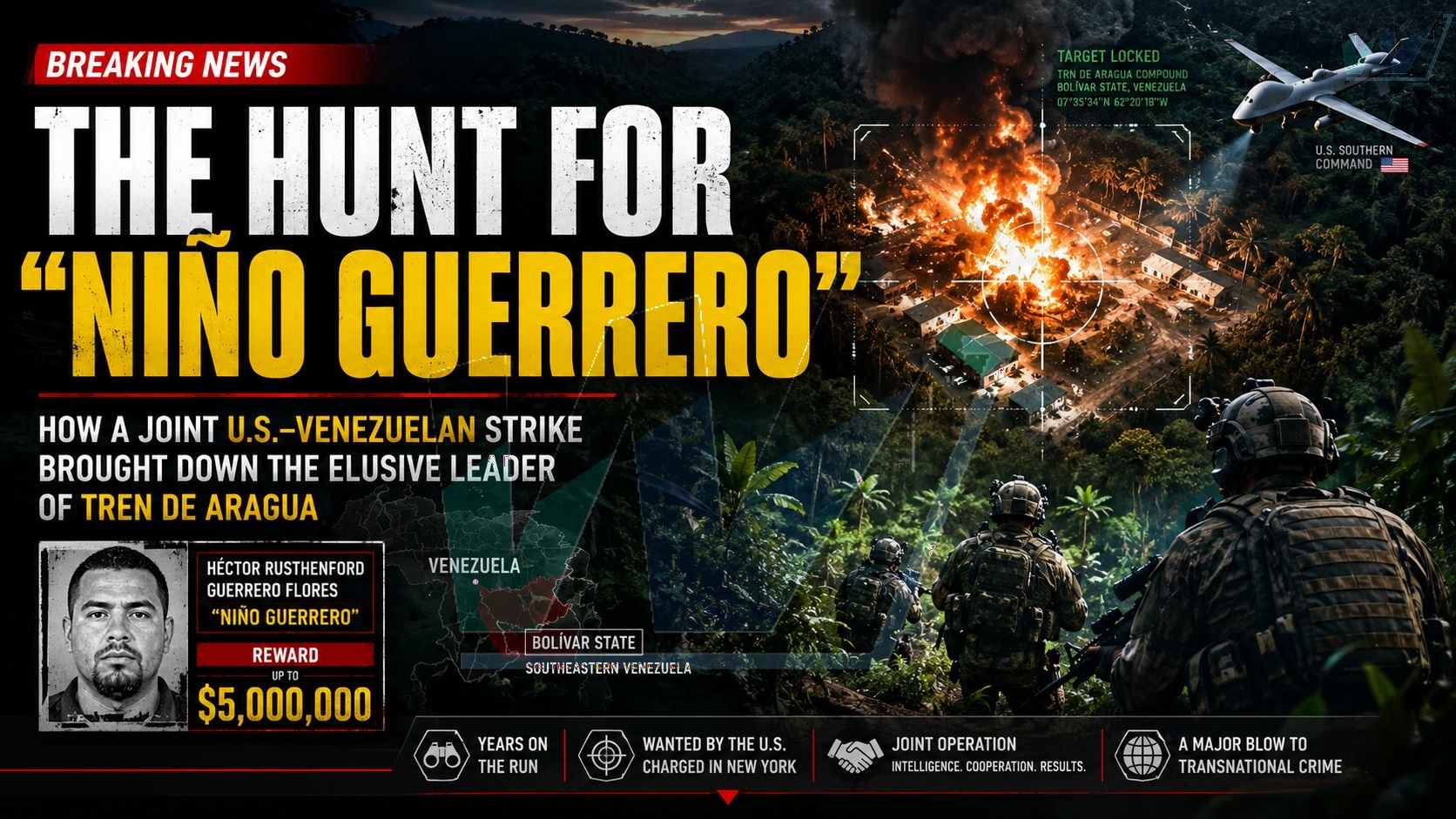
Héctor Rusthenford Guerrero Flores — better known as “Niño Guerrero,” the elusive leader of the notorious Tren de Aragua criminal organization — was dead.
For more than a decade, Guerrero had been one of the most feared and sought-after figures in Latin America. Governments hunted him. Intelligence agencies tracked him. Prosecutors built cases against him. The United States placed a reward of up to $5 million on his head.
Yet until this week, he had managed to remain beyond their reach.
Now, according to both U.S. and Venezuelan authorities, a joint operation in Venezuela’s remote Bolívar state has brought the reign of the man who transformed a prison gang into an international criminal empire to a violent end.
The Strike
President Donald Trump announced the operation Friday evening, describing it as a “swift and lethal kinetic strike” carried out by U.S. Southern Command in coordination with Venezuelan authorities. Defense Secretary Pete Hegseth later confirmed that the strike had occurred earlier in the week against a Tren de Aragua compound.
Trump released aerial footage appearing to show a precision strike obliterating a structure believed to be connected to the gang’s leadership network. Venezuelan officials subsequently confirmed Guerrero’s death, stating that armed clashes erupted during a combined security operation in the southeastern mining region of Bolívar.
Although Washington described the mission as a U.S. military strike coordinated with Venezuela, officials in Caracas emphasized intelligence-sharing and technological cooperation, insisting Venezuelan forces played the central operational role. Regardless of the differing narratives, both governments agree on the outcome: the continent’s most wanted gang leader is no longer alive.
The Rise of a Criminal Empire
To understand the significance of Guerrero’s death, one must return to the infamous Tocorón prison in Venezuela’s Aragua state.
Unlike a conventional prison, Tocorón evolved into something closer to a criminal kingdom.
Authorities and investigators have long described a surreal world inside its walls: restaurants, gambling halls, a zoo, a baseball field, and luxury accommodations reserved for gang leaders. At the center of that world stood Niño Guerrero. Rather than being confined by the prison system, he effectively controlled it.
As Venezuela’s economic crisis deepened during the 2010s, millions fled the country in search of opportunity abroad. Tren de Aragua expanded alongside that migration, building networks across South America and eventually reaching North America and Europe. Prosecutors and law-enforcement agencies linked the organization to extortion, human trafficking, kidnapping, money laundering, contract killings, illegal mining operations, and drug-related crimes.
From inside Tocorón, Guerrero allegedly directed a criminal enterprise that crossed borders and generated millions of dollars in illicit revenue.
By the time Venezuelan authorities moved to retake the prison in 2023, Guerrero had already vanished. For nearly three years, rumors swirled about his whereabouts. Intelligence agencies searched for remote mining regions, jungle corridors, and clandestine safe houses. None could locate him with certainty.
America’s Most Wanted Gang Boss
Washington’s pursuit intensified dramatically over the past year.
The U.S. government designated Tren de Aragua as a foreign terrorist organization and accused its leaders of overseeing criminal operations stretching across multiple continents. Federal prosecutors in New York charged Guerrero with racketeering conspiracy and related offenses, alleging involvement in violence, trafficking, and support for terrorist activities.
The State Department’s $5 million reward transformed him from a regional crime boss into one of the hemisphere’s highest-value fugitives. Intelligence agencies, military planners, and law-enforcement officials increasingly viewed him as more than a gang leader; he had become a symbol of transnational organized crime’s growing reach.
His death marks the culmination of a manhunt that spanned years and crossed multiple countries.
Why Bolívar Matters
The operation’s location was no coincidence.
Bolívar state is one of Venezuela’s most strategically important and least-governed regions. Rich in gold and other minerals, vast areas have long been dominated by criminal groups, illegal mining networks, and armed organizations operating beyond effective state control.
Security analysts have repeatedly identified the region as a refuge for criminal leaders seeking distance from major population centers and law-enforcement scrutiny.
If Guerrero believed the dense forests, sprawling mines, and isolated camps could shield him from capture, the strike suggests that assumption proved fatally wrong.
A Victory — Or the Beginning of a New Chapter?
Across Latin America, reactions were immediate.
Supporters of the operation hailed it as a decisive blow against one of the region’s most dangerous criminal organizations. Critics cautioned that history offers countless examples of cartels and gangs surviving the loss of top leaders by rapidly replacing them.
That uncertainty now hangs over the future of Tren de Aragua.
The organization’s structure extends far beyond a single individual. Its networks span multiple countries, and many of its senior operatives remain at large. Security experts warn that the death of a dominant leader can sometimes trigger violent succession battles, splinter factions, or the emergence of even more unpredictable commanders.
Still, there is no question that the death of Niño Guerrero represents one of the most significant blows ever delivered to the organization.
The End of the Fugitive
For years, Héctor “Niño Guerrero” Flores cultivated an image of untouchability.
He survived prison crackdowns. He evaded massive security operations. He escaped the collapse of his prison stronghold and vanished into Venezuela’s criminal underworld.
But every manhunt ends somewhere.
This one ended in a remote corner of southern Venezuela, with a flash of fire visible from the sky and a message broadcast across the hemisphere.
The kingpin who built a criminal empire from behind prison walls had finally run out of places to hide.